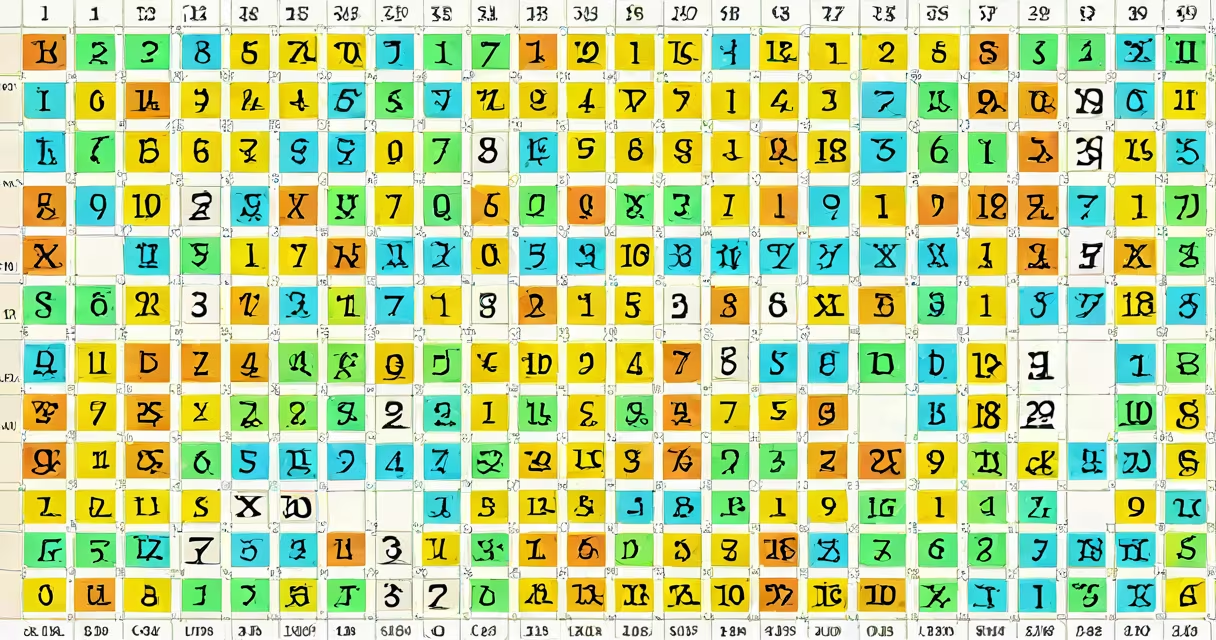
The 12x12 multiplication table is a structured grid listing all products from 1×1 through 12×12, serving as a foundational tool for arithmetic fluency. It contains 144 entries, each representing the result of multiplying two integers between 1 and 12. This table is widely used in elementary education to build automaticity in multiplication, a skill critical for success in algebra and higher mathematics.
Each row and column corresponds to a multiplier and multiplicand. For example, the intersection of row 7 and column 8 shows 56, the product of 7×8. The table is symmetric along the diagonal from top-left to bottom-right because multiplication is commutative-7×8 equals 8×7. This symmetry reduces the number of unique facts students need to memorize.
Teachers often introduce the 12x12 multiplication table in grades 3-5. By grade 4, students are expected to recall products instantly without counting or using fingers. Mastery of this table supports efficient computation in multi-digit multiplication, division, fractions, and problem-solving involving rates and proportions.
Each cell in the table represents the result of multiplying the row header by the column header. The top row displays multipliers from 1 to 12, and the leftmost column lists multiplicands from 1 to 12. The intersection gives the product. For instance, the cell at row 9, column 4 contains 36 because 9×4 = 36.
Patterns emerge within the table. Multiples of 10 end in zero. Multiples of 5 end in 0 or 5. Even numbers multiplied by any integer yield even results. These patterns help learners detect errors and verify answers quickly. For example, if a student calculates 7×6 as 43, they can recognize it's incorrect because 7×6 must be even.
Using the table repeatedly reinforces memory. A study by the National Council of Teachers of Mathematics (NCTM) found that students who practiced with multiplication tables daily improved their calculation speed by 40% over eight weeks compared to those who did not.
There are two common formats: printed charts and interactive digital versions. Printed tables appear in math workbooks, classroom posters, and flashcards. Digital versions are embedded in educational apps and websites, allowing users to hover over cells for instant feedback.
Use cases span from early learning to adult numeracy:
A key distinction often missed: the 12x12 table includes products up to 144, which is the largest square number below 150. This makes it useful for estimating square roots and understanding number density near perfect squares.
Many assume the 12x12 table is only for rote memorization. In reality, it's a scaffold for conceptual understanding. Research from the University of Chicago's Center for Education Policy shows that students who use the table to explore relationships-like how doubling one factor doubles the product-develop stronger number sense than those who memorize without context.
Another misconception is that the table stops at 10×10. While 10×10 is taught first due to its simplicity, extending to 12×12 prepares students for real-world calculations. For example, a 12-pack of drinks at $3.50 each totals $42.00, a calculation requiring 12×3.5-best done by breaking it into 12×3 + 12×0.5.
Some educators mistakenly treat the table as a final goal. It's not. The goal is fluent retrieval. Once students internalize the facts, the table becomes a reference, not a crutch. A 2021 study published in Journal of Educational Psychology found that students who moved beyond table reliance to mental strategies solved complex problems 27% faster.
Suppose you're buying 12 notebooks priced at $1.75 each. To find the total cost:
Total cost: $21.00. Without the table, this step takes longer. With it, the multiplication part is instantaneous.
Even adults use the table indirectly. When dividing 144 by 12, knowing that 12×12 = 144 allows immediate recognition of the quotient as 12. This mental shortcut saves time in budgeting, cooking, and shopping.
While the 12x12 table is standard, alternatives exist. The 10x10 table covers fewer facts but lacks coverage for common real-life scenarios like dozen-based pricing. The 20x20 table offers more depth but increases cognitive load without proportional benefit for most learners.
| Table Size | Number of Products | Best Use Case |
|---|---|---|
| 10x10 | 100 | Early learners, basic fact mastery |
| 12x12 | 144 | Standard curriculum, everyday math |
| 20x20 | 400 | Advanced students, math competitions |
For most students, the 12x12 table strikes the optimal balance between completeness and manageability. It includes all products needed for K-6 math standards and prepares learners for middle school algebra.
I once observed a 4th grader struggle with 9×7 until I pointed out the pattern: 9×6 = 54, so 9×7 = 54 + 9 = 63. She then recognized the rule: adding the multiplier to the previous product. That moment of insight-triggered by visualizing the table-was more valuable than memorizing the answer.
Understanding the 12x12 multiplication table is not about memorizing 144 facts. It's about recognizing structure, applying patterns, and building confidence in numerical reasoning. When students internalize this table, they gain a tool that supports lifelong mathematical thinking.