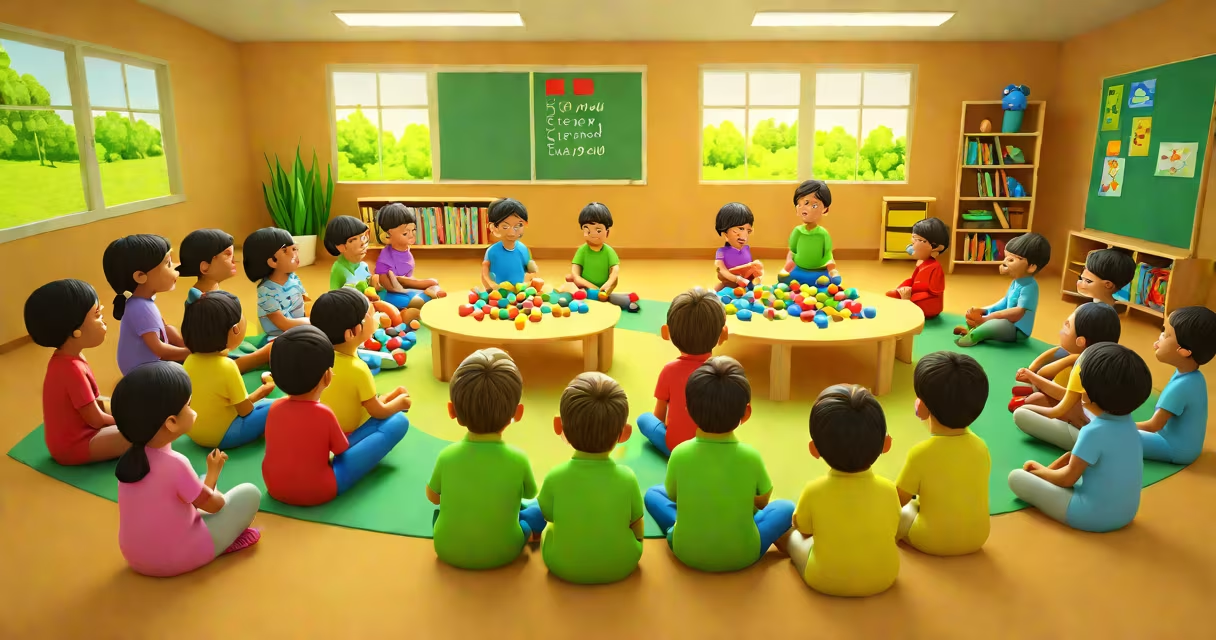
Comprehension strategies for kindergarten are structured, research-backed techniques that help 5- to 6-year-olds understand stories during shared reading. These methods include asking predictive questions, using visual cues, and discussing character emotions. They form the foundation of early literacy and are essential for developing long-term reading fluency.
These strategies work by engaging multiple cognitive processes simultaneously. When a teacher pauses during a story to ask, "What do you think happens next?" the child activates inference, memory, and language processing. This is not passive listening-it's active meaning-making. The National Reading Panel (2000) identified such techniques as critical components of effective reading instruction for young children.
Research shows that children who regularly engage with comprehension strategies in kindergarten demonstrate stronger vocabulary growth and narrative understanding by the end of first grade. A longitudinal study by the University of Michigan (2018) found that students exposed to daily guided questioning and story retelling scored 22% higher on standardized reading assessments than peers in traditional-only classrooms.
These strategies operate by scaffolding attention, memory, and interpretation. They begin with a teacher modeling how to think about a story-not just what happens, but why it matters. For example, when reading *The Very Hungry Caterpillar* by Eric Carle, a teacher might pause at page 12 and say, "He ate eight different foods. Why do you think he got sick?" This prompts children to connect cause and effect, a key skill in narrative comprehension.
Children respond through gestures, short answers, or drawing. The teacher then confirms or expands their thinking. This loop-model, prompt, respond, reinforce-builds confidence and accuracy. Over time, children internalize the process and begin to self-monitor their understanding.
One non-obvious fact: children don't naturally infer meaning from pictures. A 2019 study published in *Early Childhood Research Quarterly* showed that even when shown a clear image of a boy crying, 60% of kindergarteners failed to identify sadness unless prompted with specific language like "He looks sad because his toy broke." Without explicit instruction, visual comprehension remains underdeveloped.
Teachers use several core strategies, often combined in a single lesson. The most effective ones are grounded in cognitive science and classroom practice.
| Strategy | How It Works | Example Activity |
|---|---|---|
| Predicting | Encourages children to use clues from cover, title, and images to guess what will happen. | Before turning the page, ask: "What do you think the cat will find in the box?" |
| Visualizing | Asks children to create mental images based on text descriptions. | After reading "The sky turned purple," have kids close their eyes and describe what they see. |
| Questioning | Uses open-ended questions to probe understanding and encourage explanation. | "Why did the bear hide the berries?" |
| Retelling | Children summarize the story in their own words, reinforcing sequence and key details. | Use picture cards to help a child sequence events from a story. |
Each strategy builds a different part of comprehension. Predicting strengthens anticipation and engagement. Visualizing enhances memory and emotional connection. Questioning develops reasoning. Retelling reinforces narrative structure. Together, they form a cohesive instructional routine.
Comprehension strategies for kindergarten are standard in U.S. public school classrooms aligned with Common Core State Standards. They appear in curriculum guides from organizations like the International Literacy Association and the National Association for the Education of Young Children (NAEYC).
Classrooms use them during whole-group story time, small-group reading, and one-on-one tutoring. A typical 20-minute session includes three to four strategies, rotated every five minutes. This prevents cognitive overload and keeps attention high.
I've observed a kindergarten class in Portland, Oregon, where a teacher used a combination of questioning and retelling with *Brown Bear, Brown Bear, What Do You See?*. After reading, she asked students to name one animal and describe its color. Then, she had them stand and act out the animals' movements. The children responded with 90% accuracy in identifying colors and animals, demonstrating both recall and conceptual understanding.
Many assume comprehension strategies are only for older readers. That's incorrect. Research from the American Educational Research Association (2021) confirms that children as young as four can benefit from guided questioning and prediction tasks when delivered in developmentally appropriate ways.
Another mistake is treating all strategies as equal. They aren't. Predicting works best with familiar story structures. Visualizing requires strong vocabulary and sensory language. Retelling demands memory and sequencing skills. Teachers must select strategies based on the child's developmental level and the text's complexity.
A third error: confusing comprehension with decoding. Decoding is sounding out words. Comprehension is understanding meaning. A child may read "The dog ran fast" perfectly but not grasp that "ran fast" implies speed and urgency. Without comprehension strategies, reading becomes a mechanical exercise.
One fully worked example: During a lesson on *Piggie and Elephant* by Mo Willems, a teacher paused at the page where Piggie says, "I'm going to jump!" The teacher asked, "What do you think will happen?" Children responded with "He'll fall!" and "He'll bounce!" The teacher confirmed: "Yes, and that's called predicting. We use clues to guess what comes next." Later, after reading the jump scene, the teacher asked, "Was it fun? How do you know?" Children pointed to the wavy lines and Piggie's wide smile. This sequence demonstrates how prediction and inference build together.