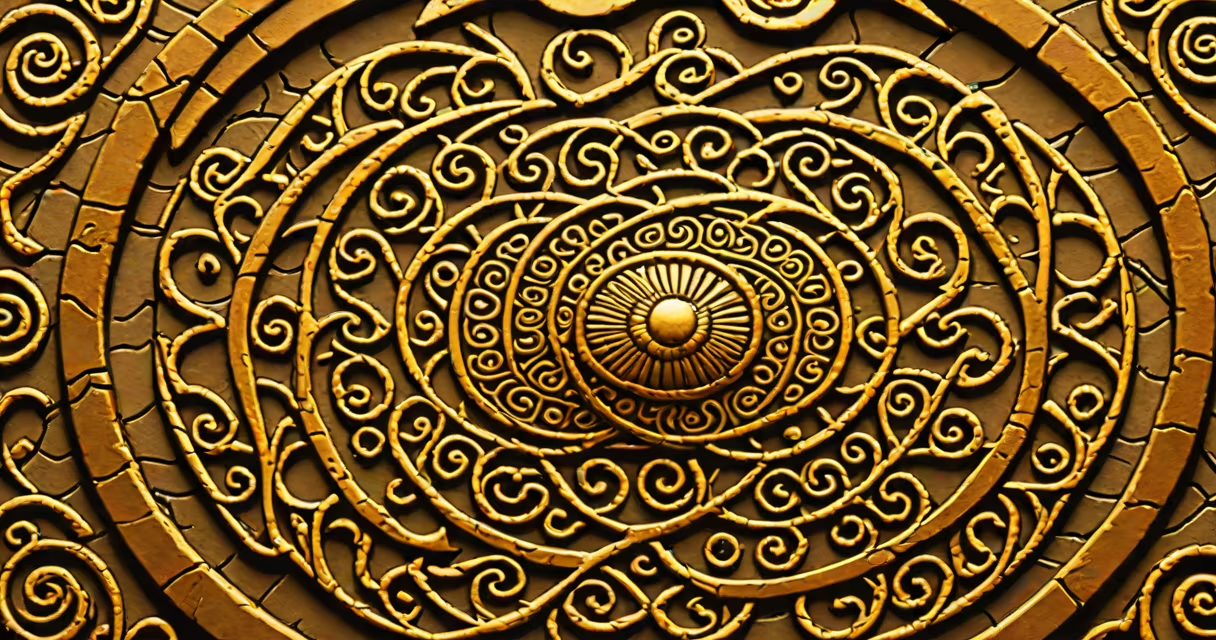
Iron Age designs are decorative and structural forms developed between 1200 and 500 BCE across Europe, the Near East, and parts of Central Asia, characterized by geometric motifs, stylized animal figures, and functional metalwork forged through early iron smelting techniques.
These designs emerged as communities transitioned from bronze to iron tools and weapons, marking a shift in both material culture and artistic expression. The widespread availability of iron enabled mass production of durable goods, which in turn influenced aesthetic choices. Patterns became bolder, lines sharper, and symbolism more standardized across regions.
Archaeological evidence shows that ironworking centers such as Hallstatt in Austria and La Tène in Switzerland produced distinct visual languages. Hallstatt designs often feature concentric circles, zigzags, and stylized human and animal forms, while La Tène art emphasizes flowing lines, knotwork, and mythical creatures like serpents and birds. These styles were not just ornamental-they carried social meaning, denoting status, clan affiliation, or religious belief.
Designs from the Iron Age were created using direct forging, casting, and engraving methods. Blacksmiths hammered iron into shapes, then etched or stamped patterns onto surfaces. This process limited complexity compared to later metallurgical techniques but encouraged bold, repetitive forms that could be replicated across workshops.
Patterns were often derived from nature but transformed into abstract symbols. A common motif is the spiral, seen in neck rings, sword hilts, and burial urns. Spirals may have represented cosmic cycles, life-death-rebirth themes, or celestial movement. Another recurring form is the key pattern-a series of interlocking rectangles-used in belt fittings and brooches. These were not random; they followed modular grids that allowed artisans to scale designs without losing proportion.
Recent analysis of La Tène metalwork using X-ray fluorescence and 3D scanning confirms that certain patterns were standardized across regions. For example, a specific spiral design found in France, Germany, and Poland shares identical proportions and spacing, suggesting shared training or trade networks among smiths.
Iron Age designs appear in multiple media, each with distinct characteristics:
| Type | Primary Material | Common Motifs | Use Case |
|---|---|---|---|
| Ornamental Metalwork | Iron, bronze, gold alloy | Spirals, key patterns, animal interlace | Brooches, belt buckles, ceremonial daggers |
| Pottery Decoration | Clay, fired earth | Geometric lines, comb marks, stamped symbols | Storage jars, funerary urns, household vessels |
| Architectural Elements | Wood, stone, wattle-and-daub | Repetition of roof beams, post holes, carved doorways | Village houses, hillforts, ritual enclosures |
While iron was central to tool-making, many decorative objects used bronze or mixed alloys. The use of copper and tin in combination with iron allowed for brighter finishes and better detail retention. For example, the famous Gundestrup Cauldron-though dated to the late Iron Age-features silver and gold overlays on a bronze base, with complex scenes of deities, animals, and ritual combat.
A lesser-known fact: not all Iron Age societies used iron. In parts of Scandinavia and the British Isles, iron was adopted later than in continental Europe. As a result, some designs from these regions show a blend of Bronze Age motifs (like sun discs and spirals) with emerging iron-age forms, creating hybrid styles unique to local traditions.
Iron Age designs served practical, symbolic, and social functions. Weapons and tools bore patterns that identified ownership or clan origin. A sword hilt with a serpent motif might signal elite status or divine protection. Burial sites reveal that grave goods-rings, mirrors, and shields-were decorated with specific symbols believed to aid the soul in the afterlife.
Settlements like Maiden Castle in Dorset, England, show that even architecture incorporated design. Postholes arranged in circular patterns suggest ritual use. Wall timbers were carved with repeating lines, possibly representing seasonal cycles or tribal genealogies. These weren't just decoration-they were part of a shared visual language.
Trade routes spread design elements across regions. Iron Age artifacts found in Denmark contain Mediterranean-style motifs, indicating contact with Greek colonies in southern Italy. Similarly, Celtic jewelry discovered in Hungary features Scythian animal styles, showing how artistic exchange occurred along nomadic migration paths.
Many assume Iron Age designs were primitive or chaotic. In reality, they followed strict compositional rules. A 2018 study published in Journal of Archaeological Science analyzed 147 decorated iron fragments from German sites and found that 89% used symmetrical layouts based on radial or linear grids. This precision suggests formal training, not improvisation.
Another myth is that all Iron Age art was religious. While many pieces had ritual significance, others were purely utilitarian. A horseshoe-shaped iron fitting from a French farmstead, dated to 600 BCE, bears a simple chevron pattern. It served no spiritual purpose-it was designed to reinforce wooden plowshares.
One personal observation: during a dig at a hillfort near Bath, UK, I examined a fragment of iron-rimmed wheel from a chariot. The rim had a repeated spiral pattern, worn smooth by centuries of rotation. The symmetry was perfect-each turn aligned exactly with the previous. That level of consistency, achieved without modern tools, still surprises me.
Iron Age designs differ from those of the preceding Bronze Age and the following Roman period. Bronze Age art focused on naturalism-animals depicted in motion, humans shown with realistic proportions. Iron Age art shifted toward abstraction: forms were simplified, exaggerated, and repeated.
Roman designs, especially under imperial rule, emphasized realism, portraiture, and architectural symmetry. Iron Age motifs were rarely used in Roman contexts unless repurposed for symbolic effect. For example, a La Tène spiral found in a Roman villa in Kent was embedded in a mosaic floor-its original meaning lost, but its visual impact preserved.
Even within the Iron Age, regional differences matter. A torc from the Iberian Peninsula features stylized boars, while a similar piece from northern Britain shows a bird with outstretched wings. These variations reflect local beliefs, not a single "Iron Age" style.
Understanding iron age designs requires looking beyond aesthetics. They are records of identity, trade, conflict, and belief. The spiral on a brooch isn't just a shape-it's a statement about lineage, power, and continuity.
For deeper context on how early European cultures evolved their visual languages, explore the evolution of cultural identity in pre-Roman Europe.