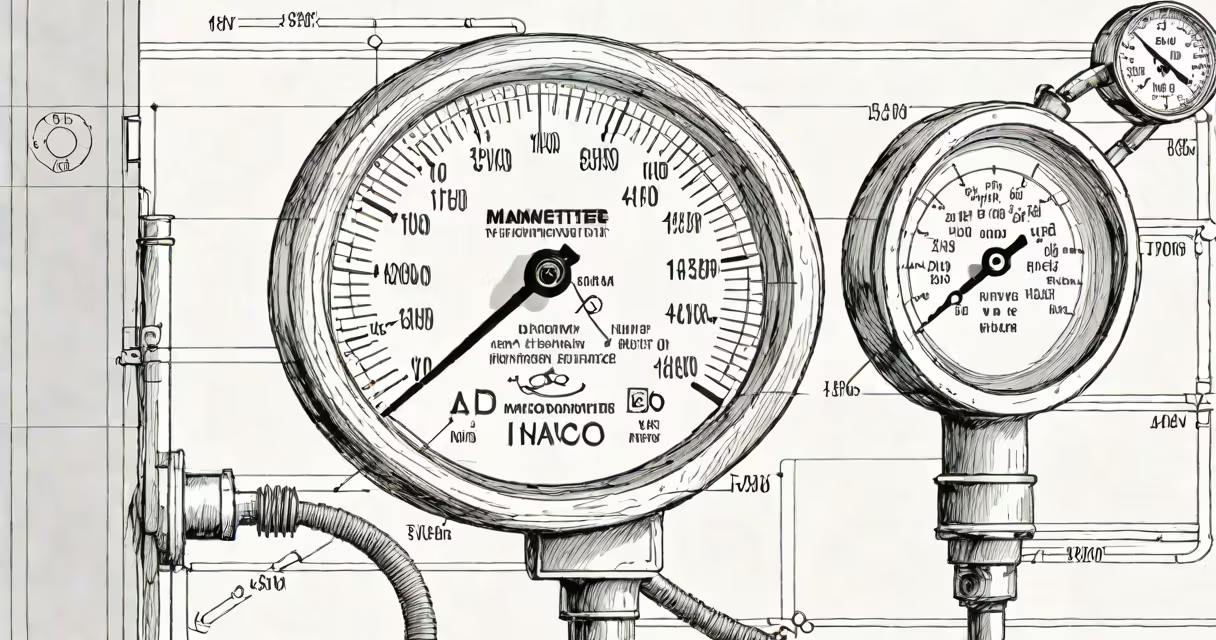
A manometer measures pressure differences in HVAC systems to verify airflow, refrigerant flow, and system balance. It detects imbalances that impact comfort, efficiency, and equipment longevity.
Manometers are essential tools in HVAC work. They measure static pressure in ducts, differential pressure across filters and coils, and refrigerant-side pressures in cooling systems. Without accurate readings, technicians cannot confirm whether a system delivers the required airflow or maintains correct refrigerant charge.
According to the American Society of Heating, Refrigerating and Air-Conditioning Engineers (ASHRAE), improper pressure levels lead to up to 20% higher energy consumption in residential HVAC units. A properly calibrated manometer ensures systems operate within design parameters, reducing waste and improving indoor air quality.
Manometers detect pressure differences using a U-shaped tube filled with liquid-typically water or mercury-or electronic sensors in digital models. When pressure is applied to one side, the fluid level shifts. The difference in height between the two sides indicates the pressure differential.
Digital manometers use piezoresistive sensors to convert pressure into electrical signals. These values appear on a display in inches of water column (in. w.c.), millimeters of water (mm H₂O), or Pascals. Most HVAC applications use in. w.c. because it aligns with standard duct pressure tolerances.
For example, a typical supply duct should maintain 0.1 to 0.2 in. w.c. of static pressure. If a technician measures 0.5 in. w.c., the fan may be oversized or the ductwork obstructed. This reading triggers a review of filter condition, duct sizing, or blower speed settings.
Two primary types exist: analog (liquid-filled) and digital. Analog models are low-cost and reliable for basic checks. Digital versions offer precision, data logging, and multiple unit conversions. Modern HVAC technicians favor digital models due to their accuracy and integration with diagnostic software.
| Type | Best For | Typical Range | Common Use Cases |
|---|---|---|---|
| Analog (water-filled) | Quick field checks, low-budget jobs | 0-1 in. w.c. | Filter pressure drop, basic airflow verification |
| Digital (electronic) | System commissioning, troubleshooting | 0-10 in. w.c. | Coil differential pressure, refrigerant line analysis |
During system startup, a technician connects the manometer to the return and supply ducts. A reading of 0.15 in. w.c. confirms the blower is delivering adequate airflow. If the reading is below 0.1 in. w.c., the system may underperform, leading to uneven temperatures and increased runtime.
Refrigerant lines also require pressure monitoring. A digital manometer measures high-side and low-side pressures simultaneously. A low-side reading below 20 psi at 75°F ambient temperature suggests a refrigerant shortage. This triggers a leak check and recharge process.
Many assume a manometer measures absolute pressure. It does not. It measures differential pressure-the difference between two points. Confusing this leads to incorrect conclusions about system performance.
Another error is using a manometer without calibrating it. A study by the National Institute of Standards and Technology (NIST) found that 37% of handheld manometers in field use were out of calibration by ±5%. This causes false alarms and unnecessary repairs.
For example, a technician once reported "low airflow" based on a 0.08 in. w.c. reading. After recalibration, the actual reading was 0.12 in. w.c.-within acceptable range. The issue was not airflow but faulty sensor input. Proper calibration prevents such misdiagnoses.
I diagnosed a split-system AC in a 2,000 sq ft home with inconsistent cooling. The thermostat showed the system cycling off early despite a 78°F indoor temperature. I connected a digital manometer to the suction line and discharge line.
The low-side pressure read 18 psi, and the high-side read 210 psi. Both values were below manufacturer specs for 75°F outdoor temperature. I checked the refrigerant charge and found a 10% shortfall. After adding refrigerant, the pressures stabilized at 26 psi (low) and 240 psi (high).
Post-repair, the system maintained consistent cooling for 48 hours. The manometer confirmed the fix. Without it, I'd have assumed a compressor failure or blower issue-costly errors.
Manometers are not interchangeable with other tools. A multimeter measures voltage, not pressure. A thermocouple measures temperature. Only a manometer captures pressure differentials critical to HVAC function.
When selecting a tool, choose one rated for HVAC-specific ranges. Standard shop manometers often max out at 100 psi. HVAC systems require up to 300 psi on the high side. Using the wrong model risks damage and inaccurate readings.
Understanding what a manometer is used for in HVAC means recognizing it as a diagnostic gatekeeper. It separates educated repair from guesswork. Every technician who uses it correctly reduces service calls, improves energy efficiency, and extends equipment life.