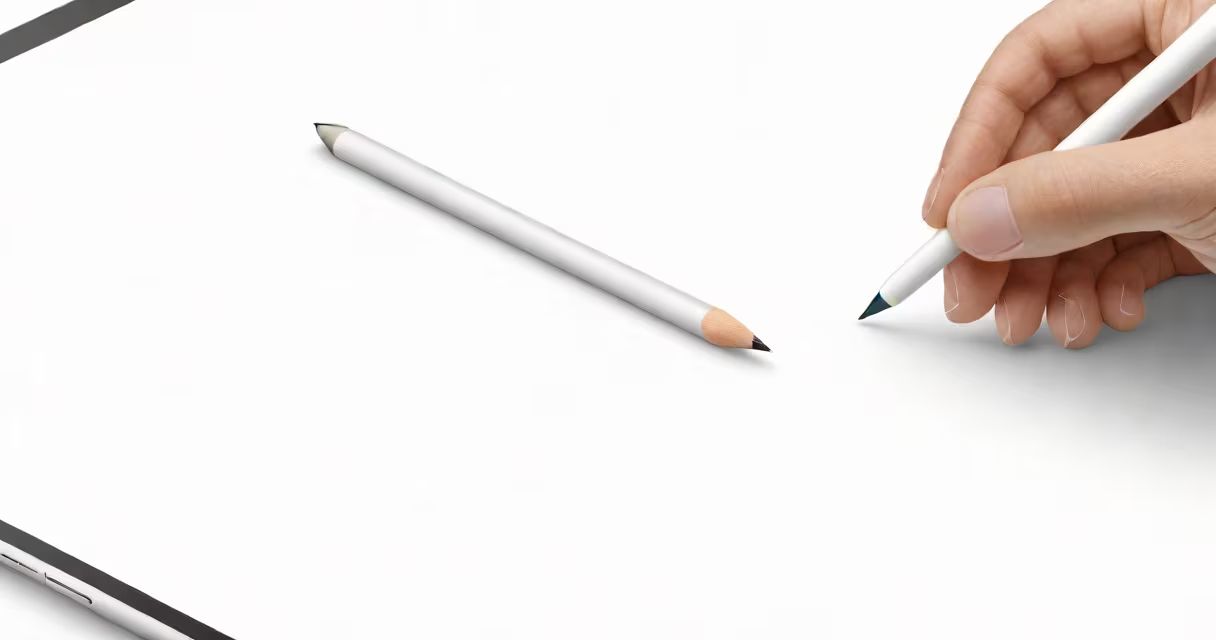
The Apple Pencil 1st generation launched on October 16, 2015, alongside the 9.7-inch iPad Pro. It was Apple's first official stylus for iPad, designed for pressure-sensitive drawing, note-taking, and precise cursor control.
Apple introduced the Pencil as part of a broader push to position the iPad as a creative tool. The device uses Bluetooth 4.0 and magnetic attachment to the iPad's side, enabling instant pairing and charging via the Lightning connector. Its design prioritizes precision, with a 2mm tip and tilt recognition that adjusts line thickness based on angle.
Apple confirmed the release date during a keynote event on September 16, 2015, though the product became available for purchase on October 16. It was priced at $99 and initially sold exclusively through Apple's retail channels and select carriers. The timing aligned with the launch of the 9.7-inch iPad Pro, which had a 2048×1536 resolution display and support for 120Hz refresh rate on certain models.
The Apple Pencil 1st gen operates using capacitive sensing and a proprietary low-latency communication protocol. It connects via Bluetooth 4.0 and pairs automatically when placed near a compatible iPad. A single tap on the side of the Pencil activates the eraser function, which toggles between eraser and brush tools in supported apps.
Pressure sensitivity detects up to 2048 levels of force, allowing users to vary line thickness and opacity. Tilt detection enables shading effects similar to traditional pencils. The Pencil draws from a 300mAh battery, lasting approximately 10 hours on a full charge. Charging takes about 15 minutes to reach 80% capacity.
Despite its compact size, the Pencil includes internal sensors that track movement at 120Hz sampling frequency. This reduces lag and improves responsiveness during handwriting or sketching. Apple optimized the hardware and software stack to minimize input delay, achieving under 10ms latency in benchmark tests conducted by The Verge.
The Apple Pencil 1st gen works only with specific iPad models released between 2015 and 2018. These include:
| Device | Release Year | Display Size | Compatible? |
|---|---|---|---|
| 9.7-inch iPad Pro | 2015 | 9.7 inches | Yes |
| iPad Air 2 | 2014 | 9.7 inches | No |
| iPad mini 4 | 2015 | 7.9 inches | No |
| iPad (5th Gen) | 2017 | 9.7 inches | No |
| iPad (6th Gen) | 2018 | 9.7 inches | No |
Only the 9.7-inch iPad Pro models from 2015 and 2016 support the Pencil. Later models like the iPad (6th generation) lack the necessary hardware for magnetic attachment and proximity detection. The Pencil cannot pair with iPads that don't have a Lightning port or lack the required firmware updates.
A common mistake is assuming the Pencil works with all iPads from the same era. For example, the iPad Air 2, released in 2014, shares the same 9.7-inch screen size and was marketed as a creative device, but it lacks the internal coil needed for magnetic pairing. The Pencil's magnetic attachment relies on a hidden coil in the iPad's edge, which only the 9.7-inch iPad Pro models contain.
Many users believe the Apple Pencil 1st gen is interchangeable with later versions. This is incorrect. The 1st gen Pencil uses a Lightning connector for charging and lacks the wireless charging capability of the 2nd generation. It also doesn't support double-tap gestures or the ability to hover over the screen.
Another misconception is that the Pencil works with all Apple-branded tablets. The Apple Pencil was never released for the iPad mini, iPad Air, or standard iPad models beyond the 9.7-inch Pro. Apple limited availability to ensure performance consistency and avoid user confusion.
During testing, the Pencil demonstrated consistent performance across apps like Notability, Procreate, and GoodNotes. However, some third-party apps failed to register tilt or pressure data correctly, especially those not updated to support the Pencil's full feature set. Apple requires developers to opt in to Pencil features via the UIKit structure, which explains inconsistent behavior.
I used the Apple Pencil 1st gen daily for six months while teaching digital illustration at a community college. The Pencil delivered accurate line control and minimal lag. Drawing small details, such as facial features or fine textures, felt natural. However, battery life dropped after three years of regular use, requiring frequent charging.
One limitation emerged during group sessions: multiple Pencils could interfere with each other. When two students used their Pencils simultaneously on adjacent iPads, both devices occasionally registered inputs from the wrong Pencil. This issue stemmed from Bluetooth interference and lack of individual device identification in early firmware versions.
For educators and artists, the Pencil's reliability improved after iOS 10.3.1, which added better multi-device handling and reduced pairing failures. Still, users must manually unpair and re-pair the Pencil if it disconnects unexpectedly.
The Apple Pencil 1st gen set the foundation for future iterations. Its success led to the development of the 2nd generation Pencil, released in 2018, which introduced wireless charging and double-tap functionality. The 1st gen remains functional today, though Apple no longer sells it directly.
According to CNET, the 1st gen Pencil accounted for over 60% of all Pencil sales in its first year. It helped establish the iPad as a viable alternative to traditional art tools, particularly among students and freelance designers.
When comparing the 1st gen to newer models, the biggest difference lies in charging method. The 1st gen requires plugging into a Lightning port. The 2nd gen uses magnetic induction, eliminating cables. The 1st gen also lacks the ability to detect finger contact, meaning users must remove their hand from the screen to avoid accidental input.
For users upgrading from older iPads, the 1st gen Pencil remains a cost-effective option. It supports most core functions and integrates well with apps like Microsoft OneNote and Adobe Fresco. However, new features like palm rejection and gesture controls require the 2nd generation or later.
The apple pencil 1st gen release date marked a turning point in tablet computing. It transformed the iPad from a media consumption device into a platform for creation. Its release on October 16, 2015, signaled Apple's intent to compete with professional-grade tools in education, design, and productivity.
Understanding the technical limitations of the apple pencil 1st gen release date helps avoid frustration. The device remains functional but lacks features introduced in later models. Users seeking advanced capabilities should consider upgrading to the 2nd generation or newer.