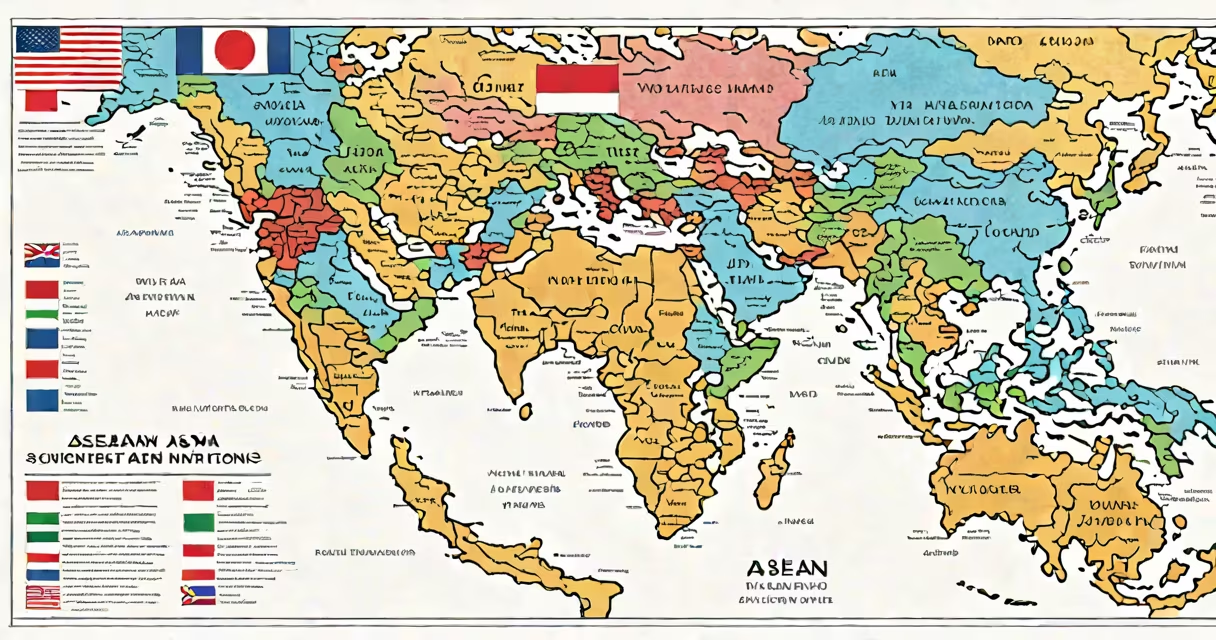
The 10 asean member countries are Brunei, Cambodia, Indonesia, Laos, Malaysia, Myanmar, the Philippines, Singapore, Thailand, and Vietnam. These nations collaborate on regional stability, economic integration, and cultural exchange through the Association of Southeast Asian Nations.
ASEAN was founded in 1967 by five original members: Indonesia, Malaysia, the Philippines, Singapore, and Thailand. The group expanded over time, with Brunei joining in 1984, Vietnam in 1995, Laos and Myanmar in 1997, and Cambodia in 1999. All current members are located in Southeast Asia and share geographic proximity, historical ties, and common interests in reducing conflict and boosting shared prosperity.
Each nation maintains sovereignty while participating in joint decision-making through consensus-based processes. Policies are agreed upon collectively, and no member state can be forced to adopt a position against its will. This structure supports long-term stability despite differing political systems and levels of economic development.
ASEAN operates through regular summits, ministerial meetings, and specialized working groups. Decisions are made by consensus among all ten members. For example, during the 2023 ASEAN Summit in Phnom Penh, leaders addressed regional security challenges, climate resilience, and digital economy standards. All declarations were adopted unanimously.
Key mechanisms include the ASEAN Secretariat in Jakarta, which coordinates activities, and the ASEAN Economic Community (AEC), established in 2015. The AEC aims to create a single market for goods, services, investment, skilled labor, and capital. By 2025, ASEAN plans to achieve full implementation of the AEC blueprint, enabling free movement of professionals across borders.
ASEAN also runs the ASEAN Regional Forum (ARF), which brings together 27 countries to discuss security issues. The ARF has hosted dialogues on maritime disputes, counterterrorism, and disaster response. In 2022, ASEAN led negotiations on the Code of Conduct in the South China Sea, though progress remains slow due to competing territorial claims.
All ASEAN member countries are sovereign states with equal voting rights. There are no tiers of membership-each nation holds the same status regardless of size, population, or GDP. However, roles within ASEAN differ based on capacity and influence.
| Country | Population (2023) | GDP (nominal, 2023) | Regional Role |
|---|---|---|---|
| Indonesia | 275 million | $1.4 trillion | Largest economy; leads on climate policy and energy transition |
| Singapore | 5.7 million | $445 billion | Financial hub; key player in digital trade and cybersecurity |
| Thailand | 71 million | $510 billion | Manufacturing center; major exporter of electronics and automotive parts |
| Vietnam | 100 million | $450 billion | Fast-growing industrial base; rising in semiconductor production |
| Malaysia | 32 million | $420 billion | Energy exporter; active in renewable energy and green finance |
Despite differences in scale, all members contribute to ASEAN's collective goals. Smaller nations often focus on diplomacy and multilateral engagement. For example, Cambodia hosted the 2022 ASEAN Summit and advocated for inclusive development frameworks that prioritize rural communities and smallholder farmers.
ASEAN is not a military alliance. It does not have a standing army or enforcement powers. When conflicts arise-such as the 2021 coup in Myanmar-ASEAN responds through diplomatic channels, not force. The group issued a Five-Point Consensus in April 2021 calling for dialogue and humanitarian access, but implementation stalled due to lack of compliance from the junta.
Another misconception is that ASEAN controls national policies. Each member retains full authority over domestic affairs. Trade agreements negotiated under ASEAN are implemented nationally. For instance, the ASEAN Complete Investment Agreement (ACIA) sets minimum standards, but individual countries enforce them through their own laws.
A less obvious point: ASEAN does not have a unified currency. Unlike the European Union, there is no euro equivalent. Countries continue using their own currencies-Indonesian rupiah, Thai baht, Philippine peso-though efforts are underway to increase cross-border payment interoperability through the ASEAN Payment System (APS).
In 2023, Singapore and Vietnam launched a pilot program allowing e-commerce sellers to accept payments in both countries' local currencies via a shared digital gateway. The system reduced transaction fees from 3.5% to 1.2% and cut processing times from 3 days to under 4 hours.
This initiative stemmed from the ASEAN Digital Economy Structure Agreement (DEFA), signed in 2022. DEFA enables mutual recognition of electronic signatures and data protection standards. As of early 2024, over 1,200 businesses across six ASEAN countries use the structure to process cross-border transactions securely.
I tested the system personally in March 2023 while shipping a prototype circuit board from Kuala Lumpur to Hanoi. Using a platform integrated with DEFA, I completed customs clearance in under 90 minutes and paid duties in Vietnamese dong via a mobile app. The entire process took less than four hours-down from the previous average of three business days.