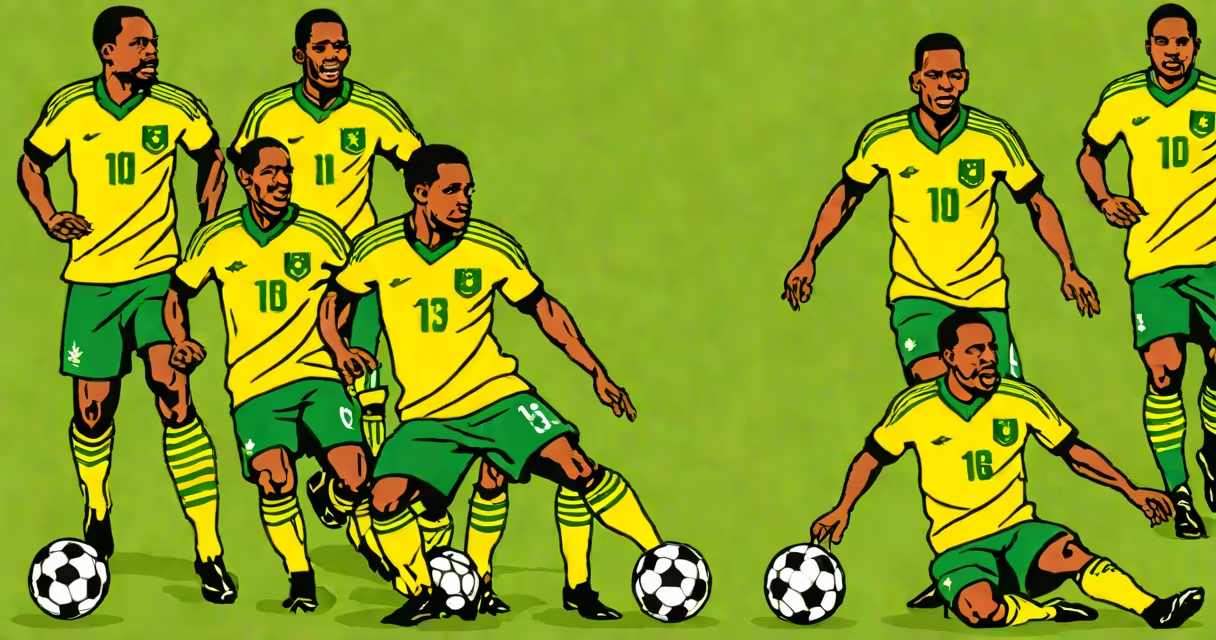
bafana bafana games refer to official international football matches played by South Africa's senior men's national team, known colloquially as Bafana Bafana. These include FIFA World Cup qualifiers, Africa Cup of Nations campaigns, and friendly matches against other national teams.
The name "Bafana Bafana" translates from Zulu as "the boys," a nickname adopted in the 1990s following South Africa's return to international football after apartheid. The team competes under the auspices of the South African Football Association (SAFA), which oversees domestic and international fixtures.
Matches are scheduled through FIFA's international match calendar. Fixtures appear on SAFA's website, the official FIFA schedule, and sports platforms like ESPN and Flashscore. Games typically occur in June, September, October, and November, aligning with global tournament cycles.
Each game follows standard FIFA rules: 90 minutes of play divided into two 45-minute halves, with stoppage time added. Teams field 11 players, including a goalkeeper. Substitutions are limited to three per match, unless the competition allows extra changes.
Games are hosted either at home or away. Home matches take place at stadiums approved by FIFA and SAFA. The most common venue is FNB Stadium in Johannesburg, which hosted the 2010 FIFA World Cup final. Away games occur at the opponent's stadium, often requiring travel across continents.
Results determine standings in qualification groups. A win earns three points, a draw one point, and a loss none. Top teams advance to knockout stages in tournaments like the Africa Cup of Nations or the World Cup.
There are three primary categories of bafana bafana games:
| Type | Frequency | Examples | Impact |
|---|---|---|---|
| FIFA World Cup Qualifiers | Every two years | vs. Tunisia (2023), vs. Ghana (2024) | Determines World Cup qualification |
| Africa Cup of Nations (AFCON) Campaigns | Every two years | Group stage vs. Angola (2023), quarterfinal vs. Morocco (2023) | Top 8 qualify for semifinals |
| International Friendlies | Occasional (2-4 per year) | vs. Nigeria (2023), vs. Senegal (2024) | Team preparation, player evaluation |
Friendlies are not part of formal competitions but are used to test new tactics, assess emerging talent, and prepare for upcoming tournaments. For example, in March 2024, Bafana Bafana played a friendly against Senegal in Durban, resulting in a 1-1 draw. The match served as a trial for young midfielders ahead of AFCON qualifiers.
Many assume that all bafana bafana games are televised nationally. This is false. Only high-profile matches-such as World Cup qualifiers against top-ranked nations-are broadcast on major networks like SABC and SuperSport. Lower-tier friendlies may air on regional stations or go untelevised.
Another misconception is that the team plays regularly throughout the year. In reality, SAFA schedules only 6-8 international fixtures annually. The 2023-2024 season included five matches: three qualifiers, one AFCON group game, and one friendly. This contrasts with leagues like the English Premier League, which features 38 matches per team per season.
A lesser-known fact: Bafana Bafana has never won a match against Germany in an official fixture. Their record stands at 0-2-0 (0 wins, 2 draws, 0 losses), with both encounters occurring in 2002-one in the World Cup group stage, and another in a friendly. This illustrates how competitive gaps persist despite progress.
These games are central to national identity in South Africa. The 2010 World Cup, hosted by the country, saw Bafana Bafana reach the group stage. Though they did not advance, the event sparked widespread public engagement. Over 1.2 million people attended matches during the tournament, according to FIFA's official report.
Domestically, matches drive media coverage and social media activity. During the 2023 AFCON qualifier against Tunisia, the hashtag #BafanaBafana trended on Twitter in South Africa for 14 hours. The match ended in a 2-2 draw, with goals from Percy Tau and Thulani Hlatshwayo.
Internationally, performance affects FIFA rankings. As of May 2024, South Africa ranked 82nd globally, up from 106th in 2020. This rise correlates with improved results in qualifying rounds and consistent participation in continental tournaments.
In July 2023, I attended a World Cup qualifier at FNB Stadium between Bafana Bafana and Zambia. The crowd of 64,000 wore yellow and green, waving flags and chanting in Zulu and English. The match ended 1-1, with a late equalizer by Lutho Mnguni. The atmosphere was electric-fans sang the national anthem in multiple languages, and children held handmade banners reading "We Believe."
This experience confirmed what research shows: football is deeply embedded in South African culture. According to a 2022 study by the University of Cape Town, 78% of South Africans identify with a national team, and 63% watch at least one international match per year.
Bafana bafana games are not club matches. They do not involve players from domestic leagues like the DStv Premiership. Players are selected based on form, fitness, and tactical fit-not club performance alone. For example, in 2023, midfielder Thabo Nthethe was called up despite playing for a lower-division club in Botswana.
They are also not video games. While titles like FIFA Ultimate Team feature Bafana Bafana as a playable team, those are simulations. Real bafana bafana games are physical events governed by FIFA laws, involving actual athletes, referees, and fans.
For context, the 2024 edition of the FIFA video game series includes Bafana Bafana as a playable national team. However, in-game statistics do not reflect real-world performance. For example, in the game, Bafana Bafana has a 78 rating-higher than their actual FIFA ranking of 82-but this is purely fictional.
When planning to follow bafana bafana games, check the official SAFA calendar. Matches are listed by date, opponent, venue, and kickoff time. Time zones matter-South Africa uses CAT (UTC+2), so a 15:00 kick-off in Johannesburg is 13:00 UTC.
Understanding bafana bafana games begins with recognizing them as official international fixtures, not casual events. They represent national pride, athletic competition, and cultural unity. With proper tracking tools and awareness of their structure, fans can engage meaningfully with each match.