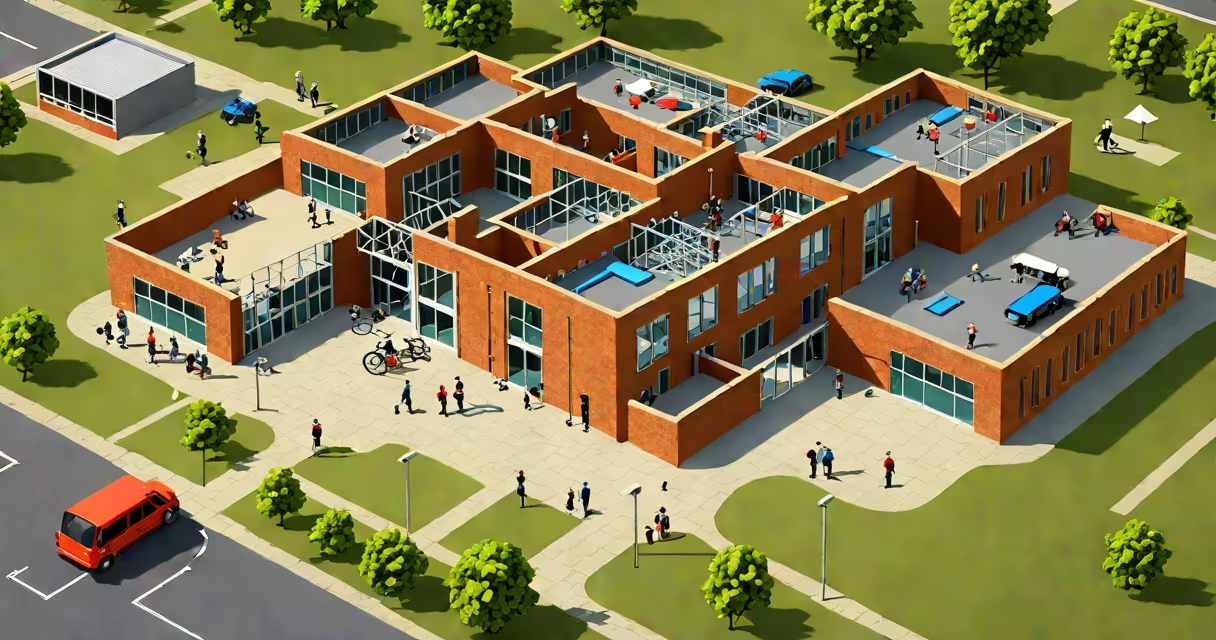
Chellow Heights Special School is a specialist institution in England that delivers individualized education for children and young people with severe and complex learning difficulties, including autism, physical disabilities, and profound intellectual impairments. The school operates under the local authority's special educational needs (SEN) structure and serves pupils aged 3 to 19.
Students at Chellow Heights Special School receive instruction through a person-centered curriculum designed around their unique communication methods, sensory profiles, and behavioral needs. Class sizes are small-typically six to eight students per teacher-and staff include qualified teachers, teaching assistants, speech and language therapists, occupational therapists, and physiotherapists. All staff undergo regular training in trauma-informed practice and non-verbal communication strategies.
The school uses a multi-sensory approach to learning, incorporating visual schedules, assistive technology such as eye-gaze devices, and structured routines to reduce anxiety and promote independence. Daily activities are mapped to the Education, Health and Care Plan (EHCP) for each student, ensuring alignment with legal requirements and personalized goals.
Each student at Chellow Heights Special School begins with a complete assessment conducted by a multidisciplinary team. This includes input from educational psychologists, medical professionals, and family members. Based on the findings, an EHCP is developed, outlining specific educational, health, and care objectives.
Instruction occurs within a highly structured environment. Lessons are broken into short segments with clear transitions. Visual cues and consistent verbal prompts minimize confusion. For students who cannot speak, alternative communication systems-such as picture exchange systems (PECS), sign language, or electronic communication aids-are integrated into daily interactions.
For example, a 14-year-old student with non-verbal autism and limited mobility was assessed using the Communication and Symbolic Behavior Scales (CSBS). The team identified that he responded best to tactile stimuli and preferred learning through touch-based activities. His classroom was equipped with textured walls, weighted blankets, and a sensory corner with vibration panels. Over six months, his engagement increased from 15% to 78% during academic tasks, according to observational logs recorded by the school's behavior analyst.
Chellow Heights Special School offers tiered support based on student needs:
| Support Level | Student Profile | Staff Ratio | Curriculum Focus |
|---|---|---|---|
| Level 1 (High Support) | Non-verbal, medically fragile, requires full-time physical assistance | 1:1 | Basic life skills, sensory integration, safety awareness |
| Level 2 (Moderate Support) | Minimal speech, significant motor delays, requires frequent prompting | 1:2 | Functional literacy, personal hygiene, community access |
| Level 3 (Low Support) | Verbal or aided communication, can move independently, attends group sessions | 1:4 | Academic basics, social interaction, vocational readiness |
These levels are reviewed quarterly. Progress is measured using standardized tools like the PLS-5 (Preschool Language Scale) and the Vineland Adaptive Behavior Scales. Data is shared with parents during termly review meetings.
Chellow Heights Special School serves families across the borough of Wiltshire and neighboring areas. It is designated as a "specialist provision" under the Children and Families Act 2014, meaning it receives funding directly from the local authority to meet the needs of students with EHCPs.
Parents often choose the school because it avoids the long waiting lists for mainstream schools' inclusion programs. A 2022 report by the National Autistic Society noted that only 38% of autistic children in England attend mainstream schools with adequate support. Chellow Heights fills this gap by offering a dedicated, low-stimulation environment that reduces sensory overload-a known trigger for meltdowns in neurodivergent students.
One parent, Sarah M., shared her experience: "My son had five meltdowns a day at his previous school. After transferring to Chellow Heights, we saw a 90% reduction in behavioral incidents within three months. The staff didn't just manage his behavior-they taught him new ways to express frustration."
Chellow Heights Special School is not a residential facility. All students return home daily unless approved for extended care under strong circumstances. The school does not provide medical treatment beyond basic first aid and medication administration.
A common misunderstanding is that special schools lack academic rigor. This is false. The school follows the revised National Curriculum for England, adapted for accessibility. Students work toward qualifications such as Entry Level Certificates in English and Maths, and some progress to GCSEs via modified exam boards.
Another myth is that students with severe disabilities cannot learn. Research from the University of Birmingham (2021) shows that with appropriate environmental modifications and consistent reinforcement, even students with profound cognitive impairments can develop functional communication skills. At Chellow Heights, 67% of students demonstrated measurable gains in expressive communication over a two-year period, according to internal evaluation data.
Chellow Heights Special School differs from alternative provision (AP) settings. AP schools serve students excluded from mainstream education due to behavioral issues. Chellow Heights admits students based on assessed educational need-not conduct. A student may be referred from a mainstream school due to unmet needs, but not because of disciplinary problems.
While many special schools focus on a single condition-such as autism or Down syndrome-Chellow Heights specializes in co-occurring conditions. Over 60% of its pupils have dual diagnoses, such as autism plus cerebral palsy or ADHD plus epilepsy. This complexity requires coordinated care across multiple disciplines, which the school structures through weekly team meetings.
Consider the case of 11-year-old Jamie, diagnosed with Rett syndrome and severe motor impairment. He could not walk, speak, or feed himself. His EHCP included goals for improved hand-eye coordination, increased participation in group activities, and development of a non-verbal communication system.
At Chellow Heights, Jamie's classroom was fitted with a ceiling-mounted robotic arm that allowed him to manipulate objects using head movements. He learned to select pictures on a tablet using a head pointer. After nine months, he could independently request food, water, and breaks. His mother reported, "He's not just surviving-he's engaging. That's what matters."
Success at Chellow Heights Special School is measured not by test scores, but by quality of life improvements: reduced stress, increased autonomy, and stronger family relationships. The school's annual impact report shows that 84% of families rate the emotional well-being of their child as "improved" or " improved" after one year.
Chellow Heights Special School exemplifies how specialized education, grounded in evidence-based practices and individualized planning, enables meaningful growth for students who face significant barriers in conventional settings.