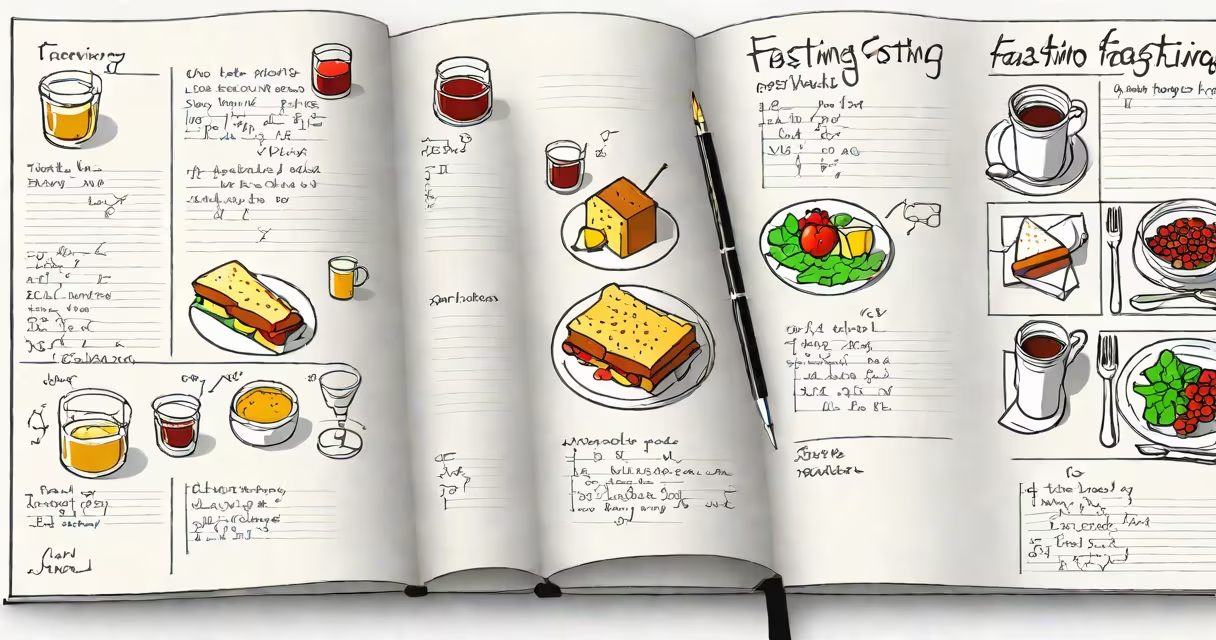
An intermittent fasting journal is a personal record of your fasting periods, food intake, energy levels, hydration, mood, and physical symptoms. It documents daily patterns to help you adjust your routine for better results and long-term consistency.
Unlike automated apps, a journal gives you space to reflect on subjective experiences-like mental clarity or hunger cues-that algorithms may miss. It turns raw data into insight through deliberate writing, making it especially useful for identifying triggers behind skipped fasts or energy crashes.
Research shows that self-monitoring improves adherence to health behaviors. A 2021 study in Frontiers in Psychology found that individuals who tracked their habits were 3.6 times more likely to maintain changes over six months compared to those who didn't. The journal becomes a tool for behavior change, not just data collection.
You record key details each day during your fasting window and after breaking your fast. Entries typically include start and end times of your fast, what you ate, how you felt physically and mentally, and any disruptions like fatigue or cravings.
For example, if you follow a 16:8 schedule (16 hours fasting, 8 hours eating), you'd note when you began your fast at 7 PM and ended it at 11 AM the next day. You'd then log your breakfast-say, scrambled eggs with spinach-and rate your energy level on a scale of 1 to 10. Over time, this builds a timeline of how your body responds to different routines.
Some people include notes on sleep quality, stress, or exercise. These factors influence fasting tolerance. One user reported that skipping fasts on days with poor sleep led to increased cravings-information that prompted them to prioritize rest before fasting.
There's no single correct format. The best journal aligns with your lifestyle and goals. Common approaches include:
| Type | Best For | Example Format |
|---|---|---|
| Plain notebook | Minimalists, reflection-focused users | Simple lines for date, fast duration, meal log, mood rating |
| Printed planner | Structured routines, habit tracking | Pre-designed grids with columns for hydration, energy, notes |
| Digital app with journal feature | Users who want reminders and analytics | Apps like Zero or Fastify with built-in journal fields |
| Hybrid (paper + digital) | Those who want flexibility and backup | Handwrite entries daily, upload photos to cloud storage |
Many find that combining a printed template with handwritten notes increases engagement. A 2020 study in Applied Cognitive Psychology showed that handwriting improves memory retention by 40% compared to typing. This makes paper journals effective for reinforcing habits.
People use an intermittent fasting journal to identify patterns that affect their success. Without tracking, you might assume you're "not cut out" for fasting because of low energy-but the journal reveals whether poor sleep, dehydration, or inconsistent timing is the real cause.
For example, one user noticed consistent fatigue between 10 AM and 12 PM during their fast. After reviewing logs, they discovered they weren't drinking enough water in the morning. Increasing intake by 500 mL reduced fatigue within three days. That insight came only through daily documentation.
Another benefit is accountability. Writing down your choices creates psychological ownership. A 2019 review in Journal of Behavioral Medicine confirmed that written goal setting increases adherence by 28% in weight management programs. The journal acts as a daily checkpoint against impulsive eating.
Many think a journal must be detailed or perfect. But perfectionism kills consistency. A single sentence like "Fasted 16 hours. Felt fine. Ate eggs and toast." is valid. The goal isn't to write a novel-it's to build awareness.
Another error is waiting until the end of the week to fill in entries. Delayed logging leads to inaccuracies. Research from Health Psychology Review shows that retrospective reporting underestimates actual behavior by up to 35%. Entries should be made within 30 minutes of finishing your fast.
Some confuse the journal with a food diary. While both track intake, a fasting journal emphasizes timing, duration, and subjective experience. A food diary focuses on calories and macros. Mixing them can dilute focus. Keep separate records if needed.
Consider Maya, a 32-year-old teacher using a 14:10 schedule. She started her journal with a blank notebook. Her first week included:
After five days, she noticed a pattern: high-fat meals (avocado, salmon) improved her mental clarity. Low-fiber meals (oatmeal) caused sluggishness. She adjusted her meals accordingly and saw sustained energy throughout the day.
This adjustment wasn't based on guesswork-it came from consistent, daily observation. Her journal became a feedback loop for refinement.
I kept a handwritten intermittent fasting journal for 42 days while transitioning from 12:12 to 16:8. On Day 17, I missed my fast due to a late meeting. I wrote: "Felt guilty. Craved sweets. Didn't drink water." The entry helped me recognize emotional triggers. I started scheduling fasts around meetings and added a 500 mL water bottle to my desk. By Day 30, I was consistently hitting 16 hours.
The journal didn't just track progress-it revealed gaps in planning. That insight changed how I approached fasting long-term.
Begin with a simple notebook or printable template. Set a daily reminder to log entries within 30 minutes of breaking your fast. Focus on three elements: fast duration, meal content, and energy/mood.
Use prompts to reduce friction:
After two weeks, review your entries. Look for trends: Are certain foods linked to low energy? Do fasts fail on weekends? Adjust based on evidence, not assumptions.
An intermittent fasting journal is not a passive record. It's an active tool for understanding your body's signals, adjusting your routine, and building lasting habits. The power lies not in the pages, but in the reflections they prompt.