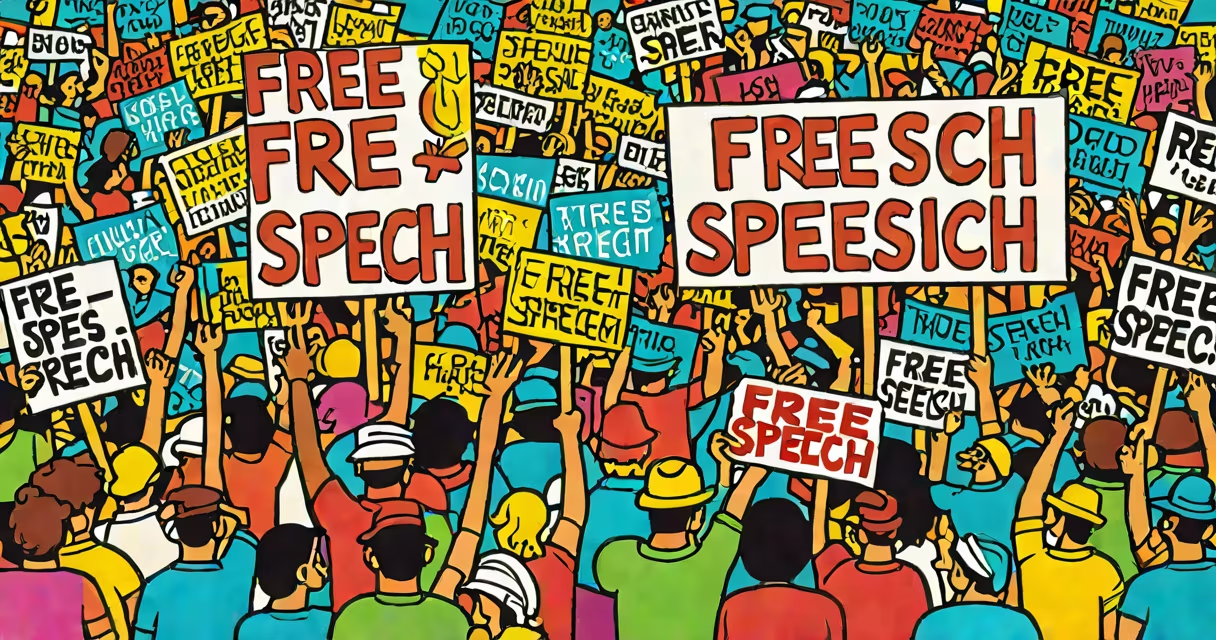
The right to speech and expression is a legal protection allowing individuals to communicate ideas, opinions, and information publicly without government interference or punishment. It forms a core element of democratic governance and is enshrined in national constitutions and international human rights frameworks.
This right enables people to criticize leaders, report injustices, share scientific findings, and participate in public debate. It applies to spoken words, written texts, art, protests, and digital communication. The U.S. Constitution's First Amendment explicitly prohibits Congress from making laws that abridge this freedom, while Article 19 of the Universal Declaration of Human Rights affirms it globally.
Not all speech is protected equally. Governments may restrict speech that incites violence, contains threats, spreads false information causing harm, or promotes illegal activity. Courts weigh the nature of the speech, the context, and potential public danger when determining limits.
When someone speaks publicly about a political issue, publishes an opinion piece, or shares a video criticizing a policy, they exercise their right to speech and expression. The government cannot arrest them solely for expressing views, even if those views are unpopular or offensive.
For example, in 1969, the U.S. Supreme Court ruled in *Tinker v. Des Moines Independent Community School District* that students wearing black armbands to protest the Vietnam War were protected under the First Amendment. The Court found that symbolic speech-like wearing a badge or holding a sign-falls within constitutional protection unless it causes substantial disruption to school operations.
Similarly, in *Citizens United v. FEC* (2010), the Court extended corporate political spending as protected speech, ruling that limiting independent expenditures by corporations in elections violates the First Amendment. This decision sparked debate over whether money equates to speech, but it established that financial support for political messages counts as expression under the law.
Not all forms of communication receive equal protection. The courts distinguish between categories based on content, intent, and impact. Below are key types and their legal treatment:
| Type of Expression | Legal Protection Level | Examples |
|---|---|---|
| Political speech | High | Campaign speeches, protest signs, op-ed articles |
| Artistic and symbolic speech | High | Protest art, flag burning, performance pieces |
| Commercial speech | Moderate | Advertising, product labeling, business promotions |
| Obscenity and child pornography | None | Explicit sexual material involving minors |
| True threats and incitement | None | Direct calls to violence, targeted harassment |
Even high-protection speech can be restricted if it creates a clear and present danger. The Supreme Court established this standard in *Schenck v. United States* (1919), stating that speech posing an immediate threat to public safety is not protected. For instance, falsely shouting "fire" in a crowded theater is not protected because it creates panic and risk.
A common misconception is that free speech means absolute freedom. In reality, the right operates within boundaries set by law. The U.S. government cannot ban books, shut down newspapers, or silence speakers simply because their message is controversial. But it can regulate time, place, and manner of expression-for example, requiring permits for large demonstrations in city centers.
Many assume that the right to speech and expression applies universally across all institutions. That is incorrect. While the government cannot censor citizens' speech, private entities such as social media platforms, employers, schools, and landlords can enforce their own rules.
For example, a company can fire an employee who posts offensive remarks on Facebook during off-duty hours. A university can discipline a student for hate speech on campus, even if the speech is legally protected. These actions do not violate the right to speech and expression because the restriction occurs in a private setting, not by state action.
Another confusion arises around online speech. While internet users enjoy broad expression rights, platforms like Twitter, Facebook, and YouTube have their own community guidelines. They may remove content deemed harmful, misleading, or violating terms of service-even if the content is constitutionally protected. This distinction matters: the government cannot force removal, but private companies can.
The right to speech and expression does not guarantee a response. You can speak freely, but others are not obligated to listen, publish, or engage. The right is about protection from punishment-not about ensuring attention or influence.
In 1971, the New York Times published classified documents revealing government deception about the Vietnam War. The Nixon administration sought a court injunction to stop further publication, arguing national security was at stake.
The Supreme Court ruled 6-3 in *New York Times Co. v. United States* that prior restraint-the government stopping publication before it happens-is unconstitutional except in extreme cases. The justices emphasized that the press has a important role in informing the public, especially when exposing official misconduct.
This case remains a landmark example of how the right to speech and expression safeguards transparency. Without it, governments could suppress information indefinitely. The decision reinforced that even sensitive material related to war and intelligence falls under First Amendment protection when disclosed by responsible media.
I once attended a local town hall meeting where a resident challenged a zoning proposal using detailed data and citations. The mayor initially dismissed her, but when she cited the First Amendment and demanded a formal hearing, the council reconsidered. Her argument was not about being heard-it was about the legal right to speak in public forums. That moment clarified how the right to speech and expression functions beyond theory: it's a tool for accountability.
The right to speech and expression differs from related concepts such as the right to privacy, the right to a fair trial, and the right to access information. Privacy protects personal data and intimate details from public exposure. Free expression allows sharing information, even if it reveals private facts-but only if it serves public interest.
The right to speech and expression is not a privilege granted by authorities. It is a safeguard against arbitrary power. When governments suppress dissent, censor journalists, or silence critics, they undermine democracy itself. Protecting this right helps society can debate, correct course, and evolve through open dialogue.
Understanding the right to speech and expression begins with recognizing its scope, limits, and real-world application. It is not about saying anything at any time. It is about protecting the space where ideas can be tested, challenged, and refined-without fear of punishment.