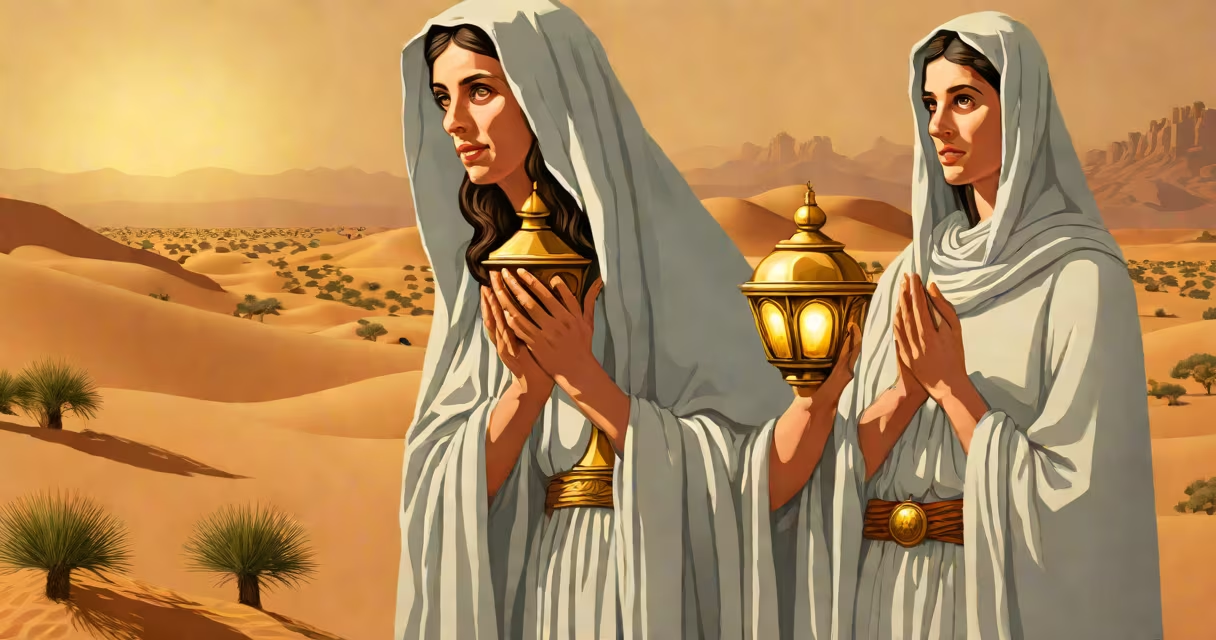
Rachel means "ewe" in Hebrew and is associated with fertility, devotion, and divine favor in the Bible. She appears in Genesis as the beloved wife of Jacob and mother of Joseph and Benjamin.
The name Rachel (רָחֵל) derives from the Hebrew word *rāchēl*, meaning "ewe" or "female sheep." This animal symbolized purity, gentleness, and pastoral abundance in ancient Near Eastern culture. The choice of such a name reflects the cultural values of her time, where livestock were central to identity and survival.
Her story begins in Genesis 29, where Jacob arrives at Paddan-aram and meets Rachel, the younger daughter of Laban. He falls in love instantly and agrees to work seven years for her hand. After the wedding, Laban deceives Jacob by giving him Leah instead, forcing Jacob to serve another seven years for Rachel. This double marriage sets the stage for complex family dynamics and emotional tension throughout the narrative.
Rachel's role in the Bible is not defined solely by her name. Her actions and emotional arc reveal deeper theological themes. She is portrayed as deeply yearning for children-a desire that mirrors the larger biblical theme of God fulfilling promises through barren women.
Genesis 30 records Rachel's anguish over infertility. She says to Jacob, "Give me children, or I die" (Genesis 30:1). Her plea underscores the social and spiritual weight placed on childbearing in patriarchal society. When she finally gives birth to Joseph, she names him "May he add" (Yosef), reflecting her hope for more blessings. Her death during childbirth, described in Genesis 35:16-19, marks a turning point in Jacob's process and establishes her as a figure of tragic devotion.
Her burial site near Bethlehem became a place of pilgrimage. Jeremiah 31:15 quotes Rachel weeping for her children, a passage later cited by Matthew 2:18 during the massacre of the innocents. This reference transforms Rachel from a historical matriarch into a symbol of maternal grief and intercession.
Different religious traditions interpret Rachel's legacy in distinct ways. In Judaism, she is honored as one of the four matriarchs-alongside Sarah, Rebecca, and Leah-and is invoked in prayers for mercy. The Talmud (Yevamot 64a) notes that Rachel's tears were so profound they moved God to promise eventual redemption.
In Christianity, Rachel is seen as a foreshadowing of Mary, the mother of Jesus. Both women are associated with sorrow and divine motherhood. The Gospel of Matthew explicitly connects Rachel's weeping to the mourning of mothers in Bethlehem, reinforcing the idea of sacred suffering.
In Islamic tradition, while Rachel is not mentioned by name in the Quran, some scholars identify her as the wife of Jacob (Ya'qub), whose story is recounted in Surah Hud (11:12-13) and Surah Yusuf (12:1-10). Her role is implied rather than detailed.
| Tradition | Key Symbolism | Textual Reference |
|---|---|---|
| Judaism | Matriarch, intercessor, embodiment of grief and hope | Genesis 35:19, Jeremiah 31:15 |
| Christianity | Prefiguration of Mary, maternal sacrifice | Matthew 2:18, Luke 1:48 |
| Islam | Wife of Ya'qub, part of prophetic lineage | Surah Yusuf 12:1-10, Surah Hud 11:12-13 |
Many assume Rachel was always virtuous or idealized. But the Bible presents her as flawed and emotionally volatile. Her theft of Laban's household idols (Genesis 31:19) shows ambition and deception-actions that contradict the passive, saintly image often given in sermons. This complexity makes her a more authentic biblical figure.
Another misconception is that Rachel's name implies beauty. While she is described as "beautiful in form and appearance" (Genesis 29:17), the name itself does not mean "beautiful." The Hebrew root *rāchēl* is purely zoological. The association with beauty comes from later interpretation, not etymology.
A lesser-known fact: Rachel's name appears in the Dead Sea Scrolls. Fragment 4Q174 (from Qumran) contains a list of names including Rachel, suggesting her name remained significant in Second Temple Judaism. This shows her lasting cultural resonance beyond the canonical text.
At the Tomb of Rachel near Bethlehem, pilgrims leave written prayers in small envelopes. These are placed between stones at the site, believed to be Rachel's burial place. A 2017 study by the Israel Antiquities Authority confirmed the site's use as a shrine dating back to the Byzantine period (c. 3rd-6th century CE).
During Jewish holidays like Tu B'Shvat, groups visit the tomb to pray for fertility and healing. One woman, interviewed by Haaretz in 2020, said she came to the site after years of infertility. "I didn't come for miracles," she said. "I came because Rachel's story is about waiting-waiting for God's timing." Her personal testimony illustrates how Rachel's narrative continues to inform lived faith.
When Jacob died, his sons buried him in the cave of Machpelah. Rachel's remains were left at Ephrath, a location identified as Bethlehem. This separation of burial sites emphasizes the symbolic divide between earthly life and eternal rest-Jacob's body returned to ancestral land, Rachel's to the place of her deepest longing.
Rachel's name means "ewe," but her story means much more. She represents the intersection of human longing and divine purpose. Her life, marked by love, loss, and perseverance, offers a model of faith amid struggle.
Understanding what does Rachel mean in the bible requires looking beyond the name. It demands engaging with her full narrative-the joy of motherhood, the pain of infertility, the tragedy of early death, and the enduring power of memory. Her legacy lives on not in perfection, but in authenticity.