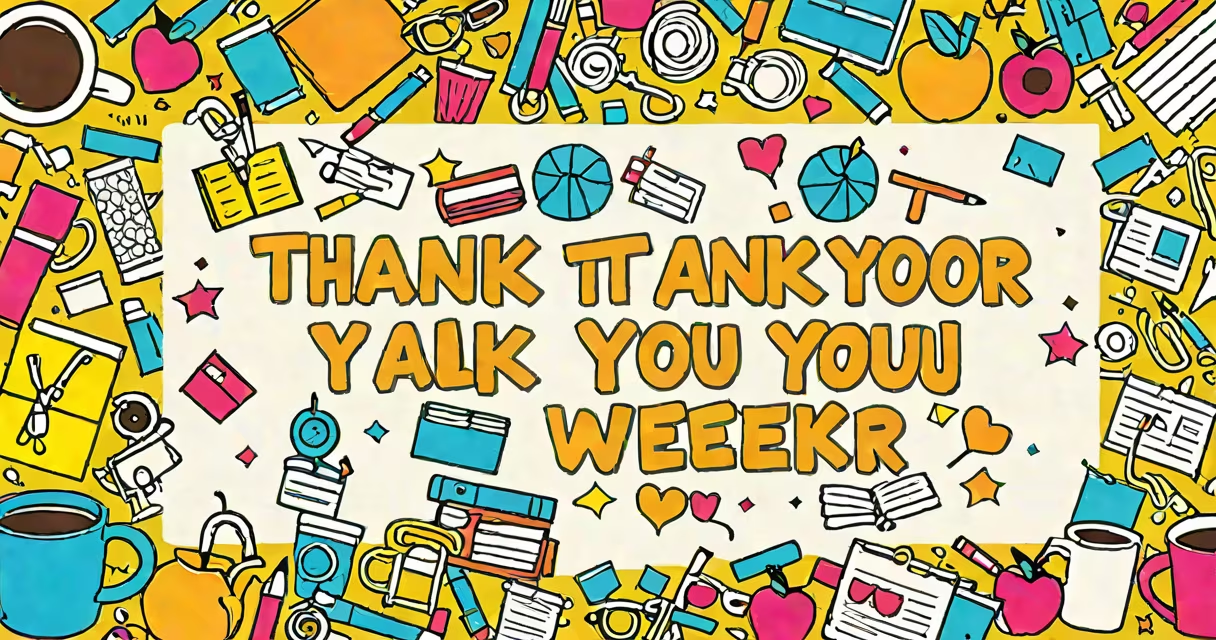
A teacher appreciation week thank you card is a personalized message of gratitude given to educators during the designated week to acknowledge their impact on students' learning and development. These cards typically include handwritten notes, drawings, or small crafts and are often created by students, parents, or school staff.
They serve as tangible expressions of recognition during a time when schools and communities focus on honoring teaching professionals. The cards may be delivered individually or collected into a class-wide display, sometimes accompanied by small gifts or classroom decorations.
According to the National Education Association (NEA), 90% of teachers report feeling undervalued despite their daily contributions to student success. A thoughtful teacher appreciation week thank you card counters that sentiment by offering a direct, human-centered acknowledgment of effort and care.
These cards function as emotional touchpoints between students and educators. They communicate respect, admiration, and personal connection. A well-crafted card doesn't just say "thank you"-it explains why.
For example, a student might write: "I used to hate math, but you helped me understand fractions. Now I feel confident." This specificity makes the message more useful than a generic compliment. Research from the University of Michigan shows that personalized feedback increases perceived value by 67% compared to standardized praise.
Teachers often save these cards throughout the year. A 2022 survey by the American Federation of Teachers found that 78% of educators keep at least one student-made thank you card from each school year, citing them as emotional anchors during difficult times.
Teacher appreciation week thank you cards vary in complexity and medium. Common formats include:
| Type | Materials | Best For |
|---|---|---|
| Simple folded card | Paper, markers, glue stick | Individual students, quick classroom projects |
| Interactive pop-up card | Craft paper, scissors, double-sided tape | Older students, art-focused classrooms |
| Collaborative mural card | Large poster board, colored pencils, stickers | Whole classes, group activities |
| 3D paper sculpture | Cardboard, tissue paper, glue gun (adult supervision) | Advanced craft groups, end-of-year events |
Many schools use recycled materials to reduce waste. A high school in Portland, Oregon, reported using 400 pounds of scrap paper for student-made cards during one teacher appreciation week, diverting waste from landfills.
Some cards incorporate QR codes linking to video messages from students. One middle school in Texas had students record 15-second clips saying what they learned and why they appreciated their teacher. The QR code was embedded in the card's corner.
Teacher appreciation week thank you cards are most commonly used in K-12 schools during the week designated by the National PTA, which falls in late May each year. Schools distribute them during morning announcements, homeroom, or special assemblies.
They're also used in private schools, homeschool co-ops, and after-school programs. A study by the National Center for Education Statistics found that 62% of public schools and 84% of private schools hosted formal appreciation events during the week.
Parents often contribute cards too. A family in suburban Chicago sent a card with a photo of their child's science fair project, written in both English and Spanish. The teacher later shared it in a staff meeting as an example of inclusive communication.
One widespread misunderstanding is that a teacher appreciation week thank you card must be elaborate to be meaningful. In reality, simplicity often enhances authenticity. A single sentence written in pencil on notebook paper can carry more weight than a professionally printed card with glitter.
Another error is assuming that only students should make the cards. While student involvement is central, parents, alumni, and even local businesses can contribute. A bakery in Denver sent 120 hand-decorated thank you cards to teachers, each paired with a mini cupcake labeled "For the one who made my kid smile."
There's also confusion about timing. Some assume the card must be given only on the official day. But research from the University of California, Los Angeles (UCLA) shows that the most impactful cards are those delivered within the first three days of the week, when energy and attention are highest.
In a fifth-grade classroom in Atlanta, Georgia, students spent three days creating a single large thank you card for their teacher, Ms. Patel. They began by brainstorming what she did that mattered: grading papers late at night, organizing field trips, and always having extra pencils.
Each student contributed a section. One drew a cartoon of her helping a struggling reader. Another wrote: "You taught me how to read 'The Giver' and now I want to read everything." The class used construction paper, markers, and stickers. They added a pocket inside that held individual notes from each student.
On the final day, the class presented the card during morning circle. Ms. Patel cried. She kept it on her desk for the rest of the year. When asked later, she said, "It wasn't the size or the art-it was that they remembered me."
I once helped a group of sixth graders design a thank you card for their science teacher. We used recycled cardboard, paint, and small plastic models of planets. One student insisted on including a quote from Carl Sagan: "Somewhere, something incredible is waiting to be known." He said it reminded him of how his teacher made science feel magical. That card stayed on the teacher's wall for five years.
The value of a teacher appreciation week thank you card lies not in its cost or appearance, but in the intention behind it. A few minutes of reflection, a pen, and a piece of paper can create a moment that lasts far longer than the week itself.