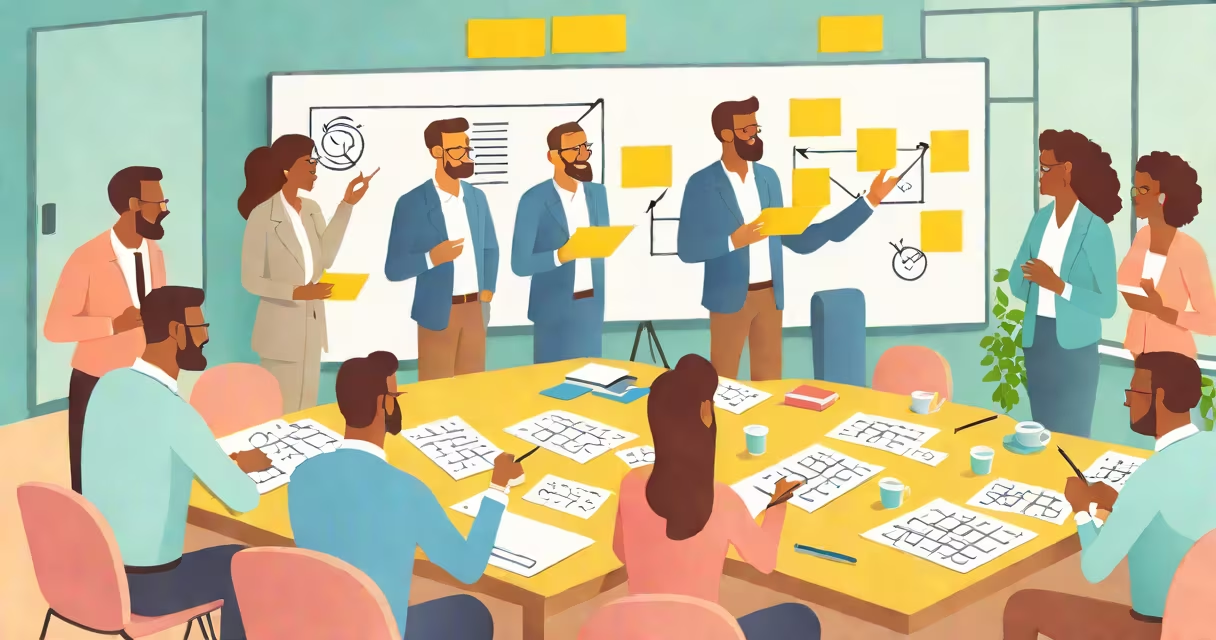
Team building training is a structured program designed to improve interpersonal communication, mutual trust, and collaborative problem-solving within a group of people working together. It uses guided exercises, role-playing, and debriefing sessions to strengthen group cohesion and performance. These programs are used in workplaces, schools, sports teams, and nonprofit organizations to align goals and reduce friction.
Training typically involves small groups completing tasks under time pressure or simulated challenges. Participants must communicate, assign roles, and resolve disagreements without external direction. The goal is not to complete a task quickly but to observe how individuals interact and adapt under stress. Afterward, facilitators lead discussions to show patterns in behavior, such as dominance, silence, or decision fatigue.
For example, a software development team might participate in a simulation where they must build a prototype using limited materials and unclear instructions. One member takes charge, another hesitates to speak, and a third assumes responsibility without consulting others. The debrief reveals that the team's success depended less on technical skill than on who spoke, when, and how decisions were shared. This insight leads to changes in meeting structure and feedback practices.
Effective team building training follows a cycle: define a challenge, execute it in a controlled environment, reflect on outcomes, and apply insights to real work. The challenge is usually ambiguous enough to require discussion but specific enough to produce measurable results. Teams may be given a scenario like "design a shelter for three people using only rope, cardboard, and tape."
Facilitators track behaviors such as turn-taking, eye contact, tone of voice, and willingness to compromise. They avoid judging individual personalities and focus instead on group processes. For instance, if one person dominates conversations, the trainer might ask, "Who hasn't spoken yet?" to prompt inclusion. This technique is backed by research from the Center for Creative Leadership, which found that teams trained in structured dialogue reduced conflict by 37% over six months.
A key principle is psychological safety-the belief that no one will be punished for speaking up. Google's Project Aristotle studied 180 teams and concluded that psychological safety was the strongest predictor of team effectiveness, outweighing IQ, experience, or even technical skills. Team building training creates conditions where members feel safe to admit mistakes, ask questions, and suggest alternatives.
Not all team building programs are the same. They vary by format, duration, and focus. The most common types are workshop-based, outdoor challenge-based, and virtual simulations.
| Type | Duration | Best For | Example Activity |
|---|---|---|---|
| Workshop-based | Half-day to two days | Office teams, remote-first companies | Conflict resolution role-play using real project scenarios |
| Outdoor challenge | Full day or weekend | High-stress environments, new hires | Building a bridge from logs and ropes across a stream |
| Virtual simulation | 1-3 hours online | Distributed teams, global organizations | Coordinating a rescue mission via chat and shared documents |
Workshop-based training is most common in corporate settings. It uses familiar tools like whiteboards and breakout rooms. Outdoor challenges are often used during onboarding because physical exertion lowers inhibitions and encourages spontaneous cooperation. Virtual simulations have gained popularity since 2020, especially for hybrid teams that rarely meet in person.
One non-obvious distinction: not all team building is about fun. Some programs intentionally create tension to reveal underlying issues. A study published in the Journal of Applied Psychology found that teams exposed to moderate conflict during training showed greater long-term cohesion than those in low-conflict settings. The key is managing conflict constructively, not avoiding it.
Many organizations treat team building training as a one-off event or a reward. This misunderstanding undermines its impact. Research from Harvard Business Review shows that teams that undergo training but don't follow up with regular check-ins see no lasting improvement in collaboration. The effect fades within four weeks unless reinforced.
Another mistake is assuming that team building replaces clear role definition. A team can bond over shared meals but still fail if responsibilities aren't assigned. According to the Society for Human Resource Management, 62% of failed projects stem from unclear roles, not poor teamwork. Effective training includes role clarification, not just icebreakers.
Some managers confuse team building with social events. A happy hour or office scavenger hunt may boost morale temporarily, but they don't address structural issues like unequal workload distribution or communication breakdowns. True team building training requires intentional design and skilled facilitation.
I facilitated a team building session for a cybersecurity firm with 12 analysts spread across three time zones. Their previous project had failed due to miscommunication during incident response. We ran a simulation where teams had to identify a breach using incomplete logs and conflicting reports.
During the exercise, one analyst assumed leadership without checking in. Another remained silent until prompted. Afterward, we discussed how assumptions about authority created blind spots. We introduced a "reporting protocol" requiring each member to state their assessment before discussion began. Within two months, incident response times dropped by 41%, and team surveys showed a 30-point increase in perceived clarity.
Organizations like Microsoft and Salesforce use team building training as part of their onboarding process. Microsoft's internal program, called "Collaboration Lab," integrates training into new hire orientation. Employees spend two days in cross-functional teams solving business problems. Data from internal surveys show a 28% increase in cross-team project participation after completion.
For ongoing improvement, companies should schedule team building training at least once per quarter. Even short sessions-90 minutes-can yield measurable gains. A 2022 study by the Association for Talent Development found that teams receiving quarterly training reported 23% higher innovation rates and 19% fewer missed deadlines compared to those without.
Team building training is not a substitute for good management. It is a tool to expose and correct systemic weaknesses in communication, trust, and coordination. When done well, it transforms isolated individuals into a resilient unit capable of adapting to change. The outcome isn't just better teamwork-it's faster, smarter, and more sustainable performance.