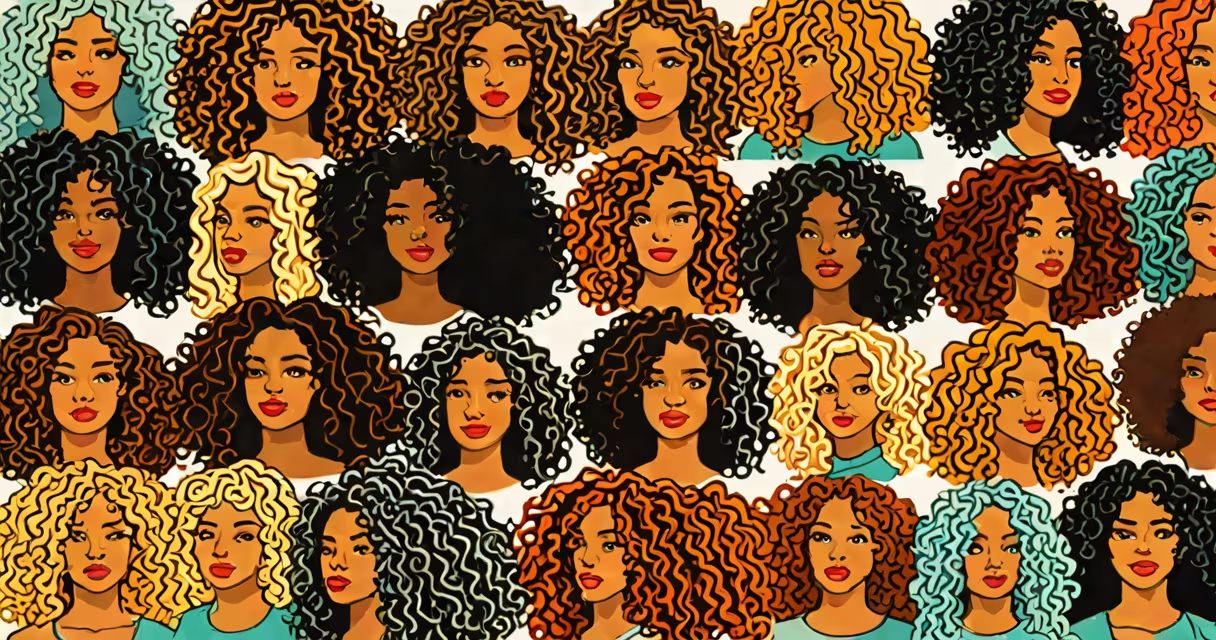
Curly hair refers to a natural hair texture characterized by spiral or wave patterns formed by the shape of the hair follicle. This trait arises from genetic variation in the keratin proteins that structure the hair shaft, resulting in non-uniform growth that bends and coils.
Genetic inheritance determines curl pattern. A single gene variant-specifically in the trichohyalin (TCHH) gene-has been linked to curly hair in populations across Africa, Europe, and Asia. Researchers at the University of Pennsylvania identified this association through genome-wide studies of over 10,000 individuals, confirming that curly hair is not random but biologically encoded.
Curly hair forms due to asymmetrical follicle shape. Unlike straight hair, which grows from a round follicle, curly hair emerges from an oval or flattened follicle. As the hair strand grows, uneven pressure along its diameter causes it to twist. The tighter the follicle's cross-section, the tighter the curl. This physical mechanism explains why some people have loose waves while others sport dense ringlets.
Curl patterns are categorized using the Andre Walker Hair Typing System, which divides hair into four main types based on curl formation:
| Type | Pattern Description | Common Traits |
|---|---|---|
| 1 | Straight | Smooth, no bend; often fine or medium thickness |
| 2 | Wavy | Loose S-shapes; prone to frizz in humidity |
| 3 | Curly | Distinct corkscrews; high shrinkage and moisture retention |
| 4 | Coily | Very tight, zig-zag patterns; fragile when dry |
Type 3 and Type 4 curls are most associated with African ancestry, though they appear globally. Type 3 curls often form in tight spirals (like a rope), while Type 4 curls exhibit a zigzag or Z-pattern, with minimal stretch. These differences affect styling, moisture needs, and product selection.
A non-obvious fact: Not all curly hair is genetically inherited. Some people develop curly patterns later in life due to hormonal shifts, illness, or medication. For example, elevated cortisol levels during prolonged stress can alter hair follicle activity, leading to temporary curl changes. This phenomenon is documented in dermatology journals, including JAMA Dermatology, which reported cases of acquired curliness in patients undergoing chemotherapy.
Many assume curly hair is inherently difficult to manage. This belief stems from outdated beauty standards that equated straightness with cleanliness and professionalism. In the 20th century, Black women were pressured to relax their hair to conform to Eurocentric norms, a practice that persists in some communities today.
Another misconception is that curly hair is always dry. While many curls lack sebum distribution due to their spiral shape, not all are dehydrated. A 2021 study published in Journal of Cosmetic Dermatology found that 68% of participants with Type 3 curls maintained adequate moisture levels when using a consistent regimen of leave-in conditioner and low-manipulation techniques.
Even among experts, confusion exists. The term "afro" is often misused to describe all curly or coily hair. However, "afro" specifically refers to a hairstyle where tightly coiled hair is styled outward from the scalp, forming a rounded shape. It is not a texture category. Confusing it with "coily" leads to inaccurate labeling and poor product recommendations.
In 2019, a high school student in Atlanta filed a lawsuit after being told she couldn't wear her natural curls to graduation. Her school required students to wear hair in "neat, professional styles," which excluded afros and twists. The case drew national attention and highlighted how societal expectations around hair texture intersect with race and gender.
After legal review, the district revised its dress code policy to allow natural hairstyles. The student's mother stated, "She wore her curls proudly. They weren't messy-they were part of who she was." This incident illustrates that curly hair is not just a physical trait but a marker of cultural belonging and self-expression.
Another example: In Nigeria, traditional hairstyles like cornrows and braids carry generational significance. Women often wear their natural curls in protective styles during ceremonies. These practices are not fashion choices-they are rooted in identity, resistance, and community pride.
Curly hair is frequently confused with wavy or coily hair. Though all fall under the umbrella of "natural hair," each requires distinct care. Wavy hair (Type 2) has less volume and shrinkage than curly (Type 3), making it easier to style with minimal products. Coily hair (Type 4) is more fragile and prone to breakage, requiring gentle handling and higher moisture levels.
For comparison:
Understanding these differences prevents damage. Using a heavy oil on Type 4 hair can weigh it down and cause buildup. Applying a protein treatment to Type 2 may lead to stiffness and brittleness.
I spent years trying to "fix" my Type 3A curls-using heat tools, flat irons, and chemical relaxers. I believed straight hair was more acceptable. After a year of damage, my strands split and broke easily. A dermatologist diagnosed me with trichorrhexis nodosa, a condition caused by repeated thermal stress.
When I switched to a moisturizing routine with sulfate-free shampoo and a leave-in conditioner, my curls regained elasticity. I learned that embracing my natural texture wasn't surrender-it was self-respect. That shift changed how I viewed myself and how I interacted with others.
What does curly hair mean? It means biology, culture, resilience, and identity. It signals genetic diversity and human adaptation. It challenges norms and demands recognition. Understanding curly hair goes beyond texture-it involves listening to lived experiences, respecting science, and rejecting harmful stereotypes.