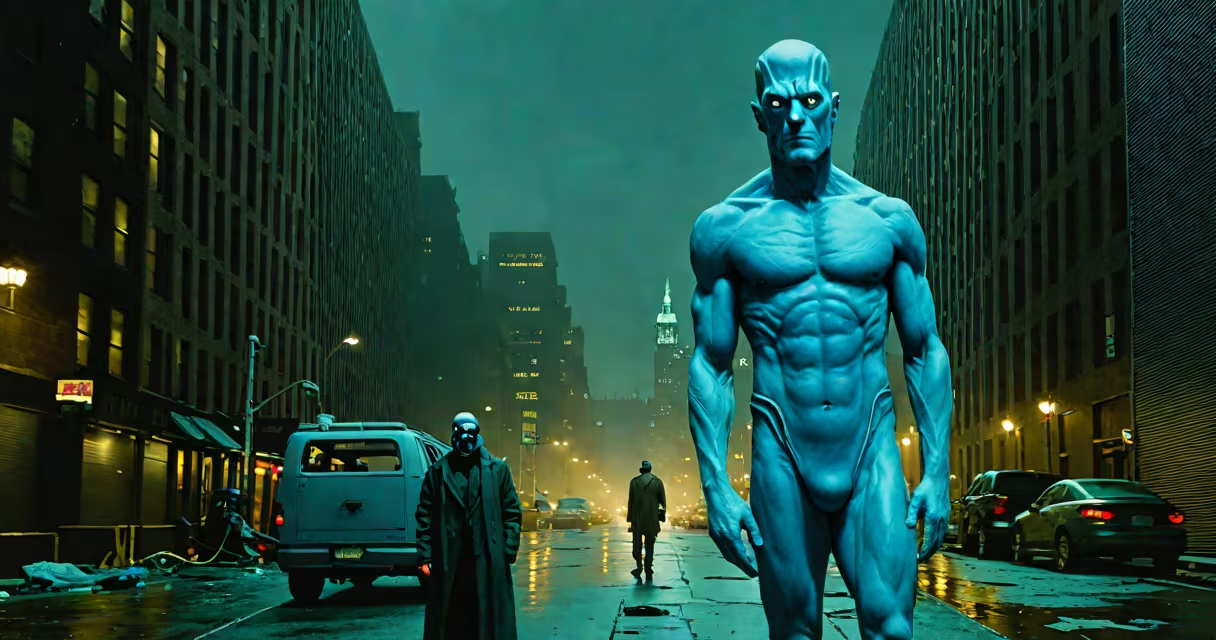
The Watchmen series is an HBO television adaptation of Alan Moore's 1986 graphic novel, reinterpreting its exploration of superhero mythos, political corruption, and moral ambiguity through a contemporary American setting. It premiered in 2019 and continues the narrative beyond the original story's conclusion, introducing new characters while expanding on the legacy of figures like Dr. Manhattan and Adrian Veidt.
Set in a fictionalized version of Tulsa, Oklahoma, the series unfolds in 2019, decades after the events of the original comic. The show centers on a racially charged incident involving police violence and a resurgence of vigilante activity among descendants of the original masked heroes. Unlike the original, which focused on retired superheroes grappling with their pasts, the HBO series shifts attention to systemic racism, historical erasure, and the weaponization of identity under state surveillance.
While the original Watchmen was published in twelve issues between 1986 and 1987, the HBO series spans nine episodes across one season. It maintains the source material's layered storytelling, using nonlinear timelines, visual symbolism, and philosophical inquiry. The show's creators, including Damon Lindelof, retained the core structure of the graphic novel-its mystery, its critique of American exceptionalism, and its deconstruction of the superhero archetype-but expanded the world to reflect modern social tensions.
The Watchmen series uses a dual timeline structure. One thread follows the present-day investigation of a series of murders targeting Black citizens wearing masks inspired by the original Comedian's costume. The other traces the history of the Tulsa race massacre of 1921, a real event suppressed from mainstream history. These narratives converge around the concept of "Red Tide," a government-sanctioned program designed to manipulate public perception through controlled violence and false flag operations.
Each episode integrates visual motifs from the original comic-such as the blood-stained smiley face badge and the recurring symbol of the seven-pointed star-to reinforce thematic continuity. The show also employs diegetic music, including a cover of "Love Is Blue" performed by a jazz ensemble, to show emotional turning points. This technique mirrors the original's use of cultural references to deepen narrative resonance.
For example, Episode 4, "Little Fear of Lightning," reveals that the character Angela Abar (played by Regina King) is the daughter of a former Klansman and a descendant of Hooded Justice, one of the earliest masked heroes. Her personal process reflects the show's central theme: inherited trauma and the burden of legacy. She wears a mask not for justice, but to protect her identity-a reversal of the original's masked protagonists who wore them to conceal their crimes.
The series draws from multiple genres: speculative fiction, political thriller, and psychological drama. Its narrative relies heavily on exposition through dialogue, archival footage, and dream sequences. The production design emphasizes color-coded symbolism-red for violence, blue for surveillance, black for mourning-and uses lighting to reflect internal states. For instance, Dr. Manhattan's presence is often signaled by a faint blue glow in otherwise dark scenes.
Key characters include:
A lesser-known but critical element is the use of the "Sisterhood," a group of women trained in combat and espionage. Their existence challenges the male-dominated legacy of the original Watchmen and introduces a feminist counterpoint to the show's themes of power and control.
The Watchmen series is used as a cultural touchstone for discussions about race, authority, and the ethics of intervention. It has been cited in academic circles for its treatment of historical amnesia-particularly the erasure of the 1921 Tulsa race massacre, in which over 300 Black residents were killed and 35 blocks of the Greenwood District destroyed. The show's portrayal of this event, based on verified records from the Tulsa Historical Society, brought national attention to the incident.
According to the Library of Congress, the original Watchmen graphic novel was added to the National Film Registry in 2019 due to its cultural significance. The HBO series extended that recognition by adapting the work for a new generation. It has been used in university courses on media studies, American literature, and political philosophy.
For example, at the University of California, Los Angeles, Professor Lisa M. Jones teaches a course titled "Superheroes and State Violence," where The Watchmen series is required reading alongside the original comic. Students analyze how the show reframes the idea of "heroism" as a tool of state control rather than individual virtue.
Many viewers assume The Watchmen series is a direct continuation of the original comic's plot. It is not. While it shares characters and settings, the HBO version operates as a standalone narrative with a distinct thematic focus. The original Watchmen ends with the death of the Comedian and the revelation that Veidt's plan to save humanity via mass deception succeeded-but only temporarily. The HBO series begins years later, with the aftermath of that success and the consequences of hidden truths.
Another misconception is that Dr. Manhattan is the central protagonist. He is not. The show treats him as a symbolic figure-a representation of unchecked power and alienation. His appearances are brief, and his influence is felt more through absence than presence. The real narrative engine is Angela Abar's investigation into her father's murder and the rise of masked resistance.
A non-obvious fact: the show's title sequence features a real-life photograph of the 1921 Tulsa race massacre, altered to include a red smiley face. This detail, noted by film critic David Bordwell in his analysis of the series' aesthetics, underscores the show's argument that history is not neutral-it is curated, manipulated, and often rewritten to serve dominant narratives.
| Original Watchmen (1986) | HBO Watchmen (2019) |
|---|---|
| Set in 1985, Cold War context | Set in 2019, post-9/11, post-Ferguson |
| White male protagonists | Diverse cast; center Black and Indigenous experiences |
| Anti-heroic tone; nihilistic ending | Hopeful resolution; emphasis on community healing |
| Veidt's plan succeeds temporarily | Truths are exposed; systems begin to reform |
I first watched The Watchmen series during a late-night screening at a film festival in Austin. The moment Angela Abar removes her mask in Episode 7, revealing her face beneath layers of scar tissue and makeup, I realized the show wasn't just about superheroes-it was about the cost of survival in a society that demands invisibility from marginalized people.
The Watchmen series is not a remake. It is a reclamation. It takes the original's warnings about power, fear, and illusion and applies them to a nation still grappling with racial injustice, surveillance, and the myth of the lone savior. The show's strength lies in its refusal to offer easy answers. Instead, it asks: Who gets to wear the mask? And who decides when it's time to take it off?