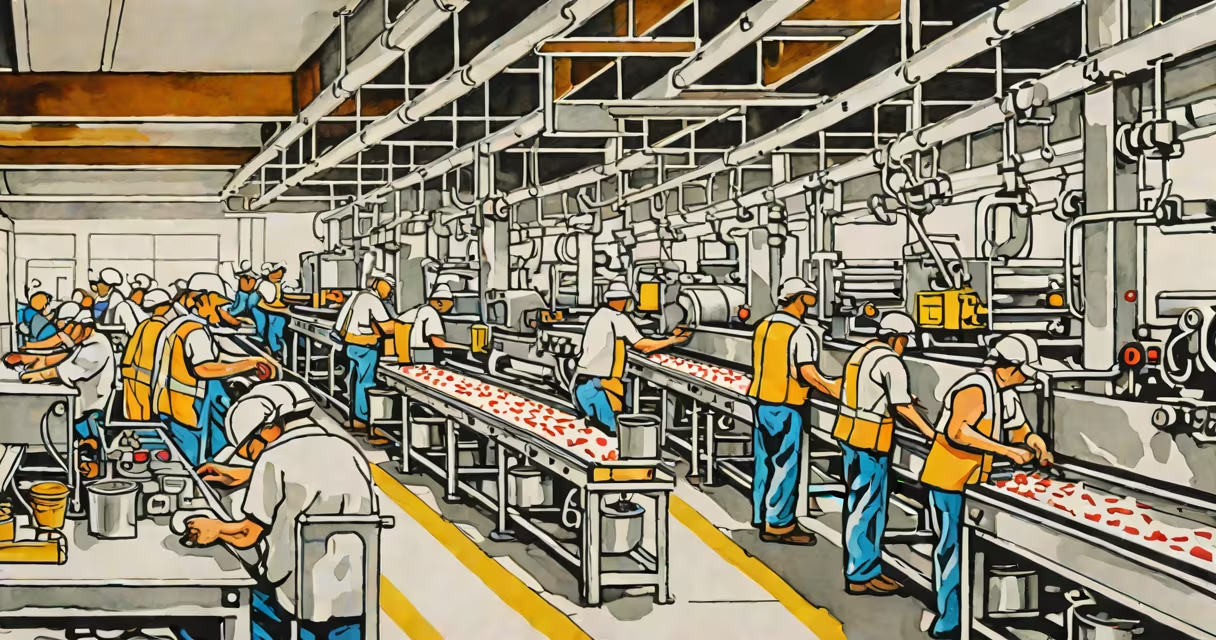
The definition of lean is a systematic approach to minimizing waste within a manufacturing or service process without sacrificing productivity. Originating in Toyota's production system, lean focuses on delivering maximum value to the customer using minimal resources.
Lean operates on the principle that every activity must contribute directly to customer value. Non-value-added tasks-such as excess inventory, waiting time, or unnecessary movement-are identified and eliminated. This results in faster cycle times, lower costs, and higher quality output.
According to the Lean Enterprise Institute, lean is not a set of tools but a philosophy rooted in respect for people and continuous improvement. The core idea is that value is defined solely by the customer's needs, not internal assumptions about what they want.
Lean works by mapping the entire workflow-from raw materials to delivery-and analyzing each step for inefficiency. Teams use visual management tools like value stream maps to track material and information flow. This reveals bottlenecks, redundant steps, and delays.
Once waste is identified, teams apply targeted improvements. For example, a hospital reduced patient wait times by 40% after implementing lean scheduling. They mapped the patient process, eliminated redundant paperwork, and standardized handoffs between departments.
Key techniques include 5S (sort, set in order, shine, standardize, sustain), Kaizen (continuous small improvements), and Just-in-Time (JIT) production. These methods reduce overproduction, waiting, transportation, overprocessing, inventory, motion, and defects-the seven wastes.
Lean is guided by five foundational principles:
While originally developed for manufacturing, lean has evolved into distinct forms based on application area:
| Type | Use Case | Key Focus |
|---|---|---|
| Manufacturing Lean | Automotive, electronics, food processing | Reducing setup time, optimizing floor layout, JIT supply chains |
| Service Lean | Hospitals, banks, government agencies | Shortening patient admission times, reducing loan approval cycles |
| Healthcare Lean | Emergency rooms, surgical units | Minimizing patient wait times, improving bed turnover |
| Software Lean | Agile development, DevOps | Reducing deployment cycles, automating testing |
A common misconception is that lean equals cutting staff or reducing budgets. That's incorrect. Lean improves outcomes by removing friction, not by slashing headcount. A 2018 study by the National Institute of Standards and Technology found that companies applying lean principles saw a 25% average increase in operational efficiency over three years.
People often confuse lean with cost-cutting or downsizing. But lean is not about reducing spending-it's about eliminating waste. Waste includes idle time, defective outputs, overproduction, and unnecessary movement. These are measurable and addressable.
Another mistake is assuming lean applies only to factories. While Toyota pioneered it in auto plants, healthcare providers have adopted lean to reduce medication errors. One U.S. hospital cut medication administration errors by 60% using standardized checklists and team huddles-a direct application of lean's focus on consistency and error prevention.
There's also confusion between lean and Six Sigma. Both aim to improve processes, but they differ in method. Six Sigma uses statistical analysis to reduce variation and defects. Lean targets waste elimination. Many organizations combine both-known as Lean Six Sigma-for broader impact.
For example, a logistics company used Lean Six Sigma to reduce delivery delays. They mapped the entire route planning process, eliminated redundant approvals, and implemented real-time tracking. Delivery accuracy improved from 82% to 96% in six months.
I once helped redesign a small business's order fulfillment process. Before lean, orders took 48 hours to process due to manual data entry, multiple handoffs, and unclear responsibility. After applying 5S and creating a visual workflow board, processing time dropped to under 12 hours. The team reported less stress and fewer errors. This wasn't a tech upgrade-it was a cultural shift toward transparency and ownership.
That experience confirmed a key insight: lean succeeds only when leadership supports it consistently. It requires daily engagement, not annual audits. The definition of lean includes sustained discipline, not one-off projects.
Understanding the definition of lean ensures teams don't misapply it. For example, labeling a new software tool "lean" because it saves time doesn't count unless it reduces waste systematically. True lean involves measurement, feedback loops, and employee involvement.
Research from MIT's Sloan School of Management shows that companies with mature lean programs outperform peers in revenue growth and customer satisfaction. Those that treat lean as a buzzword see little lasting benefit.
When applied correctly, the definition of lean leads to sustainable gains. A single warehouse that reduced storage space by 30% through better bin organization and labeled zones saved $180,000 annually in rent and labor-without hiring more staff.
The definition of lean is not a static list of rules. It's a living structure for continuous improvement. Organizations that adopt it deeply-rather than superficially-achieve lasting results in speed, quality, and cost control.