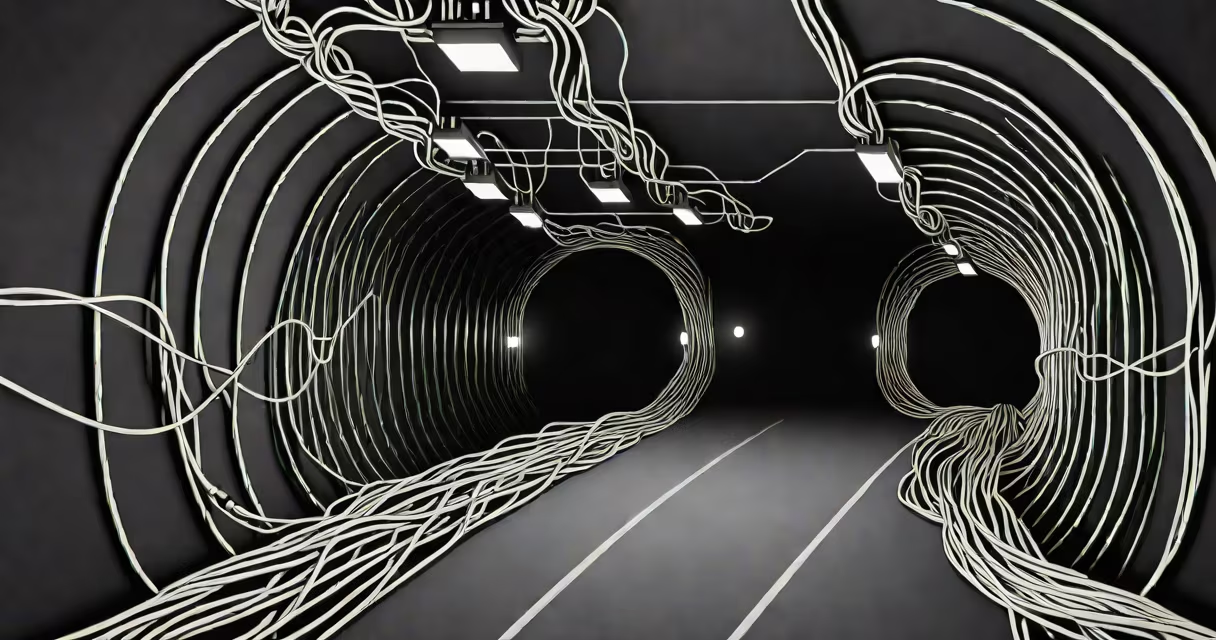
Dark fiber in telecom refers to unused fiber optic cable installed during network construction but not yet activated with light signals. It remains dormant until a customer or provider powers it with laser transmissions to carry data.
Unlike shared broadband or managed services, dark fiber provides a dedicated, unshared physical connection. This means the bandwidth capacity is entirely under the user's control, with no throttling or congestion from other users. The term "dark" comes from the absence of light-no signal is flowing through the fiber.
Telecom providers install dark fiber during infrastructure builds to future-proof networks. Cities, campuses, and enterprises often lease or buy dark fiber to create high-capacity private networks. It supports data-heavy applications like video streaming, cloud computing, and real-time financial trading.
Dark fiber operates on the principle of total ownership and control. When a provider installs a fiber line, they lay the physical medium-usually single-mode glass strands-but do not connect transceivers or power systems. The fiber remains inactive until the customer installs their own equipment.
To activate dark fiber, a business must deploy optical equipment such as media converters, routers, and lasers. These devices convert electrical signals into light pulses that travel through the fiber. The receiving end reverses the process, turning light back into data.
For example, a university might lease 10 kilometers of dark fiber between its research center and main campus. They install their own transceivers at both ends, then run a 10 Gbps link exclusively for internal research traffic. No third party monitors or shares the line.
Dark fiber deployment varies based on ownership and access model. The most common types are:
| Type | Description | Use Case |
|---|---|---|
| Leased Dark Fiber | Provider owns the cable; customer pays to use it and supplies their own equipment. | Enterprises needing full control over network performance. |
| Purchased Dark Fiber | Customer buys the fiber outright, including rights-of-way and maintenance. | Large institutions building long-term, private networks. |
| Managed Dark Fiber | Provider manages the equipment and maintenance while leasing the fiber. | Businesses wanting high performance without handling hardware. |
Leased dark fiber is the most common model. Providers like AT&T, Lumen, and Zayo offer regional dark fiber leases. Prices vary widely-$10,000 to $50,000 per kilometer annually depending on location and demand.
A key distinction: dark fiber is not the same as lit fiber. Lit fiber is already active, with service providers managing the signal. Dark fiber gives users direct access to the underlying medium, enabling customization and scalability.
Organizations choose dark fiber for performance, security, and long-term cost efficiency. A single strand can carry 100 Gbps or more using wavelength division multiplexing (WDM), allowing multiple data streams over one fiber.
Financial firms use dark fiber for low-latency trading. A hedge fund in Chicago might lease dark fiber to New York to reduce latency below 10 milliseconds. Even a 1-millisecond edge matters in high-frequency trading.
Healthcare systems rely on dark fiber for secure transmission of patient records and medical imaging. A hospital network in Seattle uses dark fiber to transfer MRI scans between facilities without risk of interception or delay.
One non-obvious fact: dark fiber doesn't require a new build. Many cities have existing dark fiber networks from past municipal broadband projects. In 2021, the city of Chattanooga, Tennessee, offered dark fiber access to local businesses through its municipally owned network. Over 150 companies now use it for private connections.
Dark fiber is often confused with standard fiber internet. The latter uses shared bandwidth and is managed by ISPs. Users pay for speed tiers but don't control the underlying infrastructure. With dark fiber, you own the pipe.
Another myth: dark fiber is always expensive. While initial setup costs are high-equipment, installation, and maintenance-the long-term savings exceed traditional leased lines. A company with 10 Gbps needs may pay $15,000/month for a managed service. The same bandwidth over dark fiber averages $6,000/month after the first year.
In 2022, a biotech startup in San Diego needed to move 2 terabytes of genomic data daily between labs and a cloud analytics platform. Their ISP offered 1 Gbps shared fiber, but upload speeds dropped during peak hours.
They leased 5 km of dark fiber from a regional provider. Installed their own 10 Gbps transceivers and WDM gear. Data moved consistently at full speed. Latency dropped from 45 ms to 12 ms. Over three years, they saved $210,000 compared to managed service contracts.
This case shows how dark fiber enables predictable performance and cost control-critical for data-intensive operations.
Dark fiber in telecom is not a buzzword. It's a proven infrastructure solution for organizations that need maximum control, speed, and reliability. It's not for everyone-setup complexity and upfront costs are barriers-but for those who need it, it's unmatched.