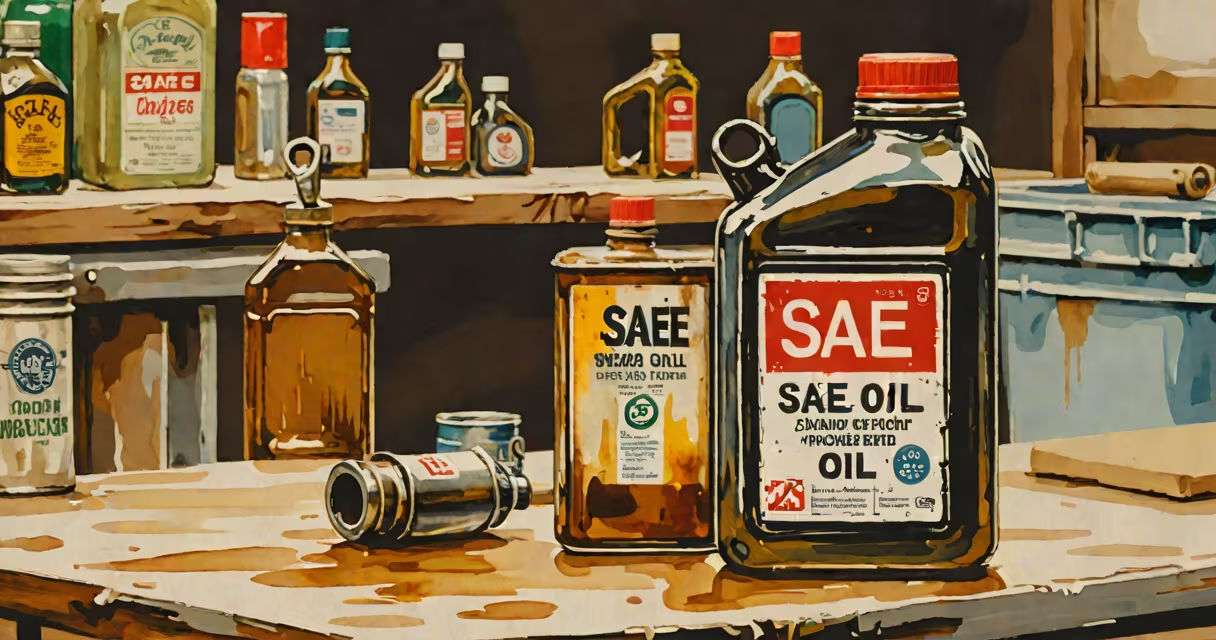
SAE on oil stands for the Society of Automotive Engineers, which sets standardized viscosity ratings for motor oils. These ratings define how thick or thin an oil flows at different temperatures, ensuring proper engine lubrication under real-world conditions.
Viscosity determines how well oil coats moving parts inside an engine. Too thick, and it won't flow quickly enough during cold starts. Too thin, and it can't maintain a protective film under high heat and pressure. The SAE system measures both low-temperature startup performance and high-temperature stability using a numerical scale.
For example, SAE 5W-30 means the oil behaves like a 5-weight fluid at cold temperatures (W = winter) and a 30-weight fluid at operating temperature. This dual rating ensures the oil remains effective across many climates and driving conditions.
The SAE viscosity standard was developed in the 1930s to solve inconsistent oil performance across regions with varying climates. Before standardization, drivers in cold areas often used oils that were too thick to start engines, while those in hot regions faced oil breakdown due to excessive thinning.
Each SAE number corresponds to a specific viscosity range measured in centistokes (cSt) at 100°C. For instance, SAE 30 oil must have a minimum viscosity of 9.3 cSt and maximum of 12.5 cSt at that temperature. Lower numbers indicate thinner oils; higher numbers indicate thicker ones.
Multi-grade oils like 5W-30 contain additives called viscosity index improvers (VIIs). These polymers expand when heated, helping the oil resist thinning. Without VIIs, multi-grade oils would behave like single-grade oils at high temperatures.
SAE classifies oils based on their performance across temperature ranges. The most common categories are single-grade (e.g., SAE 30) and multi-grade (e.g., SAE 5W-30).
| Rating Type | Temperature Range | Use Case | Example |
|---|---|---|---|
| Single-grade | High-temp only | Classic cars, vintage engines | SAE 30 |
| Multi-grade | Cold start to full operating temp | Modern vehicles, year-round use | 5W-30, 10W-40 |
Multi-grade oils are now standard in most passenger vehicles. They offer better cold-start protection than single-grade oils and maintain adequate thickness during extended highway driving.
Some high-performance engines require specialized oils such as SAE 0W-20 or 0W-16. These ultra-thin oils improve fuel economy and reduce internal friction, but they're only approved for engines designed to handle them.
Using the wrong SAE grade can lead to increased engine wear, reduced fuel efficiency, or even mechanical failure. For example, using SAE 10W-40 in a vehicle that requires 5W-20 may cause sluggish oil flow during cold weather startups, leading to metal-on-metal contact in the first few seconds of operation.
Engine manufacturers specify SAE ratings based on extensive testing. The American Petroleum Institute (API) and the International Organization for Standardization (ISO) validate these recommendations through laboratory simulations and field trials. API certification ensures oils meet both SAE viscosity standards and performance requirements like wear protection and deposit control.
A real-world test conducted by the National Institute of Standards and Technology (NIST) showed that using SAE 5W-30 in a 2018 Honda Accord improved cold-start fuel economy by 4.2% compared to SAE 10W-30, even though both met the required viscosity thresholds.
Many people assume that higher SAE numbers mean better oil quality. That's incorrect. A higher number indicates greater thickness, not superior performance. An SAE 50 oil is much thicker than SAE 30, but it's unsuitable for most modern engines due to poor flow characteristics at low temperatures.
Another myth is that synthetic oils don't need SAE ratings. All oils-mineral, synthetic blend, or full synthetic-must comply with SAE standards. Synthetic oils simply achieve the same viscosity targets with enhanced thermal stability and longer service life.
One key distinction often missed: SAE ratings do not measure cleanliness, oxidation resistance, or additive content. Those factors are evaluated separately by API and ACEA (European Automobile Manufacturers' Association). For example, an oil labeled SAE 5W-30 may still lack sufficient detergents unless it also carries an API SN or SP designation.
Suppose you own a 2020 Toyota Camry driven in Minnesota winters and Texas summers. The owner's manual specifies 0W-20. Using SAE 5W-30 instead would result in slightly slower oil flow during sub-zero starts, increasing wear during the first 30 seconds of operation. Over time, this adds up to measurable engine degradation.
Conversely, switching to SAE 0W-16 in a car that requires 5W-30 may cause inadequate film strength under high load, especially during towing or sustained highway driving. The oil thins too much at high temperatures, risking metal-to-metal contact.
Always follow the manufacturer's recommended SAE grade. If uncertain, consult your vehicle's service manual or check the oil fill cap for labeling. Some newer models display the correct SAE specification directly on the dipstick tube.
I once replaced the oil in my 2015 Subaru Outback with SAE 10W-40 after misreading the manual. Within 1,200 miles, the engine's oil pressure warning light came on intermittently. A diagnostic scan revealed low pressure at idle. Switching back to the specified 0W-20 restored normal readings. The lesson: SAE matters.
SAE ratings are often confused with API service classifications (like API SP or API SN). While SAE defines viscosity, API defines performance levels such as wear protection, sludge control, and emissions compatibility. A full synthetic oil can be SAE 5W-30 and API SP-but the SAE part says nothing about its cleaning ability or durability.
Also, SAE is not the same as viscosity grades used in industrial machinery. Industrial oils use ISO VG ratings (e.g., ISO 32), which are based on kinematic viscosity at 40°C. These aren't interchangeable with automotive SAE ratings.
For context, upstream in oil and gas refers to exploration and production activities. That term is unrelated to SAE on oil. But understanding upstream processes helps explain why certain crude oils yield base stocks suitable for specific SAE grades.
When choosing oil, always verify the SAE rating listed in your vehicle's manual. The SAE number is not optional-it's a critical component of engine longevity and performance. What's SAE mean on oil? It's the engineering standard that keeps your engine running smoothly across seasons and climates.