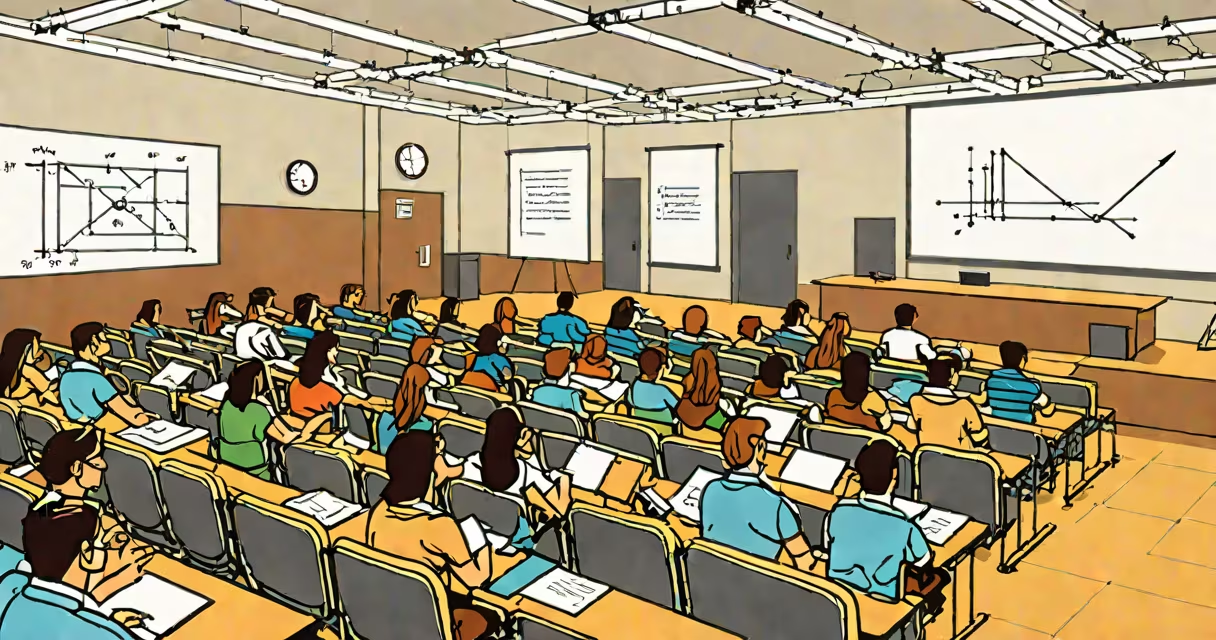
An academic apars classroom is a structured educational environment designed to teach students the formal language, rhetorical conventions, and disciplinary discourse patterns used in higher education. These classrooms focus on helping learners understand and produce academic writing and speech through explicit instruction in grammar, vocabulary, and argumentation.
Academic apars classroom instruction centers on the differences between everyday spoken language and the precise, complex forms used in scholarly contexts. Students learn how to construct arguments using evidence, cite sources correctly, and adopt a formal tone appropriate for research papers, presentations, and peer-reviewed journals. The term "apars" derives from the Arabic word "apar," meaning "to articulate," and reflects the emphasis on precision in expression.
These classrooms are commonly found in English language programs at universities, especially for non-native speakers preparing for graduate study. They differ from standard language classes by focusing exclusively on academic discourse rather than general communication skills. For example, while a regular ESL class might teach how to order food or describe weather, an academic apars classroom teaches how to write a literature review or critique a research methodology.
Instructors in academic apars classrooms use scaffolded exercises to build student proficiency. Lessons begin with identifying key features of academic texts-such as hedging ("it may be argued"), nominalization ("the implementation of policy"), and passive voice ("data were collected"). Students then practice transforming informal statements into formal equivalents.
A typical session includes analyzing model essays from journals, breaking down sentence structure, and rewriting passages using discipline-specific terminology. For instance, a biology student might revise a paragraph describing an experiment from "we did the test and it worked" to "the experimental group demonstrated a statistically significant increase in enzyme activity (p < 0.05)."
Assessments emphasize accuracy in form and function. Students submit drafts with instructor feedback focused on clarity, coherence, and adherence to genre expectations. A 2021 study by the National Center for Academic Language found that students who completed at least eight weeks in such programs showed a 37% improvement in writing scores on standardized academic assessments compared to peers in general language courses.
Academic apars classrooms vary by institution and learner level. The following table outlines common formats:
| Type | Focus Area | Typical Duration | Target Learners |
|---|---|---|---|
| Foundational | Basic academic vocabulary, sentence structure | 6-8 weeks | Undergraduates, international students |
| Advanced | Rhetorical strategies, citation styles, discipline-specific genres | 12-16 weeks | Graduate students, researchers |
| Hybrid | Online modules with live tutoring sessions | Flexible | Working professionals, remote learners |
Each format integrates authentic materials-research articles, conference proceedings, grant proposals-to expose students to real-world academic language. Instructors often use corpus linguistics tools like the Corpus of Contemporary American English (COCA) to identify high-frequency academic phrases and analyze usage patterns.
One non-obvious distinction: academic apars classroom is not synonymous with "writing center" support. While both aim to improve academic output, the former provides systematic, curriculum-based instruction, whereas the latter offers individualized feedback on drafts. A student might attend a writing center for editing help but still need an academic apars classroom to master the underlying structures of academic argumentation.
Universities in the United States, Canada, the UK, and Australia widely implement academic apars classroom programs. Institutions such as Stanford University's English Language Program and the University of Melbourne's Academic Language and Communication Centre offer dedicated courses. These programs are especially critical for non-native English speakers aiming to publish in peer-reviewed journals or present at international conferences.
For example, a PhD candidate from Nigeria studying environmental policy at the University of Michigan participated in a 12-week academic apars classroom program. Before the course, their draft thesis chapters contained frequent colloquialisms and informal phrasing. After completing the program, they revised their work using passive constructions, hedging language, and proper citation formatting. Their dissertation was accepted on the first submission, a rare outcome for international students.
Another key use case is in interdisciplinary research. When scholars move between fields-say, from psychology to public health-they must adapt their language to new disciplinary norms. An academic apars classroom helps them recognize shifts in terminology, argument style, and expected evidence standards across domains.
Many assume academic apars classroom is only for non-native speakers. This is incorrect. Native English speakers often lack exposure to formal academic discourse during K-12 education. A 2020 report from the National Council of Teachers of English noted that only 12% of U.S. high schools offer courses in academic writing conventions. As a result, even native speakers benefit from targeted instruction in academic apars classroom settings.
Another misconception is that academic apars classroom focuses solely on grammar. In reality, it emphasizes discourse-level skills such as logical progression, audience awareness, and genre awareness. A student may write grammatically correct sentences but fail to establish a coherent argument or properly position their work within existing scholarship.
I once observed a session at a community college where students were asked to rewrite a paragraph from a sociology paper using simpler language. The goal wasn't to dumb down content but to identify how complex ideas are constructed through layered syntax and precise terminology. One student remarked, "I never realized how much work goes into making something sound 'official.'" That moment revealed the core purpose: academic apars classroom teaches not just what to say, but how to say it with authority.
Academic apars classroom is not a substitute for subject-matter expertise. It complements disciplinary training by equipping students with the linguistic tools to communicate their knowledge effectively. Without it, even well-researched work risks being dismissed due to poor expression or failure to meet publication standards.
Understanding academic apars classroom enables students to engage confidently in scholarly conversation. Whether preparing for a thesis defense, submitting to a journal, or participating in a conference panel, mastery of academic language is essential. This structured approach helps ideas are communicated, precisely, and with the credibility required in academic environments.