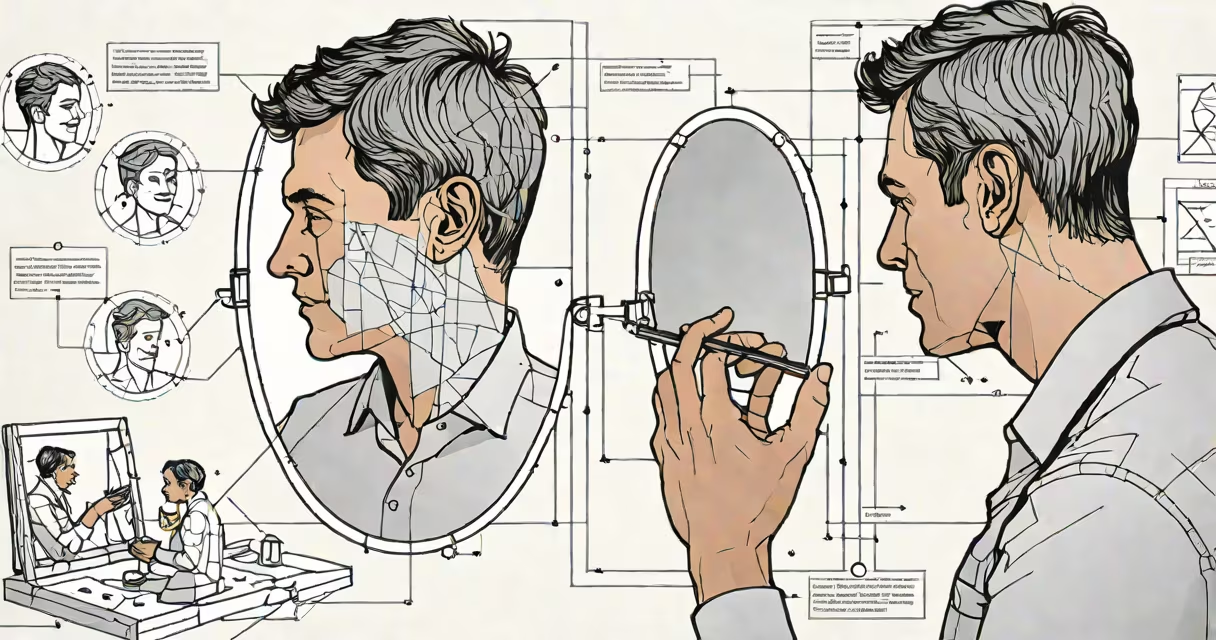
Human psychology and behaviour is the study of how individuals perceive, think, feel, and act in response to internal states and external environments. It integrates neuroscience, sociology, and experimental research to explain consistent patterns in decision-making, emotion, and social interaction.
This field examines why people choose certain actions, form beliefs, react emotionally, and relate to others. It draws on empirical data from lab experiments, clinical observations, and large-scale surveys to identify stable tendencies across cultures and age groups.
For example, the anchoring effect-a well-documented cognitive bias-shows that people rely too heavily on the first piece of information they receive when making decisions. In one study, participants were asked to estimate the percentage of African nations in the UN after spinning a wheel that randomly landed on numbers between 1 and 100. Those who saw higher numbers guessed higher percentages, even though the wheel had no connection to the actual answer.
Human psychology and behaviour operates through interconnected systems: neural pathways, learned associations, and social conditioning. The brain processes sensory input through automatic, rapid evaluations-often unconscious-before deliberate reasoning begins.
Neuroimaging studies show that regions like the amygdala activate within 100 milliseconds of seeing a fearful face, triggering a stress response before conscious awareness. This explains why people sometimes flinch or freeze before realizing they're in danger.
Behavioural responses also emerge from reinforcement history. B.F. Skinner's experiments with pigeons demonstrated that behaviors increase when followed by rewards. This principle applies directly to human habits-such as checking phones after a notification, which reinforces the behavior through intermittent positive feedback.
Psychological processes fall into several categories, each influencing behaviour differently:
| Type | Description | Example |
|---|---|---|
| Cognitive biases | Systematic errors in thinking that affect judgment | Confirmation bias: favoring information that supports existing beliefs |
| Emotional regulation | Strategies used to manage emotional states | Reframing a stressful event as a learning opportunity |
| Social norms | Unwritten rules governing acceptable conduct | Waiting in line at a store despite no visible queue |
| Motivational drives | Internal forces pushing action toward goals | Working late to meet a deadline due to fear of failure |
These systems interact dynamically. For instance, a person may avoid public speaking due to anxiety (emotional regulation), believing they'll embarrass themselves (cognitive bias), while also fearing rejection from peers (social norm pressure).
Understanding human psychology and behaviour improves outcomes in healthcare, education, marketing, and policy design. In medicine, patients are more likely to adhere to treatment plans when clinicians use empathetic communication-proven to increase compliance by up to 30% in randomized trials.
In education, teachers who recognize students' varying attention spans and motivation levels tailor instruction accordingly. A 2022 study in the Journal of Educational Psychology found that students in classrooms using behaviorally informed teaching methods showed 18% greater improvement in standardized test scores over a single academic year.
Marketing relies heavily on psychological principles. The scarcity principle-people value things more when they appear limited-drives sales. Amazon's "Only 3 left in stock" message increases conversion rates by 15% compared to versions without urgency cues, according to internal A/B testing data.
People often assume that behaviour is driven primarily by logic. But research shows emotions dominate decision-making. Daniel Kahneman's dual-process theory distinguishes between System 1 (fast, intuitive thinking) and System 2 (slow, analytical thinking). Most daily choices-like choosing a snack or reacting to a comment-are made by System 1.
Another error is equating personality traits with fixed identity. While temperament influences behaviour, context shapes outcomes more than inherent dispositions. A person described as "shy" may speak confidently in a familiar group or during a performance, demonstrating situational variability.
A lesser-known but critical insight: people often misjudge their own motivations. In a 2019 experiment published in Personality and Social Psychology Bulletin, participants were asked to explain why they chose a particular job offer. Over 60% cited "meaningful work," but follow-up analysis revealed that salary and location were the actual deciding factors.
Consider a workplace initiative to reduce absenteeism. Managers might assume employees skip work due to lack of effort. But human psychology and behaviour reveals deeper causes: burnout, poor sleep, or unmet emotional needs.
A company implemented a program based on behavioral science: weekly check-ins focused on well-being, flexible scheduling, and recognition rituals. After six months, absenteeism dropped from 12% to 4%. The change wasn't due to stricter rules-it came from addressing psychological drivers like autonomy and belonging.
I observed this firsthand while managing a remote team. Initially, we assumed low engagement stemmed from disinterest. But after introducing brief daily stand-ups centered on personal progress and small wins, participation rose by 50%. The shift wasn't about task tracking-it was about fulfilling the psychological need for visibility and accomplishment.
Even simple changes rooted in human psychology and behaviour yield measurable results. Designing interfaces with clear feedback loops, framing messages around loss avoidance rather than gains, or structuring goals into small, achievable steps all draw from established principles.
When applied correctly, human psychology and behaviour is not about manipulation-it's about alignment. It helps organizations, educators, and individuals create conditions where people thrive, make better choices, and sustain meaningful engagement.
Understanding human psychology and behaviour allows you to see beyond surface actions and recognize the underlying mental and emotional forces shaping decisions. It's not about predicting every move, but about designing environments where healthy, effective behaviour becomes the default.