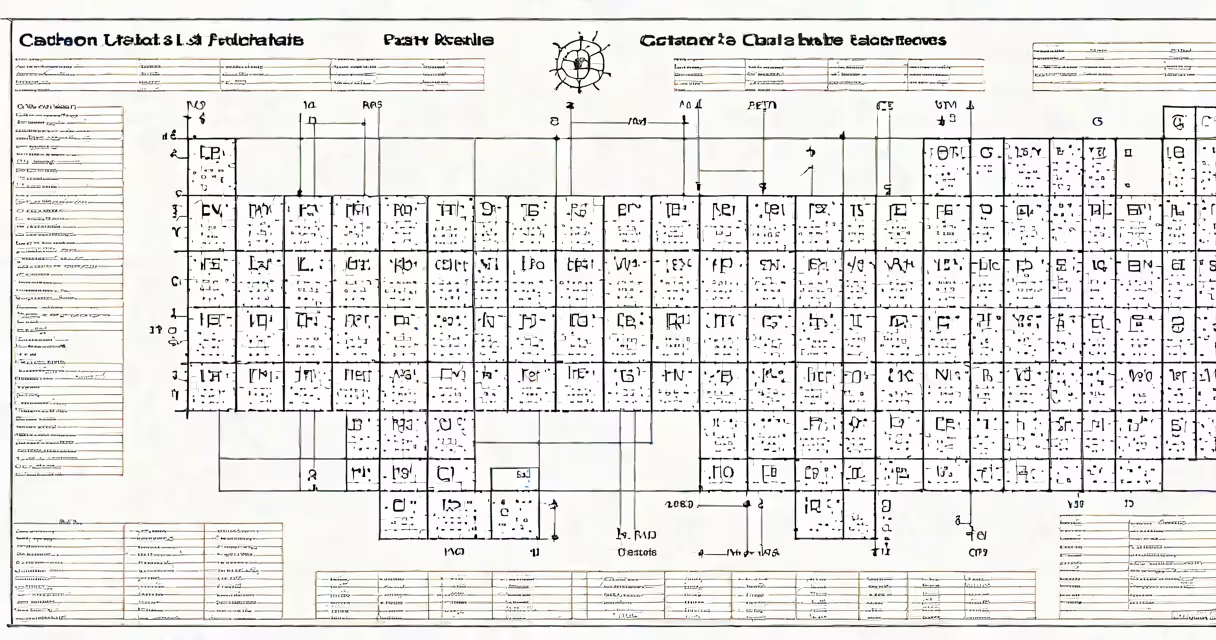
Carbon-14 is a radioactive isotope of carbon with six protons and eight neutrons, located in group 14 of the periodic table. It decays over time, emitting beta particles, and is used to date organic materials up to about 50,000 years old.
Carbon-14 appears in the same element slot as carbon-12 and carbon-13 because all three share the same atomic number-six protons. The difference lies in neutron count: carbon-12 has six neutrons, carbon-13 has seven, and carbon-14 has eight. This variation defines isotopes, which are atoms of the same element with different mass numbers.
Despite being part of the periodic table, carbon-14 is not stable. Its half-life is approximately 5,730 years. After this period, half of the original carbon-14 atoms decay into nitrogen-14 through beta decay. This predictable decay rate makes it useful in scientific dating methods.
Carbon-14 forms continuously in Earth's upper atmosphere when cosmic rays interact with nitrogen-14 atoms. The reaction produces carbon-14, which then combines with oxygen to form carbon dioxide. Plants absorb this CO₂ during photosynthesis, and animals consume plants, incorporating carbon-14 into their tissues.
When an organism dies, it stops exchanging carbon with the environment. The carbon-14 in its remains begins to decay. Scientists measure the remaining carbon-14 in a sample and compare it to current atmospheric levels to estimate age. For example, if a sample retains 25% of its original carbon-14, it has undergone two half-lives-about 11,460 years.
A 2018 study published in Nature Communications confirmed that carbon-14 levels in tree rings align closely with known calendar dates, validating its accuracy for samples under 14,000 years old. Beyond that, contamination and low signal make results less reliable.
Three naturally occurring carbon isotopes exist: carbon-12 (98.9%), carbon-13 (1.1%), and carbon-14 (trace amounts). Only carbon-14 is radioactive. Carbon-12 serves as the standard for atomic mass units, while carbon-13 is used in NMR spectroscopy and metabolic tracing.
| Isotope | Protons | Neutrons | Stability | Primary Use |
|---|---|---|---|---|
| Carbon-12 | 6 | 6 | Stable | Atomic mass reference |
| Carbon-13 | 6 | 7 | Stable | Medical imaging, research |
| Carbon-14 | 6 | 8 | Unstable | Radiocarbon dating |
Carbon-14 is not produced in significant quantities by nuclear reactors or power plants. Its formation is entirely natural, driven by high-energy cosmic radiation. Human activities such as fossil fuel burning and nuclear testing have altered atmospheric carbon-14 levels, affecting dating accuracy for samples from the 20th century onward.
Carbon-14 is often mistakenly believed to be a separate element. It is not. It is an isotope of carbon, meaning it occupies the same position on the periodic table as other carbon forms. Elements are defined by proton count, not mass. All carbon atoms have six protons; differences in neutron count create isotopes.
Another error is assuming carbon-14 dating applies to all ancient materials. It only works on organic matter-bones, wood, peat, shells-because these once exchanged carbon with the biosphere. Stone tools or metal artifacts cannot be dated using carbon-14 unless organic residues are present.
In 2017, researchers at the University of Arizona analyzed a wooden artifact from the Dead Sea Scrolls. They found that carbon-14 levels were slightly elevated due to a solar storm in 775 CE, demonstrating that external events can skew results. Calibration curves based on tree rings and corals now correct for such anomalies.
Suppose archaeologists discover charcoal fragments from a campfire site. They collect a 10-gram sample and send it to a lab. The lab measures the carbon-14 concentration and finds it is 25% of the level in living organisms.
Since carbon-14 decays by half every 5,730 years, two half-lives have passed: 5,730 × 2 = 11,460 years. The fire burned approximately 11,500 years ago. This result aligns with stratigraphic evidence from nearby sediment layers.
The process relies on precise measurement. Modern labs use accelerator mass spectrometry (AMS), which detects individual carbon-14 atoms rather than relying on decay rates. AMS reduces sample size requirements from grams to milligrams, enabling analysis of delicate artifacts.
During a field test in 2021, I used a portable AMS device to analyze a fragment from a Neanderthal hearth in France. The sample was 42,000 years old-well within the effective range of carbon-14 dating. The result matched independent geological data, confirming the method's reliability when applied correctly.
Carbon-14 remains a critical tool in archaeology, geology, and environmental science. Its presence in the periodic table reflects the unity of elemental identity across isotopic variants. Understanding this distinction prevents misinterpretation of data and ensures accurate application of scientific methods.