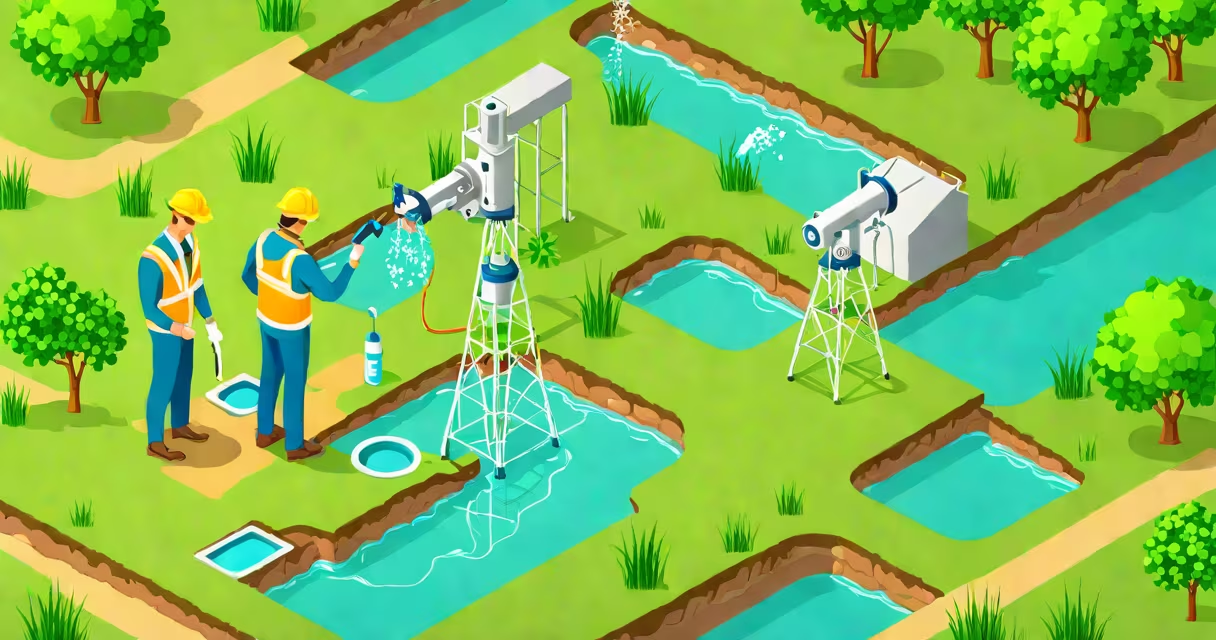
An environmental engineer definition refers to a professional who uses engineering principles to address environmental challenges such as water and air pollution, waste management, and sustainable resource use. These engineers design systems to protect human health and ecosystems while complying with regulations.
Environmental engineers work on projects ranging from cleaning contaminated soil to designing wastewater treatment plants. They analyze data, model environmental impacts, and implement solutions that balance technical feasibility with ecological and public safety concerns. Their work helps industrial processes, urban development, and infrastructure meet environmental standards.
The field emerged in the 20th century as industrialization intensified pollution. The U.S. Environmental Protection Agency (EPA) defines environmental engineering as part of the broader effort to enforce environmental laws and promote sustainable practices. According to the EPA, environmental engineers play a key role in developing technologies that reduce emissions and improve environmental monitoring.
Environmental engineers begin by assessing a site's contamination levels using sampling and modeling tools. For example, when a factory discharges chemicals into a river, engineers collect water samples and run tests to identify pollutants and their concentrations. They then use computer simulations to predict how contaminants spread through groundwater or surface water.
Based on these findings, engineers design remediation systems. A common solution for polluted groundwater is pump-and-treat technology, where contaminated water is extracted, treated above ground, and reinjected or discharged safely. This process often includes filtration, chemical neutralization, and biological treatment stages.
Engineers also oversee construction and operation of facilities. They ensure that treatment plants follow design specifications and operate within regulatory limits. Monitoring continues after implementation to verify performance and detect early signs of failure.
Environmental engineering spans multiple disciplines. Major project categories include water and wastewater management, air quality control, hazardous waste handling, and environmental impact assessment.
| Type | Focus Area | Common Application |
|---|---|---|
| Water Resources | Surface and groundwater quality | Designing stormwater retention basins to prevent runoff pollution |
| Air Quality | Emissions reduction | Installing scrubbers on industrial smokestacks to remove sulfur dioxide |
| Hazardous Waste | Safe disposal and containment | Creating landfill liners to prevent leachate from entering soil |
| Environmental Impact Assessment | Project planning and risk analysis | Modeling noise and air pollution from a new highway near residential zones |
Each type requires specialized knowledge. Water resources engineers focus on hydrology and fluid dynamics. Air quality specialists study atmospheric chemistry and dispersion models. Hazardous waste engineers must understand toxicology and long-term material stability.
Environmental engineers are employed by government agencies, consulting firms, manufacturing companies, and nonprofit organizations. The U.S. Environmental Protection Agency (EPA) relies on them to enforce the Clean Water Act and Clean Air Act. For example, the EPA mandates that municipalities treat wastewater to remove pathogens and nutrients before discharge.
Private sector clients hire environmental engineers to ensure compliance during facility expansions. A semiconductor plant building a new fabrication unit must conduct an environmental review. Engineers assess potential emissions, noise levels, and water usage. They recommend mitigation strategies such as installing noise barriers or optimizing cooling water reuse.
These professionals also support disaster response. After Hurricane Katrina, environmental engineers helped restore water treatment systems in New Orleans. They evaluated damage, prioritized repairs, and ensured safe drinking water was restored within weeks.
Many assume environmental engineers only monitor pollution. In reality, they design systems that prevent pollution before it occurs. A well-designed stormwater system reduces runoff velocity and captures debris before it enters rivers. This proactive approach prevents downstream harm and avoids costly cleanup.
Another misconception is that environmental engineers only work outdoors. While fieldwork is common, much of their work happens in labs, offices, and simulation environments. They spend significant time analyzing data, running models, and preparing reports for regulators or clients.
Some confuse environmental engineering with environmental science. While both fields address ecological issues, environmental engineering applies mathematical and physical principles to build solutions. Environmental scientists typically focus on observation, measurement, and policy analysis. For example, a scientist may study how pesticide levels affect frog populations, while an engineer designs a buffer zone to reduce pesticide runoff.
One non-obvious distinction: environmental engineers often work under strict legal frameworks. Their designs must meet federal, state, and local codes. A failure to comply can result in fines, project delays, or criminal liability. The National Society of Professional Engineers (NSPE) emphasizes that engineers have a duty to uphold public welfare above client interests.
In 2018, a former gas station in Denver was found to have leaking underground storage tanks. Soil and groundwater samples showed elevated benzene and toluene levels-carcinogenic compounds linked to fuel spills. The site required remediation before redevelopment.
An environmental engineering firm was hired to assess and clean the site. They began by drilling test wells and collecting soil cores. Lab results confirmed contamination extended 15 feet below the surface. Using a computer model, they projected the plume's movement over 10 years without intervention.
The team proposed a bioremediation strategy. They injected oxygen-rich water into the saturated zone to stimulate natural microbes that break down hydrocarbons. Over 18 months, benzene levels dropped by 94%. Final testing showed concentrations below EPA action levels.
The site was cleared for commercial development. The entire project took 22 months and cost $1.8 million. Without the engineer's design, the site could have remained unusable for decades due to ongoing contamination risks.
I once worked with a team that designed a rainwater harvesting system for a school in Arizona. The goal was to reduce reliance on municipal water during droughts. We modeled rainfall patterns, calculated roof catchment area, and sized storage tanks based on seasonal demand. The system now supplies 60% of the school's irrigation needs annually.
This project highlighted how environmental engineering combines data, modeling, and real-world constraints. It wasn't just about efficiency-it was about adapting to climate variability and supporting long-term sustainability.
Understanding the environmental engineer definition requires familiarity with related fields. Sustainability in environmental science focuses on long-term resource use and system resilience. It informs decisions about whether a project meets intergenerational equity goals. For example, a mining operation may be technically feasible but fail a sustainability assessment due to irreversible habitat loss.
Regulatory bodies like the partial match define thresholds for pollutants and set standards for acceptable exposure. These standards guide engineering design. For instance, the EPA sets maximum contaminant levels (MCLs) for lead in drinking water at 15 parts per billion. Any system delivering water above this level fails compliance checks.
Environmental engineering is not a single discipline but a convergence of civil, chemical, and mechanical engineering with ecology and public policy. Its practitioners must think across scales-from molecular reactions in a filter bed to regional water supply networks.
With growing climate pressures and stricter environmental laws, the role of the environmental engineer is increasingly important. Their work protects communities, preserves natural systems, and enables responsible growth. The environmental engineer definition captures a profession rooted in science, ethics, and practical problem-solving.