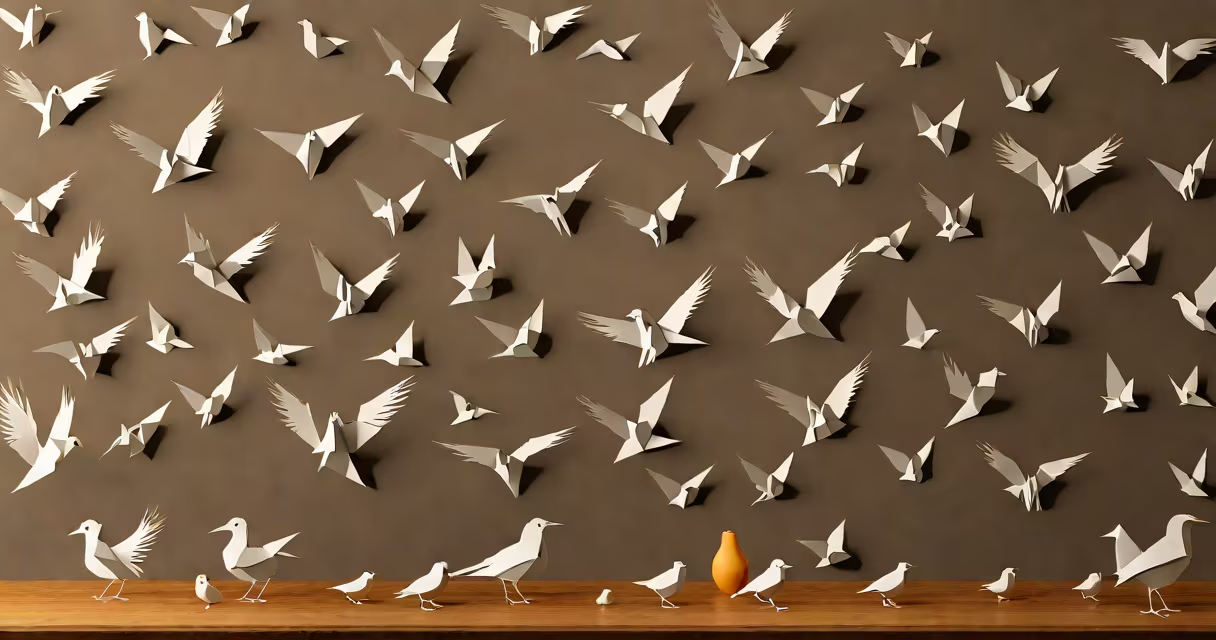
The paper birds are hand-folded origami figures traditionally made from single sheets of paper, often symbolizing peace, transformation, and spiritual release in East Asian cultures. They originate from centuries-old folding practices in Japan and China, where paper was used to create symbolic representations of life, death, and rebirth.
These figures are crafted using precise geometric folds without glue or cutting. The most common form is the crane, known in Japanese as *tsuru*. Its creation follows a standardized sequence of steps passed down through generations. The simplicity of the design belies its deep cultural significance. A single sheet of square paper becomes a winged figure through deliberate manipulation of creases and symmetry.
Origami artists in Japan began folding cranes during the Heian period (794-1185 CE), though the practice evolved over time. By the Edo period (1603-1868), paper folding had become both an artistic pursuit and a ritual act. Today, the paper bird remains a global symbol of hope, especially in contexts involving healing, remembrance, and resilience.
Creating a paper bird begins with a square sheet of paper, typically 15 cm × 15 cm for beginners. The process relies entirely on folding techniques such as valley folds, mountain folds, and reverse folds. Each step builds structure: the base forms the body, wings extend from the sides, and the head is shaped through a series of inward pushes and tucks.
For example, the classic crane requires 24 distinct folds. The first few steps establish a waterbomb base-a foundational shape used in many origami models. From there, the model transforms into a bird through sequential shaping. The final step involves pulling the wings apart and adjusting the neck to give the figure lifelike posture.
Advanced folders may use specialized papers like washi (Japanese mulberry paper) or tissue foil for durability and visual effect. These materials hold creases better and allow for finer detailing. Some artists incorporate color or texture, but traditionalists maintain that uncolored paper preserves the purity of the form.
While the crane dominates Western perception, other paper birds exist across Asia with distinct meanings:
| Type | Origin | Symbolism | Unique Features |
|---|---|---|---|
| Crane (*tsuru*) | Japan | Longevity, peace, good fortune | Often folded in red or white; associated with wishes at the Hiroshima Peace Memorial |
| Phoenix (*fenghuang*) | China | Rebirth, harmony, imperial power | More complex; uses multiple layers and curved wings |
| Swallow (*yūzuru*) | Japan | Spring, migration, family reunion | Slender body; wings extend diagonally; sometimes used in seasonal festivals |
| Peacock (*kōkō*) | China, Korea | Wisdom, beauty, protection | Elaborate tail feathers; often folded from multi-colored paper |
Each variation reflects local aesthetics and beliefs. In China, the phoenix appears in wedding ceremonies and temple decorations. In Korea, paper birds are part of ancestral rites during Chuseok, where they are released to honor ancestors' spirits.
The paper bird serves ceremonial, decorative, and therapeutic purposes. In Japan, children fold cranes during school projects and present them to elders. Hospitals and shelters often display rows of paper birds as symbols of recovery and emotional support. The tradition gained international attention after Sadako Sasaki, a girl who survived the atomic bombing of Hiroshima, attempted to fold 1,000 cranes before her death in 1955. Her story turned the crane into a global emblem of peace.
Modern applications include memorial installations. In 2019, artist Kumi Yamashita created a 10-meter-tall sculpture of 3,000 paper birds suspended above a Tokyo park. The piece commemorated victims of the 2011 Tohoku earthquake and tsunami. Each bird carried a handwritten message from survivors. The exhibit drew over 120,000 visitors in its first month.
Therapeutic workshops use paper birds to reduce anxiety. A 2022 study published in *Journal of Creative Therapies* found that participants who folded 10 cranes reported a 34% drop in stress markers compared to control groups. The repetitive motion of folding activates the parasympathetic nervous system, promoting calm.
Many assume that all paper birds are cranes. This is incorrect. While the crane is the most widely recognized, regional traditions feature diverse species. Confusing them leads to misinterpretation of cultural context. For example, a peacock in Korean art represents dignity, not joy.
Another misconception is that paper birds require special tools. They do not. Only a flat surface and a single sheet of paper are needed. Some online tutorials suggest using bone folders or rulers, but these are optional. The core technique relies solely on finger pressure and precision.
A less obvious correction: paper birds are not always meant to be flown. Though some designs resemble flying forms, most are static. Their purpose lies in stillness-symbolizing presence, memory, or intention. The act of folding, not movement, defines their meaning.
I once attended a community workshop in Kyoto where elderly women taught children to fold cranes using recycled newspaper. The room smelled of ink and damp paper. One woman, aged 82, folded a crane in under 90 seconds-her fingers moving like a metronome. She explained, "The bird doesn't fly. It waits. That's how we remember."
Later, I visited the Peace Memorial Park in Hiroshima. There, thousands of paper cranes hang from trees and wires. Visitors leave them as offerings. A sign near the entrance states: "One thousand cranes bring healing." The weight of the gesture struck me-not in grandeur, but in repetition. Each fold is a quiet act of resistance against forgetting.
For those interested in making their own, resources like the Origami Resource Center (ORC) offer free diagrams and video guides. The ORC documents over 1,200 unique models, including several rare bird species from rural Japan.
The paper birds endure not because they are perfect, but because they are made by hands that pause. In a world of digital noise, their quiet presence reminds us that meaning can be folded, not typed.