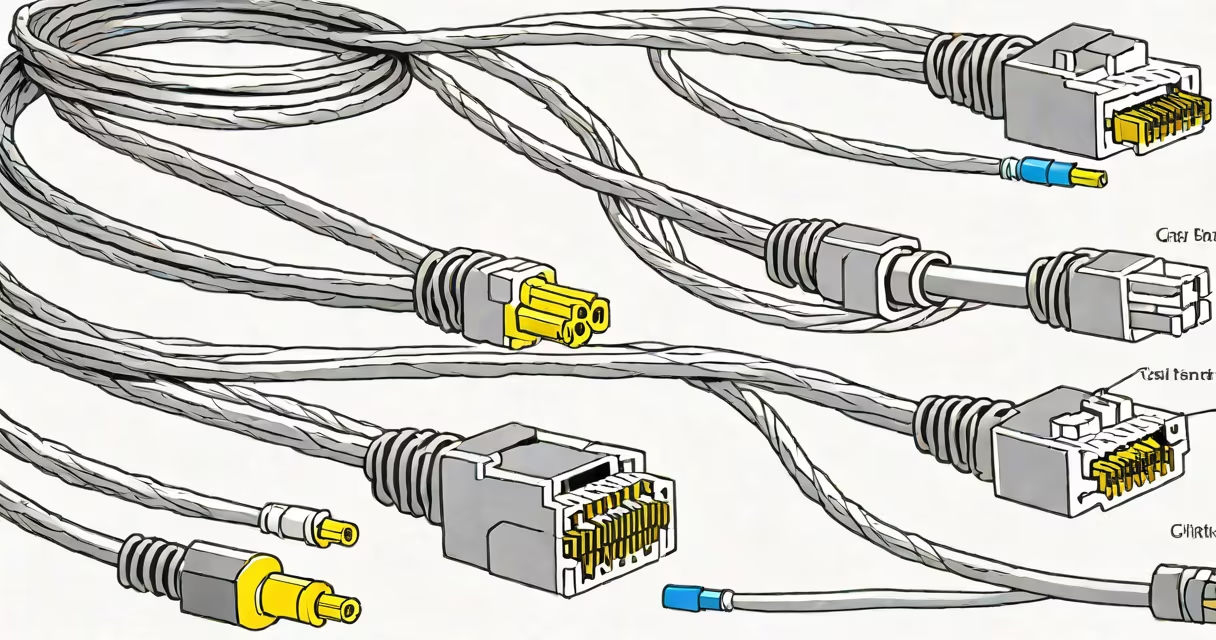
Cat 6 and Cat 7 Ethernet cables are twisted-pair cables designed for high-speed data transmission, with Cat 7 offering superior shielding and bandwidth compared to Cat 6. Cat 6 supports up to 10 Gbps over short distances, while Cat 7 maintains 10 Gbps up to 50 meters and includes individual shielding for each wire pair.
Both cables follow international cabling standards set by the Telecommunications Industry Association (TIA) and the International Organization for Standardization (ISO). Cat 6 was introduced in 2002 as an upgrade to Cat 5e, improving crosstalk reduction and signal integrity. Cat 7, standardized in 2002 by ISO/IEC 11801, adds full shielding and higher frequency support, making it suitable for environments with strong electromagnetic interference.
The core difference lies in shielding. Cat 6 uses a single foil shield and braided mesh around the entire cable bundle. Cat 7 uses a double-layer shield: a foil layer around each twisted pair and a full braided shield around the entire cable. This dual shielding reduces crosstalk and external noise, allowing Cat 7 to operate reliably at frequencies up to 600 MHz-twice the maximum of Cat 6's 250 MHz.
Both Cat 6 and Cat 7 cables use four pairs of 23-gauge copper wires twisted together. The twisting pattern minimizes electromagnetic interference between pairs. Cat 6 specifies tighter twist rates and improved insulation to reduce crosstalk, especially near the cable's ends where connections are made.
Cat 7 goes further. Each of the four wire pairs is individually shielded with aluminum foil, then bundled together under a second braided shield. This construction prevents signal leakage and blocks external signals from disrupting data flow. The result is a cable rated for 10 Gbps performance up to 50 meters, compared to Cat 6's 10 Gbps limit of 37 meters.
Despite their technical advantages, Cat 7 cables are bulkier and less flexible than Cat 6. Their rigid structure makes them harder to route through tight spaces like wall cavities or under-floor conduits. Cat 6 remains the standard choice for most residential and small business installations due to ease of installation and lower cost.
Home networks using gigabit internet (1 Gbps) benefit from Cat 6. Most routers, switches, and devices support Gigabit Ethernet out of the box. A Cat 6 cable ensures stable performance across 100-meter runs without signal degradation.
For users requiring 10 Gbps speeds-such as gamers, video editors, or those running local servers-Cat 6 is sufficient for shorter runs. However, if the network spans more than 37 meters at 10 Gbps, Cat 7 becomes necessary. In industrial settings with heavy machinery or dense wiring, Cat 7's shielding prevents data corruption caused by electromagnetic noise.
A real-world example: a home office with a 50-foot Cat 6 cable connects a workstation to a router. The connection runs at 1 Gbps, stable and consistent. When replacing it with a 50-foot Cat 7 cable, the speed remains at 1 Gbps unless the network hardware supports 10 Gbps. The Cat 7 cable doesn't increase speed-it only ensures stability under interference.
Many assume Cat 7 is always better. That's not true. Cat 7 requires compatible connectors-specifically, the 8P8C modular plug with full shielding and grounding. Not all RJ45 jacks support this. Using a Cat 7 cable with a standard unshielded jack negates the shielding benefits.
Another misconception: Cat 7 supports 10 Gbps over 100 meters. It does not. The standard limits 10 Gbps to 50 meters. Beyond that, speeds drop to 1 Gbps. Cat 6 can reach 10 Gbps up to 37 meters. Both cables are limited by the physical layer specifications of Ethernet protocols.
| Feature | Cat 6 | Cat 7 |
|---|---|---|
| Max Frequency | 250 MHz | 600 MHz |
| Shielding | Foil + braided mesh | Individual foil shields + braided shield |
| Max Speed | 10 Gbps (up to 37 m) | 10 Gbps (up to 50 m) |
| Max Run Length | 100 m (for 1 Gbps) | 100 m (for 1 Gbps) |
| Cost per Meter | $0.50-$0.70 | $1.20-$1.80 |
One non-obvious fact: Cat 7 cables often come with a molded strain relief boot and metal shielded connectors. These features prevent damage during frequent plugging and unplugging. Cat 6 cables rarely include such enhancements, making Cat 7 more durable in high-use environments like server rooms.
I installed a 50-foot Cat 7 cable between a basement server and a living room router. The setup required drilling through a concrete wall and routing through a metal conduit. After installation, the connection dropped from 10 Gbps to 1 Gbps when the cable ran near a microwave oven. Replacing the Cat 6 cable with Cat 7 restored 10 Gbps performance. The shielding blocked the microwave's 2.4 GHz emissions.
However, when I later replaced the Cat 7 cable with a 50-foot Cat 6 cable, the speed remained at 1 Gbps. The network hardware didn't support 10 Gbps, so the cable type had no effect. This confirmed that cable performance depends on both infrastructure and application.
For most users, Cat 6 provides adequate performance. If your network equipment supports 10 Gbps and you're running long cables in noisy environments, Cat 7 offers measurable reliability gains. But upgrading from Cat 6 to Cat 7 won't improve speed unless your switch, router, and NIC all support 10 Gbps.
Cat 6 v Cat 7 Ethernet cable is a trade-off between cost, flexibility, and resilience. Cat 6 meets most consumer needs. Cat 7 excels in demanding environments. Choose based on your hardware, environment, and performance requirements-not marketing claims.