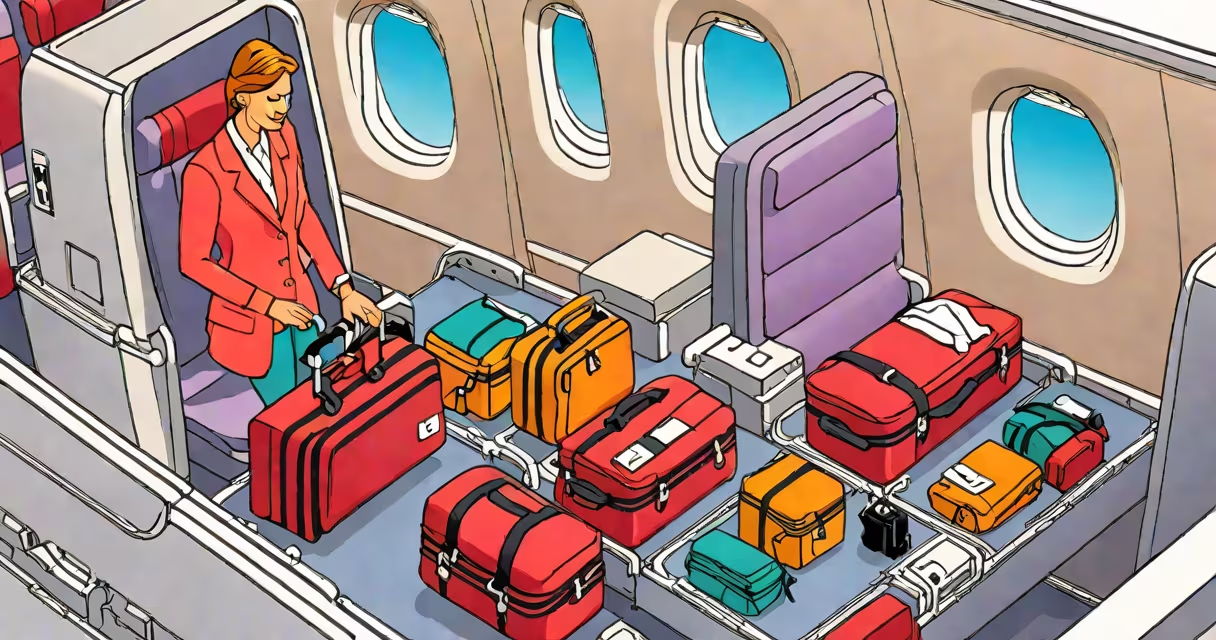
Virgin Atlantic allows one carry-on bag and one personal item per passenger in economy, premium economy, and business class. The carry-on must fit in the overhead bin and meet size limits. Personal items include handbags, laptops, or small backpacks. Checked baggage is separate and varies by route and fare.
The standard carry-on bag must not exceed 55 cm x 40 cm x 20 cm (21.7 in x 15.7 in x 7.9 in). This includes wheels and handles. The maximum weight is 10 kg (22 lbs). Passengers traveling in premium economy or business class may bring a larger carry-on, but the size limit remains the same unless specified otherwise. All bags must be stowed before takeoff.
Personal items such as a laptop bag, tablet case, or small shoulder bag must fit under the seat in front. These do not count toward the carry-on allowance. A small backpack or tote that fits under the seat qualifies. Larger bags must be checked or stored in the overhead bin.
| Cabin Class | Carry-On Size Limit | Weight Limit | Personal Item Allowed |
|---|---|---|---|
| Economy | 55 x 40 x 20 cm | 10 kg (22 lbs) | Yes |
| Premium Economy | 55 x 40 x 20 cm | 10 kg (22 lbs) | Yes |
| Business | 55 x 40 x 20 cm | 10 kg (22 lbs) | Yes |
Virgin Atlantic's carry-on policy applies to all routes, including transatlantic flights between London and New York, Los Angeles, or Miami. Some long-haul international routes allow additional flexibility for premium passengers. For example, business class travelers on routes to North America may check one bag for free, but this does not affect carry-on limits.
Common confusion arises between cabin baggage and checked baggage. Cabin baggage refers only to what you carry on. Checked baggage is stored in the cargo hold and is subject to different rules. On domestic UK flights, Virgin Atlantic allows one checked bag for economy passengers who book a Flex or Standard fare. International routes require a paid baggage option unless included in the ticket.
A frequent mistake is assuming that a large duffel bag labeled "carry-on" meets the size standard. The official dimensions are strict. A bag measuring 56 cm in length exceeds the limit even by 1 cm. Airlines enforce this during boarding. My last trip from London Heathrow to New York JFK was delayed because a passenger's bag was rejected at the gate due to a 1 mm overage in width. The gate agent measured it with a ruler.
For passengers flying with infants, a collapsible stroller and car seat are permitted as part of the carry-on allowance. These do not count toward the personal item or carry-on bag. The stroller must be folded and stored in the overhead bin or under the seat. Car seats must be secured in the seat pocket or stowed in the galley.
Some travelers assume that using a rolling suitcase automatically qualifies as a carry-on. Rolling suitcases are allowed only if they meet the size and weight criteria. A 28-inch suitcase typically exceeds the 55 cm height limit. Even if it fits, it must not weigh more than 10 kg. Overweight bags are subject to a fee at check-in.
When flying with multiple passengers, each person must have their own carry-on bag and personal item. Shared bags are not permitted. If two people share a single carry-on, the airline may charge a fee or require the bag to be checked. This rule applies regardless of fare type.
Passengers on codeshare flights operated by other airlines may face different baggage rules. Virgin Atlantic partners with Delta and Air France on select routes. On Delta-operated flights, the carry-on size limit is 56 cm x 35 cm x 25 cm. Always confirm the operating carrier's policy before travel.
Always measure your bag before arriving at the airport. Use a soft tape measure or a rigid ruler. Place the bag flat on the floor and measure from the base to the top, side to side, and front to back. Include wheels and handles. If the bag exceeds any dimension, consider packing lighter or checking it.
Final reminder: the virgin atlantic cabin baggage allowance is not negotiable. Gate agents enforce it strictly. Bags that don't fit are sent to the hold. This causes delays and increases the risk of loss. Plan ahead to avoid inconvenience.