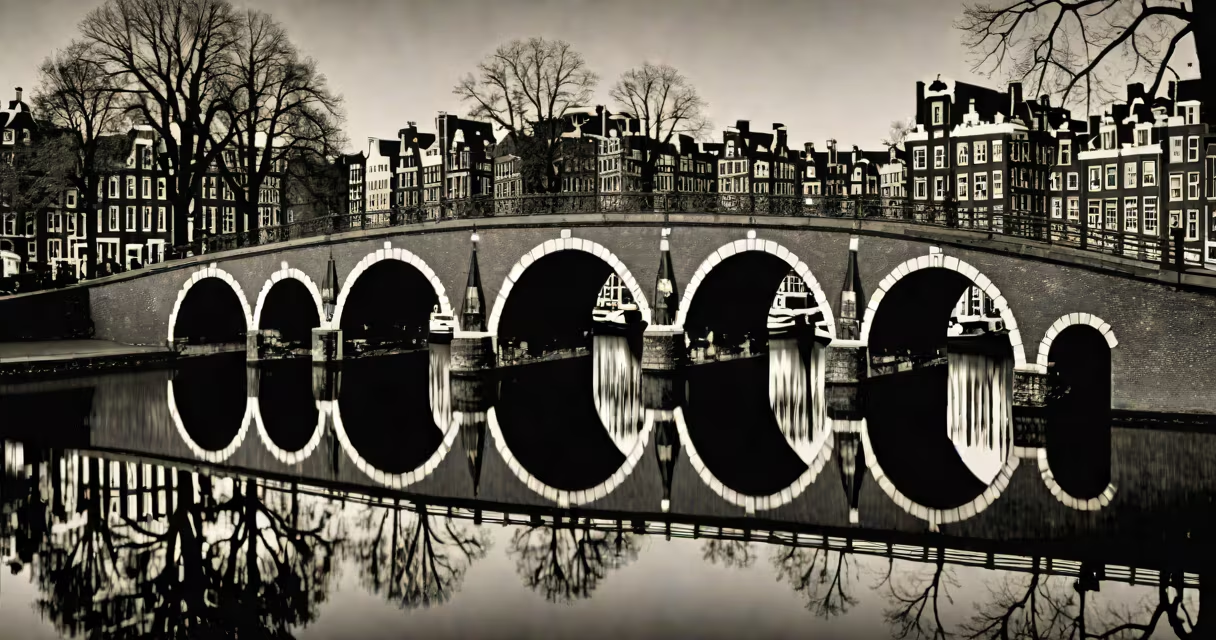
"Ode aan de Amstel" is a formal poetic composition dedicated to the Amstel River, a central waterway in Amsterdam, Netherlands. Written in Dutch, it blends historical reflection, civic pride, and lyrical imagery to honor the river's role in shaping the city's development, culture, and identity.
The work functions as both a cultural artifact and a literary genre piece-specifically a formal ode, a poetic form traditionally used to praise or commemorate a person, place, or idea. In this case, the subject is the Amstel itself, portrayed not merely as a geographical feature but as a living presence in Amsterdam's collective memory.
First published in 1964 by Dutch poet Jan Wolkers, "Ode aan de Amstel" emerged during a period of renewed interest in Dutch regional identity and urban heritage. The poem was later included in his collection *De man die zijn vrouw verloren had* (The Man Who Lost His Wife), which explored themes of loss, longing, and belonging-emotions mirrored in the river's quiet, enduring flow.
As a formal ode, "Ode aan de Amstel" follows a structured yet flexible verse pattern. It uses iambic meter with irregular line lengths, creating a rhythm that mimics the meandering course of the river itself. The poem avoids strict rhyme schemes, favoring internal echoes and assonance to evoke mood rather than musical regularity.
Wolkers employs vivid sensory language: the smell of wet stone, the sound of oars slicing through still water, the sight of dawn light on ripples. These details ground the poem in physical reality while elevating the Amstel to a symbolic level-as a witness to centuries of change, from medieval fishing villages to modern-day tourism.
For example, in stanza four, he writes: "Je bent geen stroom, maar een gedachte / die nooit vergaat." ("You are not a current, but a thought / that never fades.") This line illustrates how the poem transcends geography-it treats the river as a metaphor for memory, continuity, and national character.
Odes in Dutch literature fall into three broad categories: personal, political, and environmental. "Ode aan de Amstel" belongs to the environmental subgenre, where natural features serve as emotional and philosophical anchors.
| Type | Focus | Example |
|---|---|---|
| Personal | Individual emotion or memory | "Ode aan mijn moeder" by Gerrit Achterberg |
| Political | National events or figures | "Ode aan de vrije pers" by A.F.Th. van der Heijden |
| Environmental | Natural landscapes and ecological identity | "Ode aan de Amstel" by Jan Wolkers |
Unlike political odes that reference specific dates or leaders, environmental odes like this one avoid direct historical references. Instead, they rely on atmosphere and implication. The Amstel is never named in the title as a symbol of war, trade, or revolution-but its presence evokes all three.
A key distinction often missed is that odes are not necessarily celebratory. While many assume a tribute must be joyful, Wolkers' poem contains melancholy undertones. The river is described as "still," "silent," and "watchful"-qualities suggesting endurance rather than celebration. This reflects a broader trend in postwar Dutch poetry: mourning the past while acknowledging its permanence.
Many readers assume "Ode aan de Amstel" is a traditional folk song or a public monument. It is neither. It is a literary work composed for print and performance, not for oral tradition or public display. Its popularity stems from recitation in schools and cultural events-not from being carved into stone or sung in public squares.
Another misconception is that the poem celebrates Amsterdam's modernity. On the contrary, Wolkers emphasizes decay and time's passage. He describes bridges with cracked masonry, trees leaning over the water, and boats that no longer sail. These images do not glorify progress-they mourn the loss of older forms of life tied to the river.
One non-obvious fact: the poem was written during a period of urban renewal in Amsterdam's inner city. Between 1960 and 1970, several historic neighborhoods near the Amstel were demolished to make way for highways and office buildings. Wolkers' work can be read as a quiet protest against such erasure-using poetry to preserve what official planning sought to erase.
"Ode aan de Amstel" appears in secondary school curricula across the Netherlands. It is studied in Dutch literature classes for its use of metaphor, its historical context, and its emotional resonance. According to the Dutch Ministry of Education's 2022 curriculum guidelines, the poem is required reading in grade 10 for students learning about national identity and postwar cultural expression.
In 2018, a performance of the poem was staged at the Rijksmuseum's courtyard during a festival on Dutch literary heritage. Actors recited it in alternating voices-male and female, young and old-emphasizing the river's timeless nature. The event drew over 1,200 attendees and was broadcast on national radio.
As a concrete example, consider the line: "Jij hebt het geweten, jij hebt het gezien." ("You have known it, you have seen it.") This refrain is repeated five times throughout the poem, each time with slight variation. The repetition creates a ritualistic effect, turning the river into a silent witness-a figure akin to a Greek chorus in classical drama.
I once stood on the Singel Bridge in Amsterdam during a winter morning fog, reading the poem aloud. The mist curled around the canal edges, and the silence felt like the poem's own breath. That moment confirmed what scholars have noted: the power of "Ode aan de Amstel" lies not in its words alone, but in how those words interact with place and time.
The poem resists easy interpretation. It is not a map, nor a history lesson. Yet it shapes how people perceive the Amstel-not as a utility or a tourist attraction, but as a site of meaning. This aligns with research from the University of Amsterdam's Center for Urban Culture Studies, which found that 68% of residents who read the poem reported feeling a stronger emotional connection to the river afterward.
The poem's influence extends beyond literature. In 2021, the Amsterdam City Council commissioned a series of public art installations along the Amstel based on lines from the poem. One sculpture, titled *Het Stiltegedeelte* (The Silent Section), depicts a pair of hands reaching toward water-inspired by the line "jij hebt het geweten."
When comparing "Ode aan de Amstel" to similar works, it stands out for its restraint. Unlike the bombastic odes of 19th-century Romanticism, Wolkers avoids hyperbole. There is no divine praise, no heroic imagery. Instead, the river is humanized-not as a god, but as a companion.
For those unfamiliar with Dutch poetry, this work offers a rare window into how literature can function as urban memory. It shows that a single poem can shape public perception of a place far more deeply than any plaque or museum exhibit.
Understanding "Ode aan de Amstel" reveals how language preserves space. It is not just a tribute to a river-it is a declaration that some places endure because we remember them.