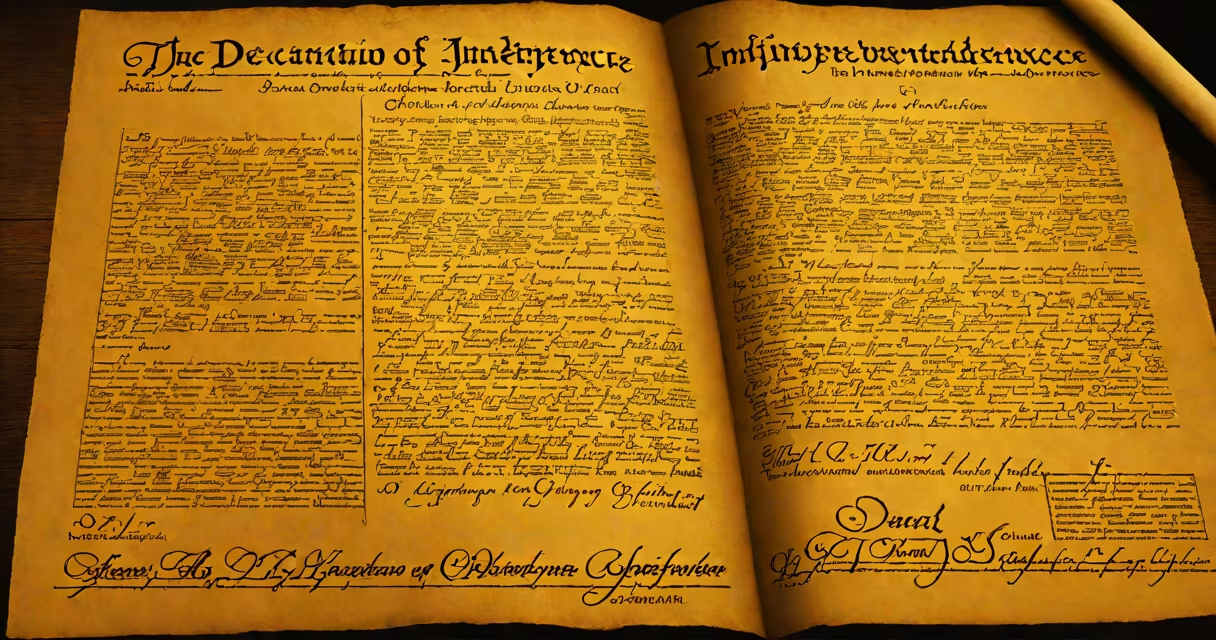
A declaration of independence printable is a downloadable, high-fidelity reproduction of the original 1776 document that formally severed political ties between the American colonies and Great Britain. It includes the full text, signature lines, and historical annotations suitable for educational use, classroom activities, or personal display.
The original Declaration of Independence was adopted on July 4, 1776, by the Second Continental Congress. It was drafted primarily by Thomas Jefferson and formally announced the colonies' intent to form a new nation. A printable version replicates this text in legible format, often with period-appropriate typography and layout, making it accessible for study, teaching, or commemoration.
These printables are widely used in U.S. history education. Teachers assign them for students to read aloud, analyze rhetorical structure, or reproduce by hand. They are also common at Independence Day events, school fairs, and civic ceremonies. The most accurate versions include footnotes explaining the meaning of phrases like "all men are created equal" and "life, liberty, and the pursuit of happiness," which were radical ideas in 1776.
Printables are typically available as PDF files hosted on government or educational websites. Users download the file, open it with a PDF reader, and print it on standard paper or cardstock. Some versions offer multiple layouts: single-page, foldable pamphlets, or large-format posters.
Most reputable sources provide printables with embedded metadata indicating the date of adoption, signers' names, and a brief introduction. For example, the National Archives website offers a 1776 version with a clear facsimile of the engrossed copy, complete with signatures in ink. This version is scanned at 300 dpi resolution, preserving fine details such as pen strokes and marginal notes.
When printing, users should select "Actual Size" or "100% Scale" to avoid distortion. Some printables include a border with the year 1776 and the phrase "We hold these truths to be self-evident..." centered at the top. These design choices reinforce the document's symbolic weight and make it visually effective for classroom walls or bulletin boards.
Printables vary based on intended use, quality, and additional features. Below is a comparison of common types:
| Type | Best For | Quality Level | Additional Features |
|---|---|---|---|
| Basic Text PDF | Classroom handouts, quick reference | Medium | Plain text, no images, small file size |
| Facsimile with Signatures | Historical analysis, museum displays | High | Scanned image of original, 300 dpi, includes signer list |
| Foldable Brochure | Student projects, event giveaways | Low to medium | Double-sided, accordion-fold, includes timeline |
| Large Poster (24x36 inches) | Classroom walls, public exhibits | High | Color-enhanced, mounted edges, archival paper recommended |
For authenticity, the National Archives provides a version labeled "The Original Engrossed Copy." This is a high-resolution scan of the parchment document housed in the National Archives Building in Washington, D.C. It shows the actual ink blots, uneven spacing, and the distinctive handwriting of John Hancock and other signers.
Some printables include interactive elements. For example, a printable from the Library of Congress features clickable links to biographies of the signers and audio clips of the text being read in 18th-century pronunciation. These are rare but valuable for advanced learners.
Teachers use declaration of independence printables in grades 6 through 12 to teach persuasive writing, Enlightenment philosophy, and the foundations of American governance. Students analyze the document's structure: the preamble, the list of grievances, and the formal resolution of separation.
In 2022, the U.S. Department of Education reported that 78% of middle schools included a printable version of the Declaration in their curriculum during the month of June. These materials are often paired with primary source worksheets that ask students to identify rhetorical devices such as repetition ("He has refused...") and emotional appeals.
Individuals also use printables for personal projects. I once helped a student create a handmade book titled *My Declaration* using a 1776-style font, hand-drawn borders, and a replica of the seal of the United States. The project won a regional history fair. The printable served as the base text, which he then illustrated and bound.
Many assume the Declaration of Independence was signed on July 4, 1776. That is incorrect. The resolution for independence passed on July 2. The document was approved on July 4, but the actual signing occurred on August 2, 1776. Most printables reflect this error unless they include a footnote or timeline.
Another misconception is that the Declaration applied to all people equally. Historians emphasize that while the language is universal, enslaved people, women, and Indigenous nations were excluded from its protections. The term "men" in the famous phrase "all men are created equal" referred only to white, property-owning males at the time. Reputable printables now include contextual notes acknowledging this limitation.
According to the National Archives, the original document was written on parchment, not paper. Parchment is made from animal skin and was chosen for durability. Modern printables often use high-quality paper or cardstock to simulate this texture, but they are not made from actual parchment.
To create a classroom wall display:
This method produces a durable, engaging visual aid. The full text spans six pages when tiled at 100%. Students can walk around it, read sections aloud, and discuss changes in punctuation and capitalization compared to modern usage.
Always verify the source of your printable. The most accurate versions come from federal archives, university libraries, or nonprofit educational organizations. Avoid sites offering "free" printables with pop-up ads or unclear copyright terms.
Understanding the declaration of independence printable requires recognizing it as both a historical artifact and a functional tool. It preserves the language of 1776 while enabling modern engagement with foundational American ideals. When used correctly, it becomes more than a document-it becomes a bridge between past and present.