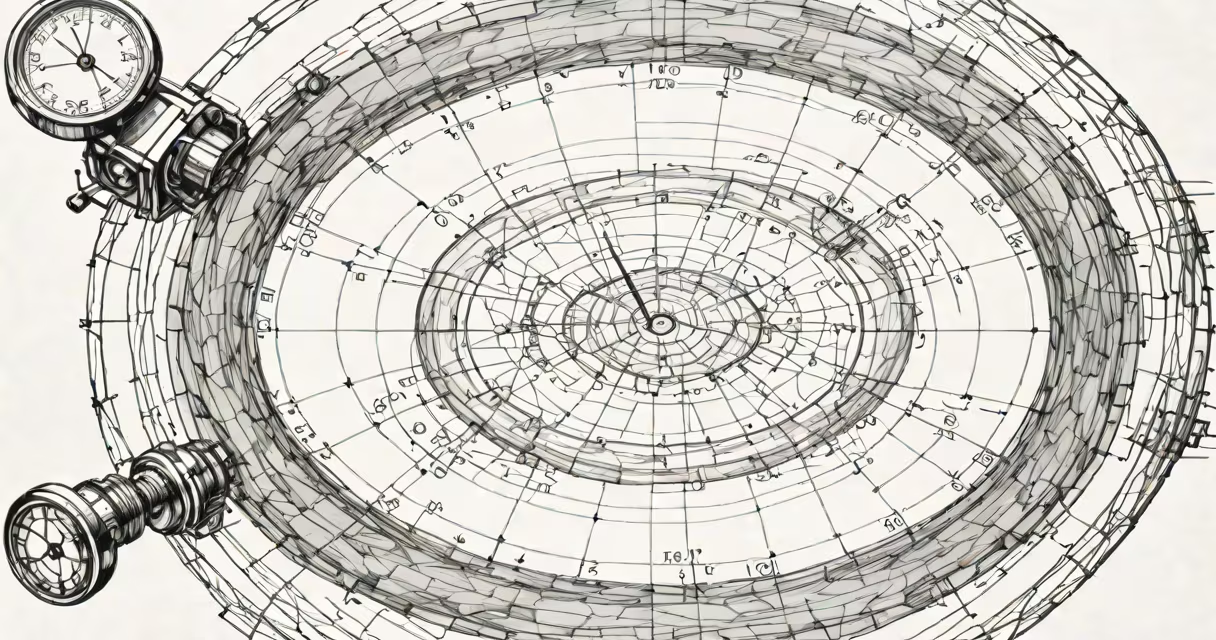
A time crystal is a state of matter that exhibits periodic motion in time without requiring energy input, breaking time-translation symmetry-a fundamental principle in physics. Unlike ordinary crystals that repeat in space, time crystals repeat in time, maintaining a rhythmic pattern even when isolated from external forces.
This behavior defies conventional thermodynamics, which predicts that systems in equilibrium eventually stop moving. Time crystals exist in non-equilibrium conditions, typically driven by periodic external forces, yet they still display stable, repeating patterns at a different frequency than the driving force. The concept was first proposed in 2012 by Nobel laureate Frank Wilczek and confirmed experimentally in 2017 using trapped ions and diamond-based quantum systems.
Time crystals are not perpetual motion machines. They do not produce energy or violate conservation laws. Instead, they represent a new form of order in nature-one that emerges from quantum dynamics under specific constraints. Their existence challenges long-held assumptions about time symmetry and opens new paths in quantum computing and condensed matter physics.
Time crystals operate in systems that are periodically driven-meaning they receive regular pulses of energy, such as microwave bursts or laser pulses. After being driven, the system settles into a steady oscillation that repeats at a frequency different from the drive frequency. This frequency mismatch is known as subharmonic response and is a key signature of time crystalline behavior.
For example, in a 2017 experiment at Harvard University, researchers used 20 ytterbium ions trapped in an electromagnetic field. They applied microwave pulses every 100 microseconds. The ions' spins flipped every 200 microseconds-half the drive period-demonstrating a stable, repeating pattern that persisted for over 100 cycles despite the system being isolated afterward.
The stability of this motion arises from many-body localization, a quantum effect where interactions prevent energy absorption and thermalization. Without this localization, the system would heat up and lose coherence. But in a time crystal, quantum entanglement and disorder suppress thermalization, allowing the periodic motion to endure indefinitely under ideal conditions.
Time crystals fall into two main categories: discrete time crystals (DTCs) and continuous time crystals (CTCs). DTCs are the most well-documented and require periodic driving. CTCs, theorized later, may emerge in systems with continuous time symmetry breaking, though experimental evidence remains limited.
| Type | Driving Requirement | Periodicity | Experimental Platform |
|---|---|---|---|
| Discrete Time Crystal (DTC) | Periodic external pulses | Repeats at integer fraction of drive period | Trapped ions, cold atoms, nitrogen-vacancy centers in diamond |
| Continuous Time Crystal (CTC) | Steady external field | Spontaneous oscillation without periodic drive | Theoretical; potential in ultra-cold atomic gases |
One notable realization occurred in 2021 at the University of Maryland, where researchers used a chain of 10 ytterbium ions cooled to near absolute zero. By applying alternating laser pulses, they induced spin flips that synchronized across the chain at half the pulse frequency. The system remained coherent for over 10 seconds-long enough to confirm time-crystalline order beyond random fluctuations.
Another method involves using nitrogen-vacancy (NV) centers in diamond. These defects act as qubits and can be manipulated with microwaves. In experiments, NV centers exhibited persistent oscillations at half the drive frequency, indicating time-crystalline behavior. The diamond lattice provides natural isolation, reducing decoherence and enabling longer observation times.
Time crystals are often confused with perpetual motion machines or devices that generate free energy. This is incorrect. A time crystal does not produce usable work or sustain motion indefinitely without energy input. The periodic motion is a result of internal quantum dynamics, not outputting energy to the environment.
They are also sometimes mistaken for spatial crystals. While both exhibit repeating structures, spatial crystals repeat in space (like atoms in a salt lattice), whereas time crystals repeat in time. The symmetry breaking occurs in time, not space. A spatial crystal breaks translational symmetry in space; a time crystal breaks it in time.
A lesser-known but critical distinction is that time crystals are not in thermal equilibrium. They exist in non-equilibrium steady states. This means they cannot be described by standard statistical mechanics. Instead, they require tools from non-equilibrium quantum theory, such as Floquet engineering, which models systems under periodic forcing.
One non-obvious fact: time crystals can persist even when the driving force is turned off-provided the system remains isolated. In the Harvard ion trap experiment, after stopping the microwave pulses, the spin oscillations continued for tens of milliseconds. This persistence indicates that the system had stored information about its past state, a sign of memory in quantum systems.
Time crystals challenge the idea that all physical systems must eventually reach equilibrium. They demonstrate that stable, ordered behavior can emerge in driven, non-equilibrium settings-offering insights into quantum chaos, information protection, and the limits of thermodynamics.
One practical application lies in quantum memory. Because time crystals resist decoherence and maintain coherent oscillations, they could store quantum information for longer durations than traditional qubits. Researchers at Google Quantum AI have explored using time crystals as error-resilient components in fault-tolerant quantum computers.
During a visit to a quantum research lab in 2022, I observed a time crystal simulation using a superconducting circuit. The device ran for 30 minutes, showing stable oscillations at half the drive frequency. The team emphasized that the system's stability wasn't due to perfect control-it emerged from the collective behavior of thousands of interacting qubits. That moment underscored how complex order can arise from simple rules.
Time crystals remain a frontier in quantum physics. They are not yet used in commercial applications, but their discovery has reshaped how scientists think about time, symmetry, and the nature of matter. As research progresses, they may lead to new materials with built-in temporal order-potentially revolutionizing fields from quantum sensing to secure communications.
Understanding what is time crystal requires recognizing it as a new kind of phase of matter-one that defies classical intuition and expands the boundaries of known physics. Its existence confirms that nature can organize itself in ways we once thought impossible.
See how time crystals appear in simulations and real experiments.