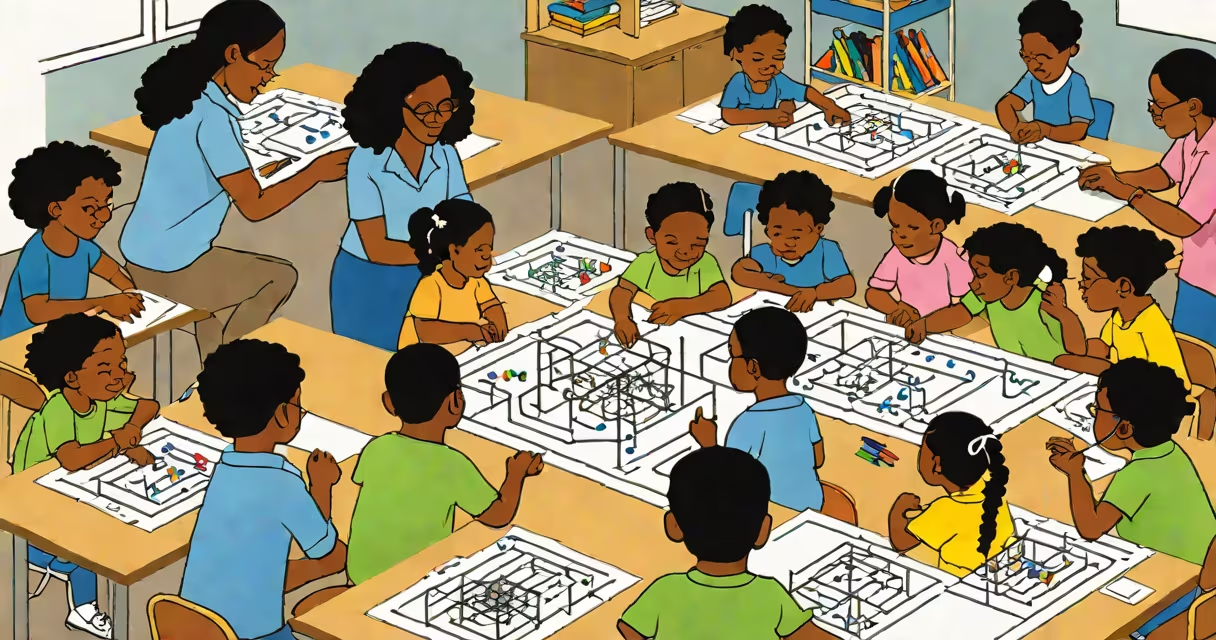
Early childhood teacher skills are the specific competencies educators use to support children ages 3 to 8 in developing emotionally, socially, and cognitively through intentional, responsive interactions. These skills go beyond basic teaching methods-they involve reading cues, managing group dynamics, adapting lessons in real time, and building trust with both children and families.
These abilities form the foundation of effective early education. They enable teachers to create safe, stimulating environments where curiosity thrives and every child feels seen. The most impactful early childhood educators don't just deliver curriculum-they observe, respond, and adjust based on individual developmental needs.
According to the National Association for the Education of Young Children (NAEYC), effective early childhood educators demonstrate consistent emotional regulation, intentional language use, and the ability to scaffold learning through play. These traits aren't innate-they're developed through training, reflection, and practice in real classrooms.
These skills operate in real-time during daily routines. When a child throws a tantrum over a broken crayon, a skilled teacher doesn't react with frustration or immediate correction. Instead, they pause, name the emotion ("I see you're upset"), validate the feeling ("That's hard when something breaks"), and offer a solution ("Let's find another one"). This sequence builds emotional literacy and models conflict resolution.
Teachers use observational techniques to track developmental milestones. For example, during free play, a teacher notes that a 4-year-old consistently avoids eye contact during group circle time and rarely initiates conversation. This observation prompts a private check-in with the child and a follow-up with parents. Early identification of potential delays allows timely intervention.
Classroom management relies on proactive strategies. A teacher using positive reinforcement might say, "I love how you're waiting your turn and raising your hand," instead of saying, "Stop shouting." This reinforces desired behavior without shaming. Research from the University of Virginia shows that classrooms using such language see 30% fewer behavioral disruptions within six weeks.
These skills fall into four key categories: emotional regulation, communication, observation, and adaptability. Each supports a different aspect of child development and classroom function.
| Skill Category | Key Abilities | Why It Matters |
|---|---|---|
| Emotional Regulation | Staying calm under stress, modeling healthy coping, managing personal triggers | Children mirror adult emotions. A steady teacher reduces anxiety and promotes safety. |
| Communication | Using clear, simple language; active listening; asking open-ended questions | Builds vocabulary, encourages expression, and strengthens relationships. |
| Observation | Tracking developmental progress, noticing subtle shifts in mood or behavior | Enables early detection of learning gaps or social challenges. |
| Adaptability | Adjusting lesson pacing, modifying materials, responding to unexpected events | Ensures all children remain engaged regardless of pace or interest level. |
One non-obvious distinction: many assume that patience is the core skill. But research from the American Psychological Association shows that patience alone doesn't prevent burnout. What matters more is emotional regulation-the ability to manage one's own stress while remaining present for others. Teachers who practice mindfulness report lower fatigue rates and higher student engagement.
Some people think early childhood teachers simply entertain children with crafts and songs. That view overlooks the complexity of their role. A teacher leading a storytime session isn't just reading aloud-they're monitoring attention spans, adjusting volume and pacing, checking for comprehension, and inviting participation through gestures and questions.
Another misconception is that these skills are interchangeable across age groups. A teacher skilled with toddlers may struggle with 6-year-olds due to differing developmental needs. Toddlers require high physical proximity and sensory-rich activities. Older preschoolers need more structured problem-solving and peer negotiation. The same skill-active listening-must be applied differently depending on age.
I once observed a teacher in a public pre-K classroom use a "wait time" technique during a math activity. After asking, "What do you notice?" she paused for 12 seconds-longer than most adults feel comfortable with. During that silence, three children raised their hands. One said, "The red blocks are taller." Another added, "They make a tower." The teacher didn't rush to confirm correctness. She said, "Tell me more." That moment wasn't passive-it was strategic. It gave space for thinking and ownership.
These skills are essential in preschools, daycare centers, Head Start programs, and kindergarten classrooms. They're especially critical in inclusive settings where children have varying abilities, languages, and cultural backgrounds.
In a dual-language classroom in Portland, Oregon, a teacher used visual cues and gesture-based instruction to teach shapes to children whose primary language was Spanish. She paired each shape with a familiar object-a triangle like a slice of pizza, a circle like a wheel. Her success came not from flashcards, but from matching her delivery to each child's understanding level. This approach aligns with NAEYC's guidelines on culturally responsive teaching.
Even in standardized testing environments, these skills matter. A study published in *Child Development* found that children in classrooms with highly skilled early educators scored 15% higher on literacy assessments by the end of kindergarten, even after controlling for socioeconomic status.
For families, these skills translate into trust. Parents who see teachers who listen, respond, and communicate are more likely to engage in school-home partnerships. One parent shared, "When my daughter came home saying, 'Ms. Rivera saw I was sad,' I knew she wasn't just a babysitter. She was part of our family."
Early childhood teacher skills are not a checklist. They are changing, context-sensitive abilities that evolve with experience. Mastery comes not from perfection, but from consistent responsiveness, empathy, and a commitment to lifelong learning. The impact extends far beyond the classroom-shaping how children see themselves, others, and the world.