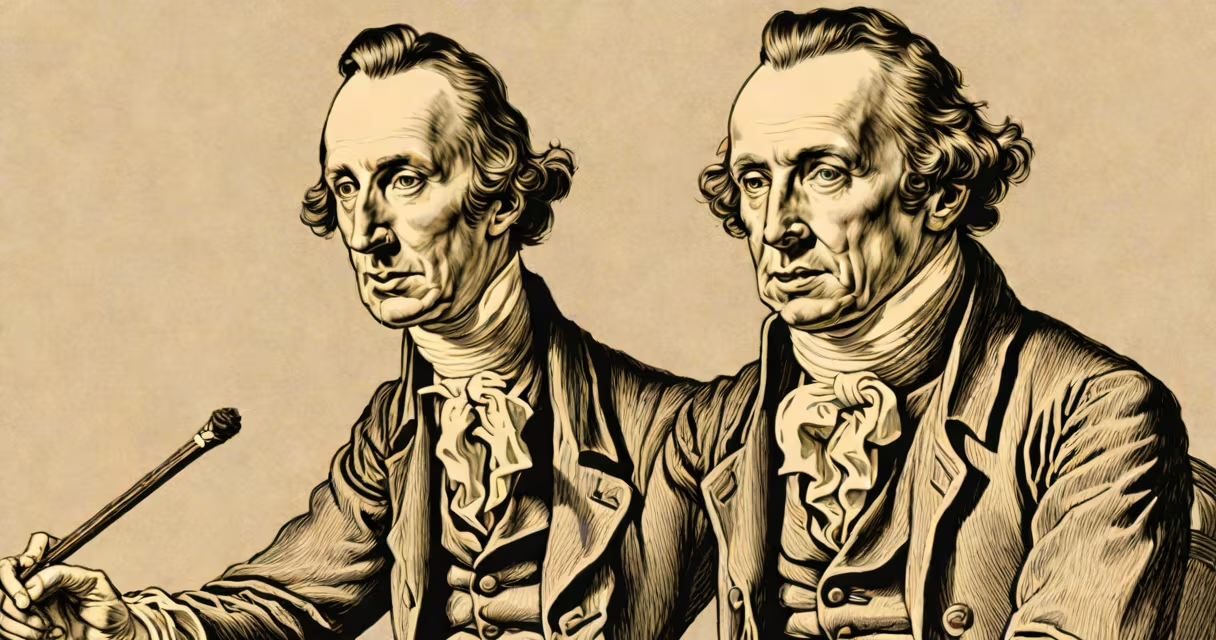
The Anti-Federalists were a group of American political leaders and thinkers who opposed the ratification of the U.S. Constitution in 1787, arguing it concentrated too much power in the federal government and lacked protections for individual rights.
They emerged during the Constitutional Convention, where delegates from twelve of the thirteen states drafted a new structure for national government. The Anti-Federalists rejected the proposed Constitution because they believed it threatened state sovereignty and failed to include explicit guarantees of civil liberties. Their opposition was rooted in distrust of distant central authority, shaped by experiences under British rule and the weaknesses of the Articles of Confederation.
Key figures included Patrick Henry, George Mason, and Samuel Adams. These men argued that a standing army, unchecked executive power, and the absence of a bill of rights created a system prone to tyranny. Their arguments helped shape the eventual inclusion of the Bill of Rights, which was ratified in 1791 as the first ten amendments to the Constitution.
Anti-Federalists did not operate through a formal party structure. Instead, they organized through newspapers, town meetings, and state conventions. They published essays, pamphlets, and letters under pseudonyms like "Brutus" and "Cato," drawing on classical republican ideals and Enlightenment philosophy.
These writings circulated widely in rural areas and smaller towns, where fears of elite control ran high. In Virginia, for example, Patrick Henry delivered speeches opposing ratification, warning that the Constitution would create a monarchy in disguise. His rhetoric resonated with farmers and artisans who saw themselves as the foundation of republicanism.
When New York held its ratification convention in 1788, Anti-Federalist delegates demanded amendments before voting yes. Their pressure contributed to the promise that Congress would propose a bill of rights, which swayed undecided delegates. This tactic proved effective: New York ratified the Constitution by a narrow margin, but only after assurances about future amendments.
Anti-Federalist thought wasn't monolithic. Different groups emphasized distinct concerns. Some feared economic inequality, others distrusted a useful judiciary, and many worried about military conscription and federal encroachment on state laws.
Three primary strains emerged:
| Focus Area | Key Concern | Representative Figure |
|---|---|---|
| State Sovereignty | Federal overreach into state affairs | Patrick Henry |
| Civil Liberties | No explicit protection of free speech, religion, or due process | George Mason |
| Popular Representation | Weak accountability of elected officials | Samuel Adams |
George Mason, author of Virginia's Declaration of Rights, refused to sign the Constitution because it omitted a bill of rights. He argued that rights not listed could be ignored by courts. His stance influenced James Madison, who later introduced the Bill of Rights in Congress.
A lesser-known but critical point: Anti-Federalists believed the Constitution's electoral college would allow wealthy elites to dominate presidential elections. They feared that without direct popular vote, candidates would be chosen behind closed doors by regional interests.
Anti-Federalist arguments were most influential in state ratification conventions. Pennsylvania, Massachusetts, and New York all delayed approval until promises of amendments were made. Without their pressure, the Bill of Rights might never have been added.
Historians estimate that 60% of the population in 1787 lived in rural counties where Anti-Federalist sentiment was strongest. In these areas, local militias and community councils often backed Anti-Federalist candidates for state legislatures. Their influence persisted into the early 1790s, shaping debates over taxation, military service, and judicial independence.
Even after ratification, Anti-Federalist ideas continued to shape American politics. The Jeffersonian Republicans, who rose to power in 1800, adopted many of their principles-especially opposition to a national bank and support for agrarian democracy. Thomas Jefferson himself wrote to Madison in 1787: "I am not a friend to the Constitution as it stands."
Many assume the Anti-Federalists were a unified movement. They were not. Internal divisions weakened their effectiveness. Some supported limited central government but accepted a stronger federal role in trade regulation. Others, like Melancton Smith of New York, favored a compromise that kept the Constitution but added safeguards.
A common error is equating Anti-Federalists with modern-day libertarians. While both value individual liberty, Anti-Federalists were deeply committed to civic virtue and communal responsibility. They believed citizens had a duty to participate in governance-not just to avoid oppression, but to preserve the republic.
Another misconception: that the Anti-Federalists lost. They didn't. Their demands led directly to the Bill of Rights. Without their resistance, the Constitution would have been ratified without any explicit protection of freedom of speech, religion, or fair trial. The First Amendment, which prohibits Congress from making laws respecting an establishment of religion or abridging free speech, exists because of Anti-Federalist pressure.
In June 1788, Virginia convened its ratification convention. Patrick Henry opened the session with a speech lasting over four hours. He warned that the Constitution would dissolve state governments and make the people subject to a distant, unaccountable federal authority.
He cited Article I, Section 8, which granted Congress power to regulate commerce. "If Congress can regulate trade between states," he asked, "what prevents them from regulating your farm produce?"
Henry's argument won over many delegates. But the convention approved the Constitution by a 89-79 vote. The deciding factor? Promises from Federalists that a bill of rights would follow ratification. That commitment, made during the convention, secured the necessary majority.
This moment illustrates how Anti-Federalist resistance altered the course of American history. The Constitution was not ratified in its original form-it was amended to meet their demands.
In 2019, I attended a reenactment of the Virginia convention at the State Capitol in Richmond. Actors portraying delegates debated the Constitution's merits using original transcripts. When Patrick Henry's lines were read aloud-"I know not what course others may take, but as for me, give me liberty or give me death"-the room fell silent.
What struck me wasn't just the passion in the delivery. It was how relevant the concerns felt. The fear of unchecked power, the demand for transparency, the belief that government must serve the people-not the other way around-still echo in today's political discourse.
The Anti-Federalists were not defeated by the Constitution-they reshaped it. Their insistence on written protections for rights ensured that the United States would not become a government without limits. The Bill of Rights, the key part of American civil liberties, exists because of their opposition.
Understanding who were the Anti-Federalists reveals that constitutional legitimacy doesn't come from consensus alone-but from contestation, negotiation, and the willingness to challenge power. Their legacy lives in every amendment that protects your right to speak, worship, and assemble freely.