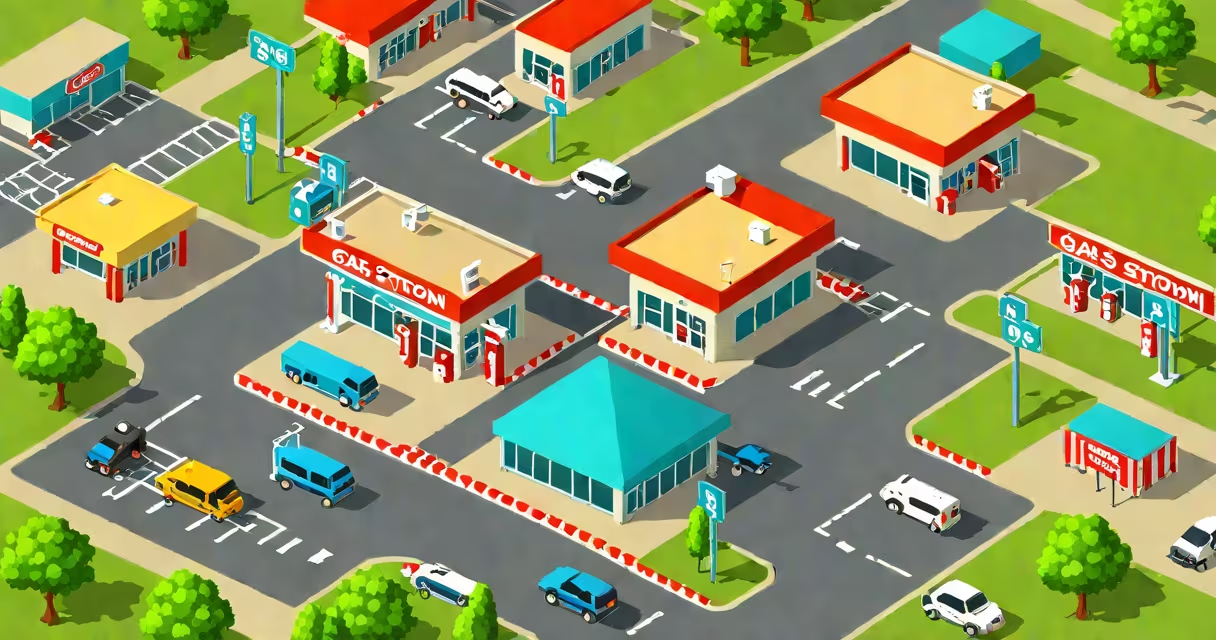
Gas station chains are groups of fuel retail locations operated under a single brand name, often spanning dozens or hundreds of sites across multiple states or countries. These chains standardize fuel pricing, branding, store layouts, and customer rewards programs.
Major chains like Shell, Chevron, ExxonMobil, and 76 operate through franchised and company-owned locations. They control supply logistics, set fuel prices based on regional benchmarks, and integrate fuel sales with in-store purchases. The largest U.S. chains serve over 100 million customers annually, with annual fuel volumes exceeding 10 billion gallons.
These operations rely on centralized procurement, automated inventory systems, and real-time price updates. For example, ExxonMobil's network uses changing pricing algorithms that adjust fuel costs every 15 minutes based on wholesale market rates and local competition.
Each location in a gas station chain follows a standardized operational model. Fuel dispensers are calibrated to federal standards, and transactions are processed through integrated point-of-sale (POS) systems linked to corporate databases. This ensures consistent pricing and fraud detection across all sites.
Chains manage fuel delivery via dedicated tanker fleets or third-party distributors. A single regional hub may supply 20-30 stations within a 100-mile radius. Fuel is stored in underground tanks rated for 100-year lifespans, with leak detection systems required by the EPA under the Resource Conservation and Recovery Act (RCRA).
Inside the convenience store, products are selected centrally. Chains like Sheetz or Wawa stock nationally branded items such as Coca-Cola, Snapple, and private-label snacks. Inventory turnover averages 1.8 times per month, higher than standalone convenience stores due to volume purchasing power.
Gas station chains fall into three primary categories based on ownership and distribution:
| Type | Ownership Model | Examples | Market Reach |
|---|---|---|---|
| Integrated Oil Companies | Company-owned and operated | ExxonMobil, Chevron, Shell | National and global |
| Franchise-Based Chains | Independent operators under brand license | 7-Eleven, Circle K, Love's Travel Stops | Wide domestic presence |
| Regional or Independent Networks | Locally owned but branded | Wawa (Pennsylvania), Sheetz (Pennsylvania) | State or multi-state clusters |
While integrated oil companies maintain full control over fuel quality and site design, franchise models allow rapid expansion with lower capital risk. Love's Travel Stops, for example, operates over 600 locations across 40 states, most of them independently owned but operating under the Love's brand with shared marketing and supply agreements.
Many assume all gas station chains offer the same fuel quality. That's incorrect. While all U.S. fuel must meet ASTM D4814 standards for octane rating and additive content, premium fuels differ in formulation. Shell V-Power contains a proprietary detergent package that reduces intake valve deposits by up to 30% compared to standard premium, according to independent testing by the American Automobile Association (AAA).
Another myth is that chains always charge higher prices. Data from the U.S. Energy Information Administration (EIA) shows that during Q1 2023, Shell stations averaged $0.08/gallon less than independent stations in Texas, despite higher brand recognition. Price variation stems more from local competition and lease terms than brand identity.
In 2022, Love's expanded its fleet by adding 27 new locations in Oklahoma, Arkansas, and Louisiana. Each site includes a full-service restaurant, truck stop facilities, and a convenience store with over 1,500 SKUs. The chain uses a centralized supply chain managed from its headquarters in Oklahoma City, reducing delivery lead times by 22% compared to regional distributors.
Love's also runs a loyalty program called "Loves Rewards," which offers 5 cents off per gallon for members who spend $50 or more monthly. The program tracks usage across all locations and integrates with mobile app check-ins. In 2023, 68% of Love's customers used the app to access discounts, increasing average transaction value by 14%.
During a 2023 winter storm in the Midwest, Love's maintained 98% fuel availability across its network by rerouting tankers from neighboring states. This resilience was attributed to a real-time monitoring system that flagged low inventory levels 12 hours before depletion, allowing proactive restocking.
Unlike independent stations, chains invest heavily in infrastructure. A typical ExxonMobil site spends $1.2 million on construction, including underground storage tanks, vapor recovery systems, and compliance with state environmental regulations. Independent stations average $600,000 in buildout costs.
Chains also prioritize customer retention through loyalty programs. According to a 2023 report by J.D. Power, customers at branded chains visit 2.3 times more frequently than those at unbranded stations. The same study found that 61% of users return to the same chain for fuel because of consistent pricing and rewards.
One non-obvious fact: gas station chains often partner with local utilities to install EV charging stations. As of 2023, 34% of Shell locations in California offered Level 2 chargers, with plans to add 1,200 DC fast chargers by 2025. This integration supports long-term fuel demand shifts and expands revenue beyond gasoline.
For context, a single Love's Travel Stop in Kansas generates approximately $1.8 million in annual fuel sales and $650,000 in convenience store revenue. The combined margin exceeds 12%, higher than standalone convenience stores, which average 8.5%.
Understanding gas station chains reveals their role not just as fuel providers but as integrated retail hubs. Their scale, standardization, and supply chain efficiency enable consistent service and pricing across vast geographic areas. The next time you fill up, consider whether your choice reflects brand loyalty, location convenience, or real cost savings.