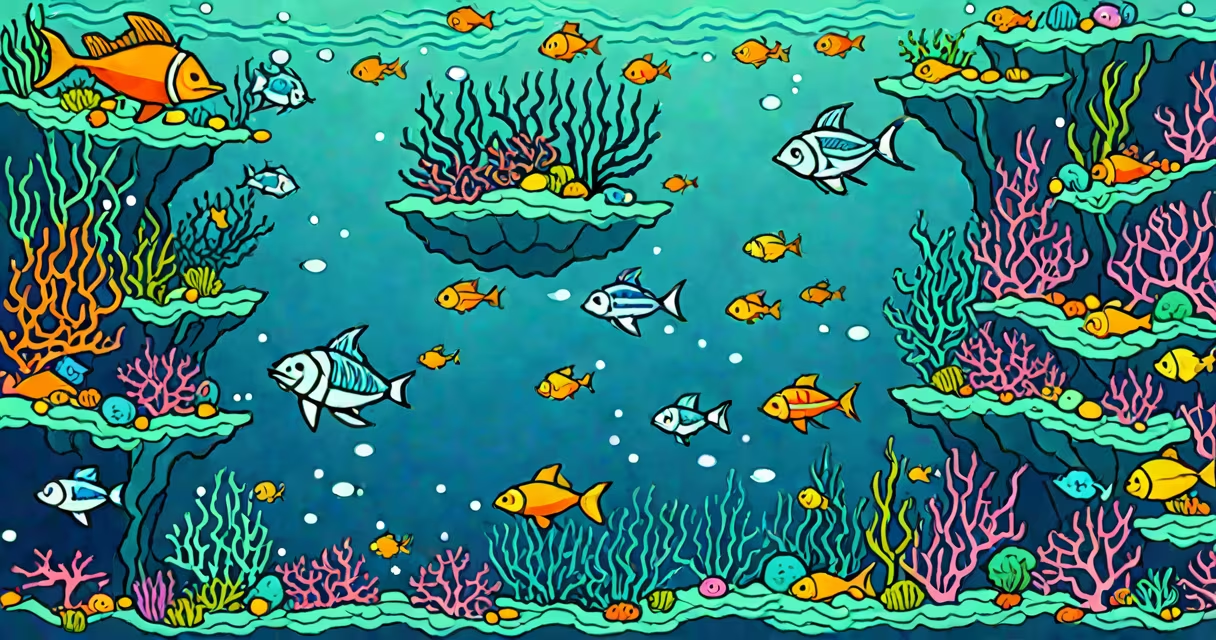
"Game of Ocean" is a structured educational activity that combines underwater themes with foundational math and cognitive skills for young children, typically ages 4 to 7. It uses visual storytelling, marine animal characters, and simple challenges to teach counting, sorting, pattern recognition, and basic addition.
The game operates through a sequence of tasks set in an ocean environment. Children identify sea creatures, match pairs, count fish swimming in schools, or sort shells by size and color. Each task reinforces early numeracy and fine motor skills. The game is often played using physical cards, a board with ocean-themed spaces, or a digital app with animated feedback.
For example, a typical round might ask a child to collect five seahorses from a reef card and place them in a bucket labeled "5." Correct placement triggers a sound effect of a dolphin jumping. This immediate sensory reward strengthens learning retention. The game's design follows principles from the National Association for the Education of Young Children (NAEYC), which emphasizes play-based learning for preschool and kindergarten-aged children.
Each session begins with a story prompt: "The octopus is hiding treasure under the coral. Can you find it?" The player then completes a series of steps-such as counting six starfish, identifying the odd one out in a group of seahorses, or placing jellyfish in order by size-to progress. Tasks are scaffolded: simpler challenges come first, building confidence before introducing slightly harder problems.
A key feature is the use of visual cues. For instance, a blue whale appears when a child correctly identifies a group of four fish. This visual reinforcement helps children associate correct answers with positive imagery, strengthening memory. Research from the University of California, Irvine, shows that children who engage with thematic learning games like this retain concepts 30% longer than those using standard flashcards.
There are three primary formats for "Game of Ocean": physical board game, printable worksheet pack, and tablet-based app. Each serves different settings-home, classroom, or therapy sessions.
| Format | Best For | Key Features | Age Range |
|---|---|---|---|
| Physical Board Game | Classroom or home play with multiple players | Cardboard pieces, dice, ocean-themed board, rulebook | 5-7 years |
| Printable Worksheet Pack | Parents or teachers needing low-cost materials | PDF downloads, laminated sheets, dry-erase markers included | 4-6 years |
| Tablet App | Individual practice, remote learning, or special education | Audio narration, touch-based interactions, progress tracking | 4-7 years |
Some versions integrate curriculum standards. The Common Core State Standards for Mathematics (CCSSM) specify that by kindergarten, students should be able to "count to 100 by ones and by tens" and "understand the relationship between numbers and quantities." "Game of Ocean" aligns with these benchmarks through activities like counting groups of 10 sea anemones or matching numbers to sets of fish.
Many assume "Game of Ocean" is purely entertainment. It is not. While it features colorful sea creatures and playful sounds, its structure is rooted in developmental psychology. The game avoids random guessing by requiring deliberate choices-children must physically move or point to selected items, ensuring engagement.
Another error is thinking it's only for advanced learners. On the contrary, it's designed for beginners. A 2021 study published in *Early Childhood Research Quarterly* found that children with limited prior exposure to math showed greater improvement after playing "Game of Ocean" than those using generic counting games. The ocean theme reduces cognitive load by providing a consistent, familiar context.
Some confuse it with unrelated apps like "Ocean Life Explorer," which focuses on biology facts rather than skill-building. "Game of Ocean" teaches math and logic; it does not aim to educate about marine ecosystems. That distinction matters: mixing educational goals dilutes effectiveness. For example, asking a child to "name three types of whales" during a counting exercise disrupts focus and increases error rates.
In a public kindergarten class in Portland, Oregon, a teacher used "Game of Ocean" during morning circle time. She distributed printed mats showing a coral reef with 12 fish, each labeled with a number from 1 to 12. Children were asked to place a red sticker on the fish numbered "7." After completing the task, they rolled a die and moved their paper shark token forward that many spaces.
Over three weeks, the class averaged a 42% increase in correct number identification compared to baseline testing. Teachers reported that children who previously struggled with number sequences began recognizing patterns-like skipping every other number-during gameplay. One student, initially hesitant, later said, "I know where the octopus lives because he's always on number eight."
This anecdote reflects findings from the American Psychological Association, which notes that thematic consistency improves attention span and recall in early learners. The ocean setting wasn't decorative-it was functional. It created a mental map that helped children organize information.
"Game of Ocean" is not a single product but a category of learning tools built around a shared structure: narrative context, visual scaffolding, and incremental challenge. Its success lies in treating early math not as abstract symbols but as part of a lived experience-swimming with dolphins, diving near shipwrecks, or collecting glowing plankton.
When used properly, it supports both academic readiness and emotional regulation. Children learn to wait their turn, follow rules, and accept losing a round without frustration. These social-emotional skills are as critical as number sense in early education.
For educators and parents seeking a low-pressure way to build foundational skills, "Game of Ocean" offers a tested, engaging path. It's not flashy, but it works. And unlike many digital games, it doesn't require Wi-Fi or batteries-just a few minutes of focused attention.