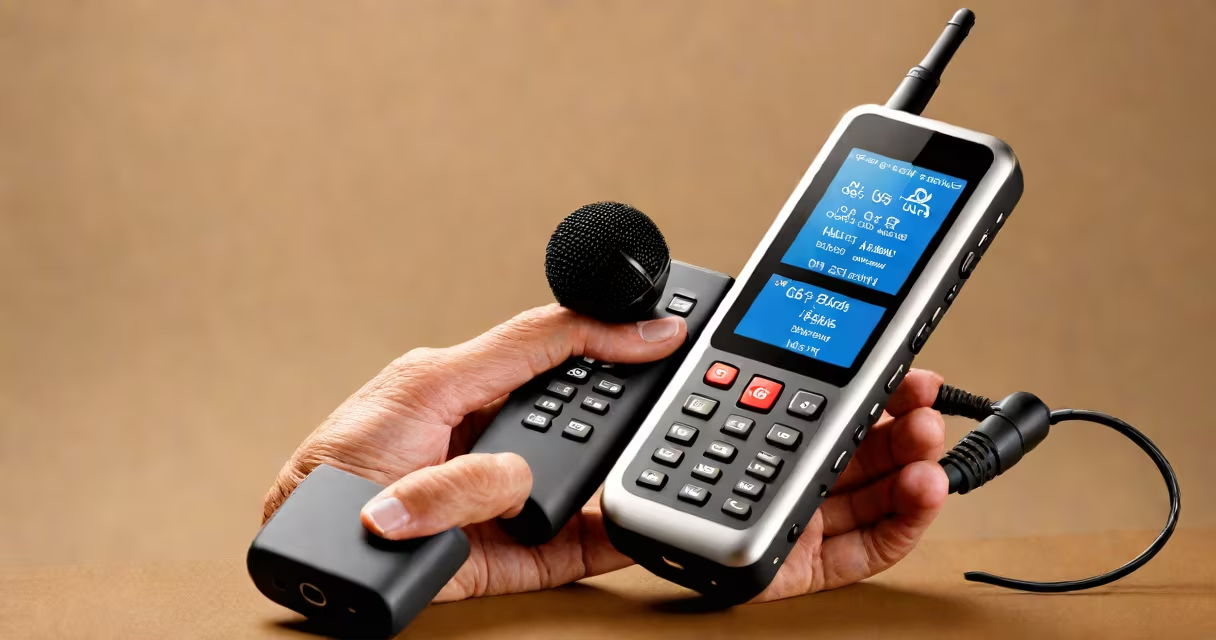
A handheld voice translator is a portable electronic device that listens to spoken language, processes it in real time, and outputs a spoken translation in another language. It enables direct verbal communication between people who speak different languages without requiring a human interpreter.
These devices typically feature a built-in microphone, speaker, and screen displaying translated text. They work by capturing audio input, analyzing the speech using artificial intelligence, converting the meaning into the target language, and then synthesizing the output as spoken words. Most models support 30 or more languages and function offline or via Wi-Fi depending on the model.
For example, a traveler in Tokyo speaking English into a device receives a Japanese response through the speaker. The same device shows the Japanese text on the screen while translating the incoming Japanese speech into English. This allows both parties to understand each other instantly during a conversation.
When activated, the device captures sound through its microphone. The audio is converted into digital signals and processed by speech recognition software. This software identifies phonemes, maps them to words, and reconstructs the sentence structure using natural language processing (NLP).
The system then translates the sentence into the selected target language using a neural machine translation engine. These engines have been trained on vast datasets of multilingual text, such as those used by Google Translate and DeepL. After translation, the system generates synthetic speech using text-to-speech synthesis, which plays through the device's speaker.
Handheld voice translators fall into two main categories based on connectivity and processing method:
| Type | Connectivity | Processing | Best For |
|---|---|---|---|
| Offline-capable | None or Bluetooth only | On-device AI chip | Travelers, remote areas, privacy-conscious users |
| Cloud-connected | Wi-Fi, cellular | Remote servers with advanced NLP | High accuracy, rare languages, complex grammar |
Offline-capable models, such as the Pocketalk Pro, use on-device AI chips to process speech without internet access. They're ideal for travelers in regions with poor connectivity. However, their language coverage is limited to around 30 languages, and translations may lack nuance compared to cloud-based systems.
Cloud-connected devices, like the Google Pixel Buds with Live Translate, rely on server-side processing. They support over 100 languages and adapt to regional dialects and slang. But they require stable internet and raise privacy concerns due to data transmission.
One key difference often overlooked: not all devices translate both ways equally. Some prioritize common language pairs (e.g., English-Spanish) and perform poorly on less common ones (e.g., Swahili-Korean). Always check the supported language list before purchasing.
Many assume handheld voice translators deliver perfect, human-level accuracy. In reality, they struggle with idioms, sarcasm, and context-dependent meanings. A statement like "That's a real knock-out" may be translated literally as "That's a real knockout," missing the figurative sense.
Another misconception is that these devices eliminate the need for language learning. While useful for basic interactions, they don't replace cultural understanding. Miscommunication can still occur when tone, intent, or social cues are lost in translation.
During a visit to a rural market in Morocco, I used a handheld translator to ask about dates. The device correctly translated my question into Darija Arabic. But when the vendor replied quickly, the device failed to catch the rapid speech, resulting in a garbled output. I had to repeat the question slowly and use gestures to clarify. This experience showed that even high-end devices fail under real-world conditions.
Handheld voice translators excel in scenarios requiring immediate, low-stakes communication. Travelers use them to order food, ask directions, or confirm hotel bookings. Business professionals use them in international meetings to grasp key points during informal discussions.
Emergency responders also benefit. During a 2022 earthquake in Turkey, aid workers used handheld translators to coordinate with local residents who spoke little English. The devices helped relay medical needs and safety instructions, though not all messages were accurately captured due to background noise and stress-induced speech patterns.
Healthcare settings use them to explain procedures to patients with limited language proficiency. A study published in JAMA Internal Medicine found that using translation tools reduced miscommunication errors by 40% in clinics serving non-English speakers, though clinicians still needed to verify critical information.
For optimal results, use the device in quiet environments, speak and at a moderate pace, and confirm understanding through follow-up questions. Avoid relying on it for legal, medical, or technical documents where precision matters.
Handheld voice translator remains a practical tool for bridging language gaps in real time. It's not a replacement for fluency, but it removes immediate barriers to communication in everyday situations.