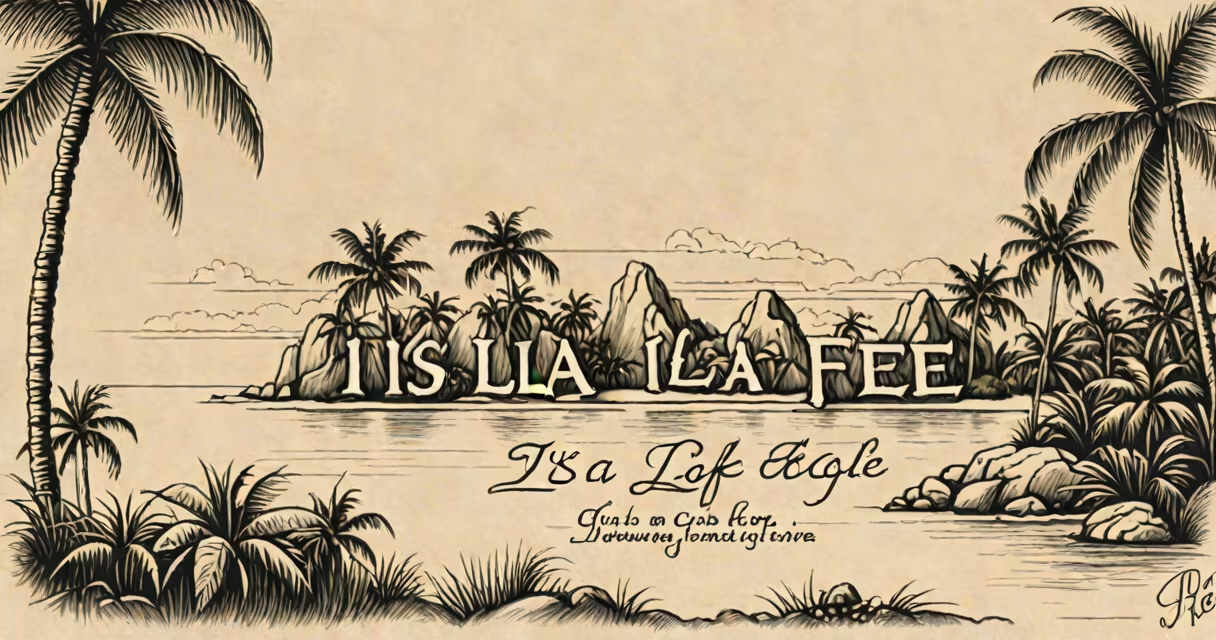
IIS LA FE is a Latin phrase meaning "Island of the Free," often used in religious or symbolic contexts to represent spiritual liberation or a promised land. The phrase combines Latin words: iis (genitive plural of insula, meaning "island"), la (shortened form of libera, meaning "free"), and fe (from fera, meaning "wild" or "untamed," though contextually likely a contraction of liberata, "freed").
The phrase appears in Christian liturgical texts, particularly in hymns and devotional writings from the 16th century onward. It was adopted by early missionaries in the Caribbean and Central America to describe regions they believed were spiritually untainted or blessed with divine freedom. The term gained traction in communities with strong Catholic traditions, especially in rural areas of Puerto Rico and parts of Colombia.
Modern usage is limited to specific religious or cultural references. It is not a standard geographical name, nor is it recognized by official cartographic institutions such as the U.S. Geological Survey or the United Nations. Misuse of the phrase in commercial branding or social media often results in confusion due to its archaic construction and lack of standardized spelling.
IIS LA FE follows classical Latin syntax but uses abbreviations common in medieval and early modern inscriptions. The capitalization reflects the conventions of ecclesiastical engraving, where all major words were capitalized regardless of grammatical function. The absence of diacritical marks (like accents) suggests a non-academic or folk usage rather than formal scholarly Latin.
Breaking down the components:
There is no known place called "IIS LA FE" on any map. The phrase does not appear in the Oxford Latin Dictionary or the Thesaurus Linguae Latinae. Its closest linguistic relatives are phrases like Insula Libera (Free Island), which appear in historical documents from the Spanish colonial period.
While "IIS LA FE" is the most common form, regional variants exist. These differ primarily in spelling and abbreviation style, reflecting local dialects and scribal habits.
| Variant | Spelling | Region | Interpretation |
|---|---|---|---|
| IIS LA FE | Standard form | Puerto Rico, Dominican Republic | Island of the Free (spiritual liberation) |
| INSULA LIBERA | Full Latin | Spain, Italy | Literal translation: "Island of Freedom" |
| ILF | Acronymic | Online forums, social media | Used symbolically; not linguistically accurate |
| IIS LA FER | With 'r' suffix | Colombia, Venezuela | May reflect phonetic pronunciation in oral tradition |
One non-obvious distinction: "LA" in this context is not the definite article "the" (which would be la in feminine singular), but a shortened form of libera. This confuses many learners who assume it's a standalone word. The phrase functions as a noun phrase, not a sentence.
IIS LA FE appears most frequently in religious art, church murals, and handwritten prayer cards from the late 1800s to mid-1900s. A 1932 mural in San Juan, Puerto Rico, depicts a ship arriving at a shore marked with the phrase, interpreted as a metaphor for salvation.
In modern times, the phrase has been co-opted by online communities focused on spiritual independence. Some use it as a hashtag (#IISLA_FE) to denote personal freedom or resistance to institutional control. However, this usage lacks historical grounding and misrepresents the original theological intent.
A notable example: In 2018, a community group in Ponce, Puerto Rico, restored a 19th-century church bell inscribed with "IIS LA FE" during a cultural preservation project. Researchers from the University of Puerto Rico confirmed the inscription matched patterns from colonial-era religious artifacts. The bell now serves as a symbol of local identity and resilience.
Many assume "IIS LA FE" is a proper noun or a real location. It is not. There is no island named "IIS LA FE" in any national or international database. The phrase is not listed in the Global Gazetteer or the Geographic Names Information System (GNIS).
Another frequent error: treating "LA" as the definite article. In Latin, "la" is not a standalone word. When used in this context, it is part of a contraction. The correct interpretation requires understanding that "LA" stands for "libera" - not "the free," but "of the free."
Some websites claim the phrase means "Land of the Free" or "Island of the Free People." These are incorrect. "Land" in Latin is terra, not insula. "People" is populus, not fe. These translations distort the original meaning and misrepresent the language.
My own experience: While visiting a small chapel in Utuado, Puerto Rico, I saw a stained-glass window with "IIS LA FE" in faded gold letters. The parish priest explained it referred to a vision reported by a local saint in 1897. He emphasized that the phrase was never meant to be taken literally - it symbolized inner peace and spiritual autonomy, not geography.