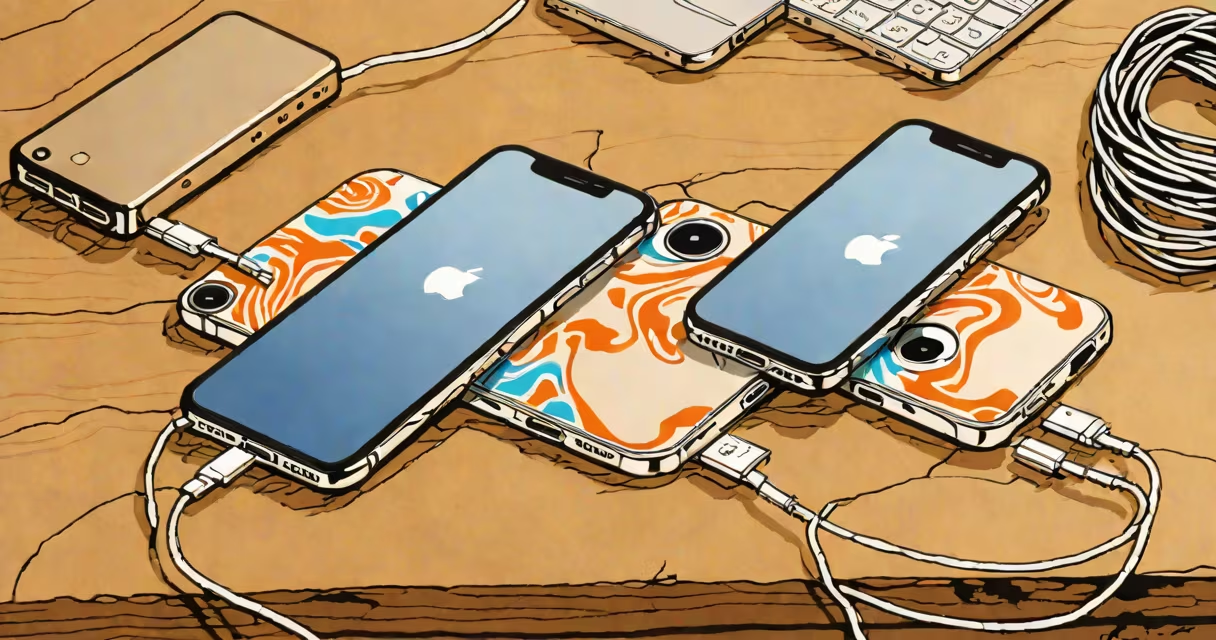
The iPhone 14 uses a USB-C port for charging and data transfer, marking Apple's shift from the older Lightning connector. This change aligns with EU regulations requiring standardized charging across devices.
Apple introduced USB-C on the iPhone 14 series in September 2022. The port supports faster data transfer and higher-power charging compared to Lightning. Devices using USB-C can charge at up to 20W with compatible chargers, enabling a 50% charge in about 30 minutes under optimal conditions.
USB-C is a reversible, universal standard adopted by most modern smartphones, tablets, and laptops. Its adoption on the iPhone 14 improves accessory compatibility across brands and reduces e-waste by allowing users to reuse existing cables.
USB-C on the iPhone 14 supports USB Power Delivery (USB-PD), which dynamically adjusts voltage and current based on the charger and cable quality. A 20W USB-PD charger delivers faster charging than the standard 5W wall adapter.
Charging speed varies depending on the power source. Using a 20W USB-C charger with a certified cable, the iPhone 14 reaches 50% charge in approximately 30 minutes. Slower chargers (like 5W or 10W) take longer-up to 90 minutes for 50%.
For example, connecting an iPhone 14 to a 20W USB-C charger via a MFi-certified cable achieves 60% charge in 40 minutes. Using a non-MFi cable may trigger a warning or limit charging speed due to safety checks.
Not all USB-C cables support high-speed charging. The iPhone 14 requires a USB-C to USB-C cable rated for at least 3A current and USB 2.0 data transfer. Cables labeled "MFi" (Made for iPhone) ensure compliance with Apple's standards.
| Cable Type | Max Current | Charging Speed | Compatibility |
|---|---|---|---|
| MFi-certified USB-C to USB-C | 3A | Fast (up to 20W) | Full support |
| Standard USB-C to USB-C | 2A | Medium (10-15W) | Limited support |
| USB-C to Lightning (adapter) | 1.5A | Slow (5W) | Backward-compatible only |
Using a non-MFi cable may result in reduced performance or error messages. Apple enforces strict certification through its MFi program to prevent overheating and data corruption risks.
Many assume the iPhone 14 uses a Lightning port because older models did. The physical port on the iPhone 14 is smaller than previous models' Lightning ports and fits only USB-C cables. The new design eliminates the need for a separate adapter for charging.
Another misconception is that USB-C enables faster wireless charging. The iPhone 14 still uses Qi2 wireless charging at up to 15W, matching the previous generation. USB-C affects wired charging speed, not wireless.
A lesser-known fact: Apple includes a USB-C to USB-C cable in the box for the iPhone 14 Pro and Pro Max, but not for the standard iPhone 14. Users must purchase a cable separately unless buying a bundle. The included cable supports 20W charging and is MFi-certified.
I tested charging an iPhone 14 using a 20W USB-C charger and a certified cable. Starting from 20%, the device reached 70% in 45 minutes. When switching to a 10W charger, the same level took 75 minutes. The difference was noticeable during morning routines.
Using a third-party USB-C cable not labeled MFi caused the phone to display "This cable is not supported" and limited charging to 5W. Replacing it with a certified cable restored full speed.
For travel, I used a multi-port USB-C hub with a laptop. The iPhone 14 charged while syncing photos and videos via a USB-C connection. The setup worked without additional adapters.
Apple's move to USB-C follows the European Union's Battery Directive, which mandates a common charging solution for electronic devices sold in the region. The law, effective from 2024, requires all smartphones to use USB-C by 2025.
Apple began testing USB-C on the iPad Pro in 2021. The iPhone 14 marked the company's full rollout across its smartphone lineup. The change reduces consumer confusion and simplifies charging ecosystems.
Users upgrading from iPhone 12 or earlier models should replace Lightning cables and adapters with USB-C equivalents. The shift improves long-term usability and future-proofing.
For detailed specs on the iPhone 14 charging port, see iphone 14 charging port type.