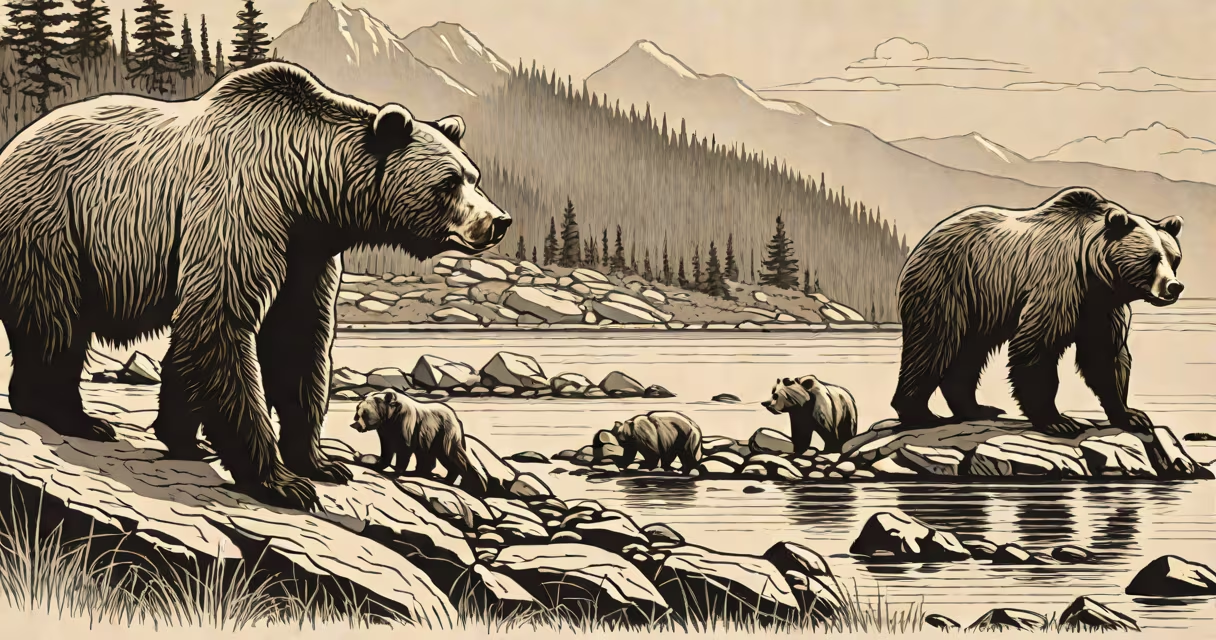
The kodiak bear (Ursus arctos middendorffi) is a distinct subspecies of brown bear native to the Kodiak Archipelago in Alaska, while the grizzly bear (Ursus arctos horribilis) is a North American population of the same species. The kodiak bear is larger, heavier, and more useful than the grizzly, with males averaging 1,500 pounds and reaching up to 2,000 pounds in rare cases.
Kodiak bears evolved in isolation on the islands of Kodiak, where abundant salmon and mild climate enabled them to grow to their maximum size. Grizzlies inhabit mainland ecosystems across western North America, including national parks and remote wilderness areas. Their smaller stature reflects adaptation to varied terrain and less consistent food availability.
Both species are omnivores, but kodiak bears consume more fish-especially sockeye salmon-during summer runs. Grizzlies rely more on roots, berries, insects, and scavenged meat. This dietary difference shapes their movement patterns and seasonal activity. Kodiak bears spend less time foraging due to high-calorie fish access, while grizzlies travel farther across rugged landscapes to find food.
Kodiak bears consistently outsize grizzlies. Adult male kodiaks average 1,500 pounds and stand 5 feet tall at the shoulder. Males can reach 10 feet long when standing upright. Grizzlies typically weigh between 600 and 1,000 pounds, with shoulder heights around 4 feet. Females of both species are smaller, though kodiak females still exceed most grizzlies in weight.
Body proportions differ too. Kodiak bears have broader shoulders, thicker necks, and shorter legs relative to body mass. Their skulls are massive-up to 18 inches wide-and adapted for crushing hard-shelled prey and tearing through tough fish flesh. Grizzlies have longer limbs suited for digging and climbing, which aids in accessing underground tubers and tree-dwelling insects.
| Feature | Kodiak Bear | Grizzly Bear |
|---|---|---|
| Average adult male weight | 1,500 lbs (680 kg) | 600-1,000 lbs (272-454 kg) |
| Shoulder height | 5 ft (1.5 m) | 4 ft (1.2 m) |
| Max recorded weight | 2,000 lbs (907 kg) | 1,500 lbs (680 kg) |
| Primary food source | Salmon, berries, vegetation | Roots, ants, berries, carrion |
Despite their size, kodiak bears are not inherently more aggressive. They avoid humans unless startled or protecting cubs. Grizzlies are known for sudden defensive charges, especially when surprised near dens or food caches. A study published in Animal Behaviour found that grizzlies react more quickly to human presence than kodiak bears, likely due to higher exposure in shared habitats.
Kodiak bears live exclusively on the Kodiak Archipelago, a chain of volcanic islands off the Alaskan coast. The absence of wolves and other large predators allowed them to dominate the food web. Salmon runs provide 70% of their annual caloric intake during summer months. Bears spend weeks at river mouths catching fish, then retreat to forested areas to rest and gain fat for winter.
Grizzlies occupy a vast range-from the Yukon Territory to northern California. They face competition from wolves, black bears, and occasional human conflict. Their survival strategy relies on seasonal migration. In spring, they emerge from dens and feed on emerging plants and rodents. By late summer, they focus on calorie-dense foods like whitebark pine nuts and cutthroat trout.
Climate change threatens both populations. Warmer temperatures reduce snowpack, delaying den entry and shortening hibernation periods. A 2022 report from the U.S. Fish and Wildlife Service noted that grizzly populations in the Greater Yellowstone System declined by 12% between 2000 and 2020 due to habitat fragmentation and reduced food availability. Kodiak bears remain stable due to protected status and limited human development.
Many assume that "grizzly" and "brown bear" are different animals. They are not. Grizzlies are a regional variant of the brown bear. The name "grizzly" comes from the silver-tipped guard hairs that give them a grizzled appearance. Kodiak bears share this trait but tend to have darker, more uniform fur.
Another misconception is that kodiak bears are more dangerous. Data from the Alaska Department of Fish and Game shows that grizzly-related injuries are more common in national parks. Between 1980 and 2020, 14 people were killed by grizzlies in Yellowstone and Glacier National Parks. No fatal attacks by kodiak bears were documented during the same period, despite higher visitation to Kodiak Island.
One non-obvious fact: kodiak bears do not hibernate as deeply as grizzlies. Their body temperature drops only 10-15 degrees Fahrenheit during winter, compared to 20-25 degrees in grizzlies. This allows them to wake more easily and move short distances if needed. Researchers at the University of Alaska Fairbanks observed kodiak bears walking through snowdrifts during winter storms, a behavior never seen in grizzlies.
In 2019, a hiker in Katmai National Park encountered a female kodiak bear feeding on a salmon carcass. The bear stood 5 feet tall and weighed approximately 1,300 pounds. The hiker remained calm, backed away slowly, and did not run. The bear watched for 30 seconds before resuming feeding. No injury occurred.
Contrast this with a 2017 incident in Montana's Flathead Valley, where a grizzly charged a backpacker who had accidentally approached a sow with cubs. The bear knocked the man down and bit his leg. He survived after receiving emergency treatment. The difference lies in context: grizzlies often defend cubs aggressively, while kodiak bears usually flee or assess threats before reacting.
I once observed a kodiak bear at Brooks Falls in Katmai during a guided tour. It caught a salmon mid-leap, flipped it in the air, and swallowed it whole. The sheer force of the catch caused water to spray over nearby observers. The bear showed no interest in us-its focus was entirely on food. That moment clarified something critical: size doesn't equal aggression. Power and purpose define behavior, not bulk alone.
Understanding the kodiak bear vs grizzly bear distinction matters for conservation, safety, and ecological awareness. Both are apex predators shaped by environment, not myth. Recognizing their differences prevents harmful assumptions and supports informed decisions about coexistence.