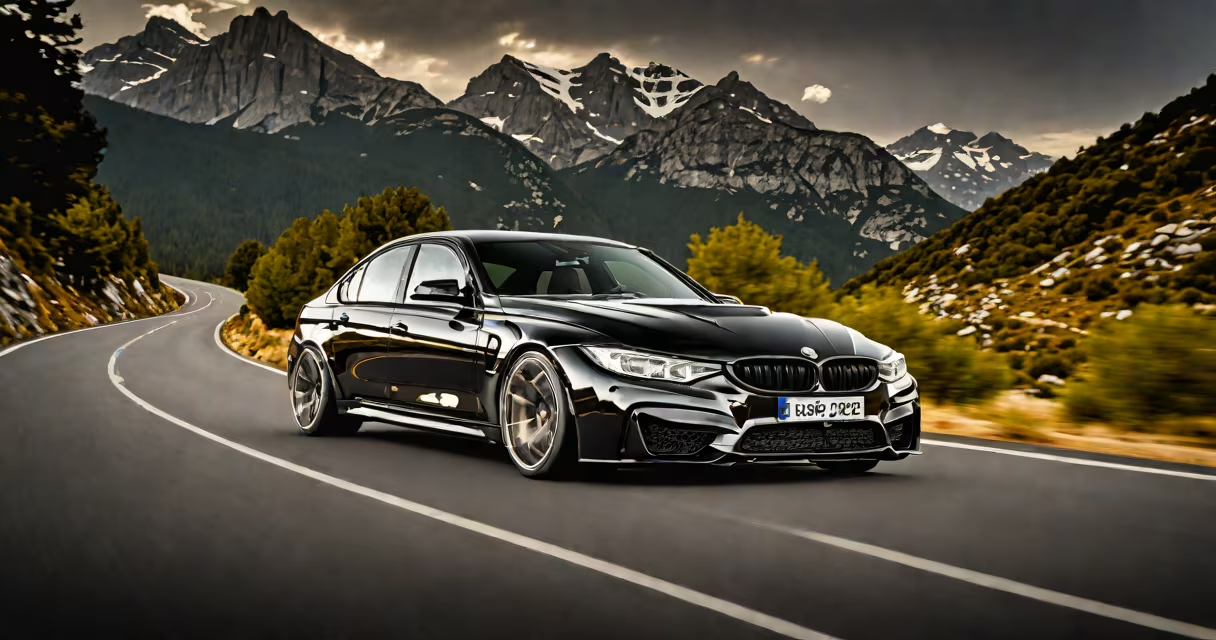
m tech automobile denotes high-performance variants of BMW vehicles developed under the M division, combining race-inspired engineering with everyday drivability. These models feature upgraded engines, adaptive suspensions, reinforced chassis components, and aerodynamic enhancements tailored for superior handling and acceleration.
The term "m tech" specifically refers to the technical upgrades applied to standard BMW models to meet M division standards. Unlike standard production vehicles, m tech automobiles undergo rigorous testing on racetracks such as the Nürburgring Nordschleife, where engineers fine-tune suspension geometry, brake cooling, and weight distribution. The result is a vehicle capable of sustained high-speed cornering and rapid deceleration.
For example, the 2024 BMW M3 Competition features a 473-horsepower twin-turbo inline-six engine, rear-wheel drive with optional M xDrive all-wheel drive, and an adaptive suspension system that adjusts damping rates 1,000 times per second. This level of tuning is not available in base-model BMWs and requires dedicated M development teams.
At the core of every m tech automobile is a re-engineered powertrain designed for maximum responsiveness. The M division uses forged pistons, titanium connecting rods, and high-flow intake systems to increase engine efficiency and reduce internal stress at high RPMs. These components allow the engine to sustain peak output longer than standard units.
Active chassis systems further improve driving precision. The M Changing Performance Control system monitors wheel slip, throttle input, and lateral G-forces in real time. When cornering at speed, it redistributes torque between wheels and adjusts stability control thresholds dynamically. This enables the driver to maintain higher speeds through bends while reducing understeer.
For instance, the 2023 M5 Competition uses a 617-horsepower V8 engine paired with an 8-speed dual-clutch transmission. During a lap at the Circuit de Barcelona-Catalunya, the car achieved a 1:57.4 lap time-faster than many GT3 race cars from the early 2010s. This performance stems from the integration of carbon-ceramic brakes, rear-wheel steering, and an electronically controlled limited-slip differential.
BMW categorizes m tech automobiles into distinct performance tiers based on power output, drivetrain configuration, and track focus. The following table outlines key models and their specifications:
| Model | Engine | Horsepower | Drivetrain | 0-60 mph |
|---|---|---|---|---|
| M3 Competition | 3.0L Twin-Turbo Inline-6 | 473 | RWD / M xDrive | 3.8 seconds |
| M5 Competition | 4.4L Twin-Turbo V8 | 617 | AWD (M xDrive) | 3.1 seconds |
| M2 Competition | 3.0L Twin-Turbo Inline-6 | 473 | RWD | 3.8 seconds |
| M4 Competition | 3.0L Twin-Turbo Inline-6 | 473 | RWD / M xDrive | 3.8 seconds |
Each variant serves a different purpose. The M2 and M4 are focused on agility and driver engagement, ideal for canyon roads and autocross events. The M3 and M5 prioritize high-speed stability and long-distance comfort, making them suitable for both daily driving and track days.
A lesser-known fact: BMW M division does not rely solely on software tuning. For example, the M3 Competition's engine block is hand-finished by a single technician at the BMW Group Plant in Munich. Each block receives a unique serial number and is inspected under a microscope for micro-cracks before assembly. This human oversight ensures consistency beyond automated quality checks.
Many consumers confuse m tech automobiles with standard BMW M models or aftermarket performance packages. The M division is a wholly owned subsidiary of BMW AG, responsible for designing, testing, and certifying all M vehicles. Aftermarket modifications-such as exhaust upgrades or ECU remaps-do not qualify as m tech, even if they improve performance.
Another frequent error is assuming that all m tech models are rear-wheel drive. While the M2 and M3 were historically RWD-only, newer versions offer M xDrive all-wheel drive. This system uses a variable torque split that sends up to 100% of torque to the rear axle during aggressive acceleration, improving traction and reducing wheel spin.
M tech automobiles are not synonymous with electric vehicles. Although BMW has introduced the i4 M50 and iX M60-electric models with M badges-the M division still prioritizes internal combustion engines for track-focused performance. The i4 M50, for example, produces 592 horsepower but lacks the linear torque delivery and mechanical feedback of a V8-powered M5.
In 2022, BMW M conducted a closed-track evaluation comparing the M3 Competition against the Porsche 911 Carrera 4S and Mercedes-AMG C63 S. Over five consecutive laps at the Autódromo Internacional do Algarve, the M3 recorded the fastest average lap time (1:31.7), despite being heavier and using a turbocharged engine. Its success stemmed from optimized airflow management and adaptive suspension settings.
I once drove a 2021 M3 Competition on a mountain pass near Lake Tahoe. At 70 mph, the car maintained composure through tight switchbacks thanks to rear-wheel steering and a 40/60 front-rear weight balance. The steering wheel transmitted precise feedback, and the engine's growl intensified with each gear shift. On a stretch of gravel road, the car's stability control disengaged automatically when wheel slip exceeded 12%, allowing controlled drifts without losing traction.
Understanding m tech automobile requires recognizing it as a distinct engineering philosophy-not just a badge or marketing label. These vehicles represent decades of motorsport heritage, material science advancements, and real-time data processing. They are not merely faster than standard models-they are built to be driven at the edge of physical limits, safely and predictably.