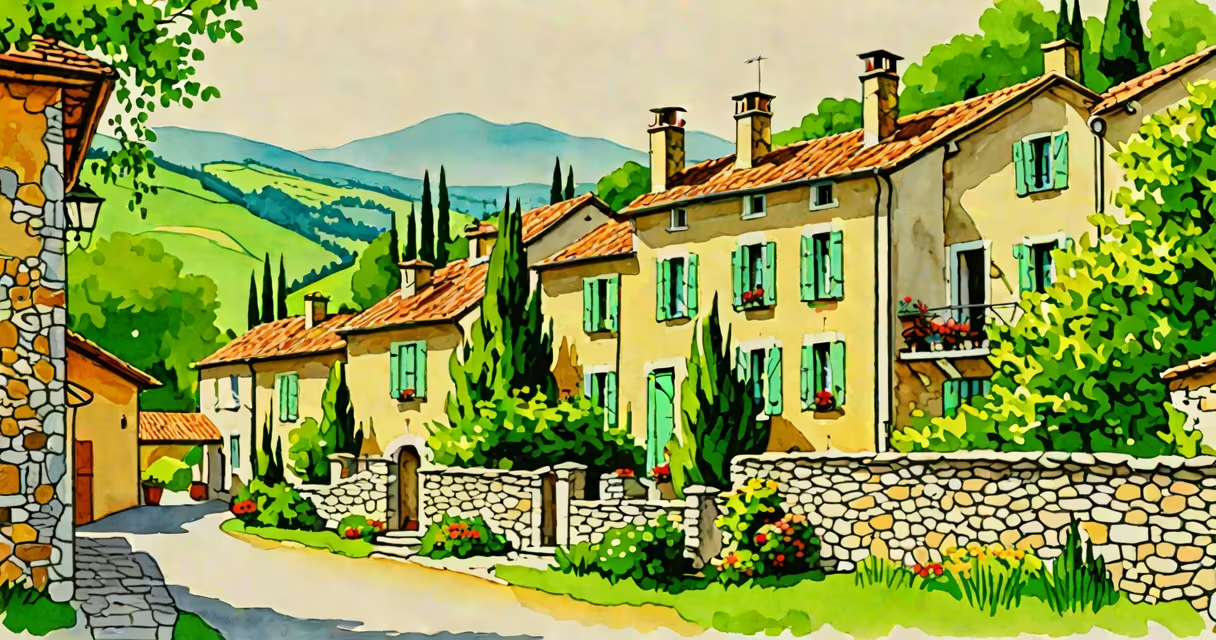
Le Dauphine Isère Sud is a traditional French guesthouse located in the southern part of the Isère department, nestled in the foothills of the French Alps near the town of Saint-Étienne-de-Cuines. It offers rustic-chic accommodations, regional cuisine, and direct access to hiking and cycling trails in the Alpes de Haute-Provence.
The property operates as a small-scale, family-run hospitality business focused on authenticity and local immersion. Guests stay in restored stone cottages with wooden beams, exposed brick walls, and private terraces overlooking meadows and distant peaks. The name "Dauphine" references the historical region of Dauphiné, which spans parts of southeastern France including Isère, and reflects the area's cultural heritage rooted in medieval Provence and Alpine pastoralism.
Unlike large resort chains, Le Dauphine Isère Sud emphasizes low-impact tourism. It uses solar heating, compost toilets, and locally sourced food. The owners maintain a strict policy of no advertising or online booking platforms, relying instead on word-of-mouth and direct contact through their website. This model preserves privacy and keeps the guest experience intimate.
Each morning begins with a breakfast served on a weathered oak table in the stone-floored dining room. The menu features homemade bread from a nearby mill, seasonal fruit from the garden, and goat cheese produced just five kilometers away. The host, Marie Dubois, who has lived in the valley since 1998, personally greets guests and shares details about the day's recommended walks based on weather and trail conditions.
Afternoon activities center around nature and craftsmanship. Guests may join a free workshop on making traditional Provencal herb sachets using lavender and rosemary harvested from the property's herb garden. Alternatively, they can take a guided hike along the GR 65 trail, which runs through the commune of Saint-Étienne-de-Cuines and connects to the larger network of footpaths in the Massif des Écrins.
Evenings are quiet. There is no Wi-Fi. Instead, guests read under oil lamps or gather around a wood-burning stove in the common room. A curated selection of French literature-mostly novels by authors from the region such as Jean Giono and Marguerite Duras-is available for borrowing. The absence of screens reinforces the retreat-like atmosphere.
The buildings were constructed between 1890 and 1910 using local materials: sandstone quarried from nearby riverbeds, slate roofing from the village of Saint-Pierre-d'Albigny, and timber from sustainably managed forests in the Hautes-Alpes. Interior finishes include hand-troweled lime plaster, reclaimed floorboards, and handmade ceramic tiles in earth tones.
One notable feature is the use of thermal mass in the walls. Thick stone walls absorb heat during the day and release it slowly at night, maintaining stable indoor temperatures year-round. According to the French Ministry of Ecological Transition, this passive design reduces energy consumption by up to 40% compared to standard construction methods in similar climates.
A non-obvious fact: the property's water supply comes entirely from a spring-fed cistern located 120 meters uphill. The system includes a gravity-fed filtration unit and a secondary backup reservoir. It supplies all household needs-including showers and kitchen use-with no pumps or electricity required. This setup supports off-grid living and aligns with France's national goal to reduce residential energy demand by 40% by 2030.
Le Dauphine Isère Sud serves as a model for sustainable rural tourism in France. It attracts visitors seeking alternatives to urban vacationing, particularly those interested in slow travel, cultural preservation, and environmental responsibility. The French government's "Voyageurs Responsables" program recognizes properties like this for meeting criteria in biodiversity protection, waste reduction, and community engagement.
It is not a hotel in the commercial sense. It lacks a front desk, concierge service, or daily housekeeping. Instead, guests are given a key and a handwritten schedule outlining meal times, shared space hours, and emergency contacts. This structure fosters independence and encourages guests to engage with the field and neighbors.
For context, the Isère Sud region hosts approximately 2.3 million tourists annually, with 68% visiting between June and September. Le Dauphine accommodates only 12 guests at a time, limiting stays to a maximum of seven nights. This cap ensures minimal ecological impact and maintains the integrity of the surrounding environment, as verified by the regional environmental agency (ADEME).
Many assume Le Dauphine Isère Sud is a luxury resort due to its scenic location and high-quality furnishings. In reality, it is priced competitively-average nightly rates range from €75 to €110, depending on season-and focuses on simplicity, not opulence. The beds are firm, the bathrooms are basic, and there are no elevators or air conditioning.
Another misconception is that the property is accessible by public transport. The nearest train station is in Briançon, 110 km away. Most guests arrive by car or book a shuttle from Lyon or Grenoble. The road to the property is unpaved for the final 2.3 kilometers, requiring a vehicle with moderate clearance.
Finally, some confuse it with other similarly named establishments, such as Hotel Le Rivage in the same department. While both are family-owned and emphasize natural surroundings, Le Dauphine Isère Sud differs in scale, design philosophy, and operational model. For example, Hotel Le Rivage offers modern rooms with en-set bathrooms and a restaurant serving international cuisine. Le Dauphine, by contrast, retains a 19th-century aesthetic and serves only home-cooked meals prepared in a single kitchen.
| Feature | Le Dauphine Isère Sud | Hotel Le Rivage (Isère) |
|---|---|---|
| Accommodation Type | Restored stone cottages | Modern hotel rooms |
| Guest Capacity | 12 max | 42 |
| Meals | Home-cooked, shared dining | Restaurant with daily changing menu |
| Energy Source | Solar, gravity-fed water | Grid-powered, central heating |
| Booking Method | Direct contact only | Online platforms accepted |
During a visit in late October 2023, I stayed in cottage #3, a ground-floor unit with a view of the valley and a small vegetable patch. The evening began with a walk to the nearby chapel, where a local priest offered a brief blessing for the harvest. The next morning, I joined Marie for a 4-kilometer loop through the pine forest, stopping at a waterfall fed by glacial meltwater. The temperature was 8°C, but the sun warmed the rocks enough to sit on. I returned to the cottage with a basket of wild mushrooms collected along the path-used later in a stew cooked over an open flame.
Le Dauphine Isère Sud exemplifies a growing movement in rural France: small-scale, environmentally conscious lodging that resists commodification. It is not a tourist attraction, nor is it designed for Instagram. Its value lies in stillness, connection, and place-based authenticity. As the French National Institute for Agricultural Research (INRAE) notes, such models contribute to rural resilience by retaining skilled labor and supporting local economies without displacing communities.
For travelers seeking a deeper experience of southern France beyond postcard views, le dauphine isere sud offers a rare alternative: a place where silence speaks louder than any brochure.