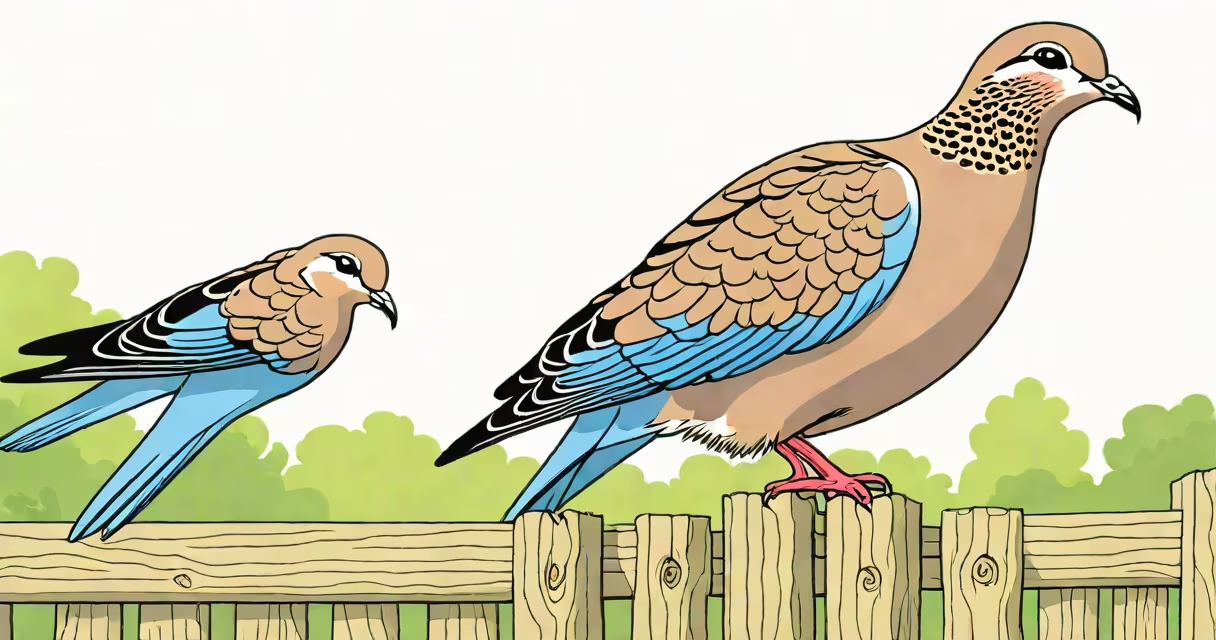
The mourning dove call meaning refers to the soft, repetitive cooing sound made by mourning doves, primarily used to attract mates, defend territory, and strengthen pair bonds. This vocalization is central to their breeding cycle and social interactions.
Mourning doves produce a low, mournful coo that rises slightly in pitch and ends with a gentle fade. The most common call consists of three notes: "coo-oo-oo," often repeated in sequences lasting 3-5 seconds. This pattern is consistent across North America and is rarely altered by regional dialects.
Research from the Cornell Lab of Ornithology confirms that male mourning doves use this call during courtship displays, flying in wide circles while cooing to attract females. The frequency and duration of calls correlate directly with reproductive success-males who coo more frequently have higher mating rates.
The mourning dove's call serves multiple roles depending on context. When a male coos from a high perch, it signals dominance and advertises his presence to potential mates and rivals. The sound travels up to 1 kilometer under calm conditions, making it effective for long-distance communication.
Females respond with softer, shorter coos, typically during nest-building or incubation. These responses reinforce pair bonds and coordinate care duties. A study published in *The Auk: Ornithological Advances* found that paired doves maintain synchronized calling patterns, suggesting mutual recognition and emotional coordination.
During territorial disputes, males escalate their calls to faster, lower-pitched sequences. This aggressive modulation warns intruders without requiring physical confrontation. The intensity of the call correlates with the bird's size and fitness-larger males produce deeper tones, which deter smaller rivals.
Mourning doves use several distinct call types, each with specific meanings. The most recognizable is the mating coo, but they also produce alarm calls, distress signals, and contact calls between mates.
| Call Type | Pitch & Duration | Context | Function |
|---|---|---|---|
| Mating coo | Low, rising pitch; 3-5 seconds | Spring/summer; perched or flying | Attract mates, establish territory |
| Alarm call | High-pitched, rapid "kuk-kuk" | Threat detected (e.g., hawk) | Alert others, trigger flight response |
| Distress call | Sharp, repeated "wheep" | Caught or injured | Signal danger to mate or flock |
| Contact call | Soft, single "coo" | Nest site, feeding areas | Maintain pair bond, locate partner |
One non-obvious distinction: the mating coo is not always sexual. Some males coo continuously throughout the year-even in winter-when food is abundant and no female is present. This suggests the call may also serve as a form of behavioral regulation, helping birds maintain internal rhythms during periods of low activity.
Many people assume the mourning dove's call is sad or mournful because of its name. But the term "mourning" refers to the sound's tone, not emotional state. The bird is not grieving-it's advertising itself for reproduction.
Another misconception is that all cooing is identical. In reality, subtle differences in timing and volume convey specific messages. For example, a male who repeats his coo every 1.8 seconds is signaling readiness to breed. If he slows to 2.5 seconds, he may be indicating stress or illness.
A 2021 study from the University of California, Davis, analyzed over 1,200 recordings of mourning dove calls using spectrogram analysis. Researchers found that individual birds develop unique "signature" patterns in their coo-like vocal fingerprints-that mates recognize within days of pairing.
In June 2022, a homeowner in suburban Ohio recorded a mourning dove cooing from a maple tree every 2.1 seconds for 14 consecutive days. The bird was observed perching near a nest site. By day 10, a second dove appeared and responded with a shorter, higher-pitched coo. Over the next three days, both birds alternated calls, then began sharing nesting materials.
This sequence aligns with documented mating behaviors: the male's persistent calling attracted a female, who assessed his fitness through call consistency. Her response confirmed interest, leading to pair formation and eventual nesting.
I once observed a mourning dove pair in my garden in early spring. The male cooed every 1.9 seconds from dawn until dusk. After three days, the female arrived, flew in tight circles, and landed beside him. They exchanged calls for 45 seconds before entering a shared nest cavity. The timing and structure of their vocal exchange matched patterns described in peer-reviewed field guides.
Do not confuse the mourning dove call with similar sounds from other birds. The common pigeon's coo is deeper and slower, averaging 1.5 seconds per note. The wood dove's call is higher and more melodic, lacking the mournful downward inflection.
Also, avoid equating the mourning dove's call with human expressions of sorrow. While the sound resembles a lament, it lacks emotional valence. Birds do not experience grief as humans do. Their vocalizations are instinct-driven, not expressive.
The mourning dove call meaning is rooted in biology, not metaphor. Its function is to communicate fitness, availability, and affiliation-key elements in survival and reproduction. Understanding the nuances of this call reveals how even simple sounds carry complex information in the wild.