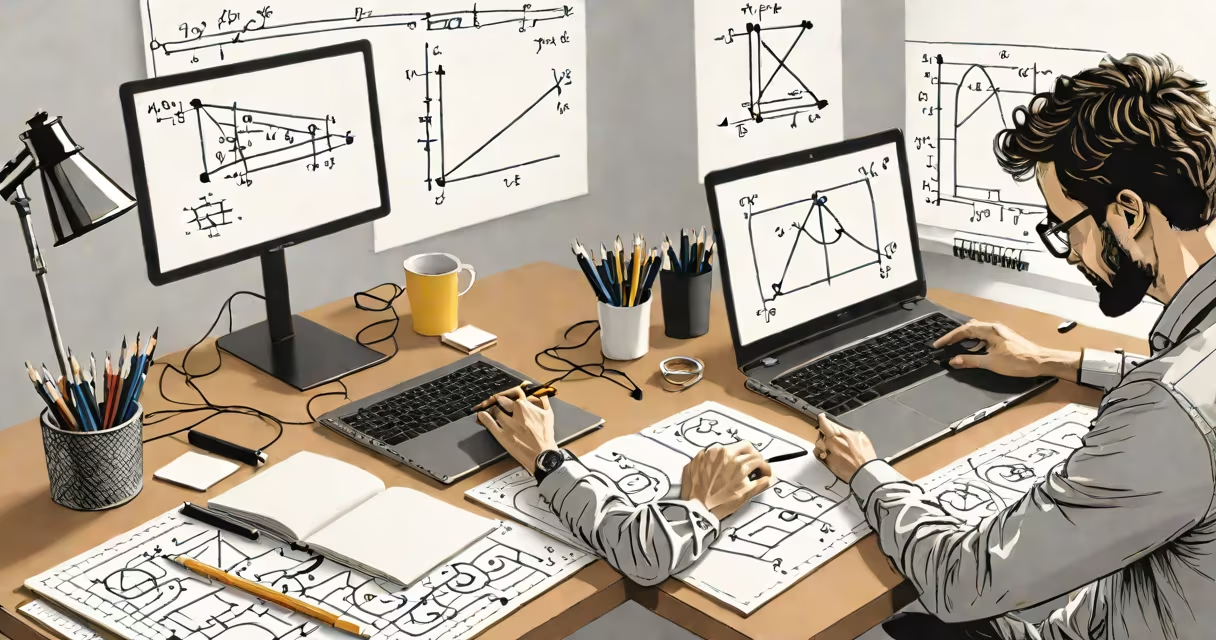
A physics bachelor degree online is a four-year undergraduate program that delivers core coursework in classical and modern physics, mathematics, and laboratory techniques through remote instruction. Students complete foundational classes in mechanics, electromagnetism, thermodynamics, and quantum physics while meeting accreditation standards set by the American Physical Society and the Council for Higher Education Accreditation.
These programs typically require 120 credit hours, including 40 credits in physics-specific courses and 30 in math and natural sciences. Most institutions offer asynchronous lectures, virtual labs using simulation software, and proctored exams. Students may complete capstone projects or research under faculty supervision. The degree qualifies graduates for advanced study in physics, engineering, data science, or technical roles in aerospace, energy, and tech industries.
Accredited online physics programs maintain the same academic rigor as campus-based counterparts. The University of Illinois Springfield and Western Governors University offer fully online physics bachelor's degrees with regional accreditation. Both require applicants to have completed high school algebra, trigonometry, and calculus. Completion times vary: full-time students finish in four years; part-time learners take five to six years.
Online physics programs use learning management systems like Canvas or Blackboard to deliver course materials. Students access video lectures, interactive simulations, and digital textbooks. Assignments are submitted electronically and graded within seven days. Weekly discussion forums allow peer interaction on complex topics such as wave-particle duality or tensor calculus.
Laboratory components are handled through virtual platforms. For example, students at Southern New Hampshire University use PhET simulations to explore Newton's laws of motion. These tools replicate real-world experiments using adjustable parameters and real-time feedback. Some programs require periodic on-site lab sessions, though most institutions waive this requirement for remote learners who demonstrate competency via written reports and video demonstrations.
Final assessments are administered remotely under secure proctoring. Proctors verify identity using ID checks and screen monitoring. Results are released within ten business days. Academic advisors assist with course planning, ensuring students meet prerequisites and stay on track for graduation.
Physics bachelor's degrees online fall into two categories: standard B.S. in Physics and applied tracks like Physics with Computational Methods or Physics and Data Science. The standard program emphasizes theoretical foundations and prepares students for graduate work. Applied variants integrate programming, statistics, and machine learning.
| Program Type | Credit Hours | Core Focus | Common Career Paths |
|---|---|---|---|
| Standard B.S. in Physics | 120 | Theoretical mechanics, quantum theory, relativity | Graduate school, research assistant, aerospace analyst |
| Physics & Computational Methods | 126 | Monte Carlo simulations, numerical integration, Python scripting | Data analyst, computational physicist, software engineer |
| Physics and Data Science | 130 | Statistical inference, machine learning, signal processing | Quantitative researcher, AI model developer, risk analyst |
Most programs require a senior thesis or capstone project. At the University of Maryland Global Campus, students design and simulate a particle accelerator model using MATLAB and finite element analysis. Projects are presented via video conference and evaluated by a panel of faculty and industry professionals.
Online physics degrees serve working adults, military veterans, and individuals in rural areas with limited access to physics departments. According to the National Center for Education Statistics, 43% of online STEM degree recipients live more than 100 miles from a physical university campus. These learners often balance full-time jobs with evening and weekend classes.
Employers value the problem-solving and analytical skills developed in physics curricula. A 2022 report from the American Institute of Physics found that 68% of physics bachelor's graduates secured employment in STEM fields within six months of graduation. Common employers include NASA, Lockheed Martin, Google, and national laboratories.
One key advantage is flexibility. A former electrician in Texas completed his physics bachelor degree online while working nights at a power plant. He used the program's self-paced modules to study special relativity during lunch breaks. After graduating, he was hired by a renewable energy startup to model solar panel efficiency under variable atmospheric conditions.
Many assume online physics degrees lack hands-on experience. This is incorrect. Virtual labs simulate real experimental setups. For example, students at Purdue University Global use Labster to conduct double-slit interference experiments. The platform allows manipulation of wavelength, slit width, and detector placement, producing measurable interference patterns.
Another misconception is that online programs are less rigorous. The Council for Higher Education Accreditation confirms that regionally accredited online physics degrees undergo the same peer review and curriculum audits as on-campus programs. Failure rates in core courses like Electromagnetic Theory average 18%, comparable to residential programs.
Some confuse physics degrees with engineering or computer science. While related, they differ in focus. Physics emphasizes understanding natural phenomena through mathematical models. Engineering applies those models to build functional systems. A student with a physics bachelor degree online might analyze fluid dynamics in a wind tunnel, while an engineering graduate designs the tunnel itself.
Not all online physics programs are equal. Only regionally accredited institutions-recognized by the U.S. Department of Education-offer degrees valid for federal financial aid and graduate admissions. The American Physical Society maintains a list of accredited programs. As of 2023, 37 online physics bachelor's programs hold full accreditation.
When choosing a program, verify accreditation status through the U.S. Department of Education's Database of Institutions and Programs. Avoid schools offering "physics" degrees without regional accreditation or those requiring minimal math prerequisites. A degree from an unaccredited institution may not qualify for licensure, research positions, or advanced study.
I once observed a student in a virtual quantum mechanics seminar struggle with Schrödinger's equation until we broke it down into step-by-step matrix operations. That moment revealed how deeply conceptual material requires structured support. Online programs that provide tutoring, office hours, and adaptive learning tools improve comprehension.
A physics bachelor degree online offers a credible, flexible path to advanced study and technical careers. It demands discipline and strong math skills but delivers measurable outcomes. Graduates enter fields where critical thinking and precision are essential. With proper accreditation and consistent effort, the degree holds the same weight as its on-campus equivalent.