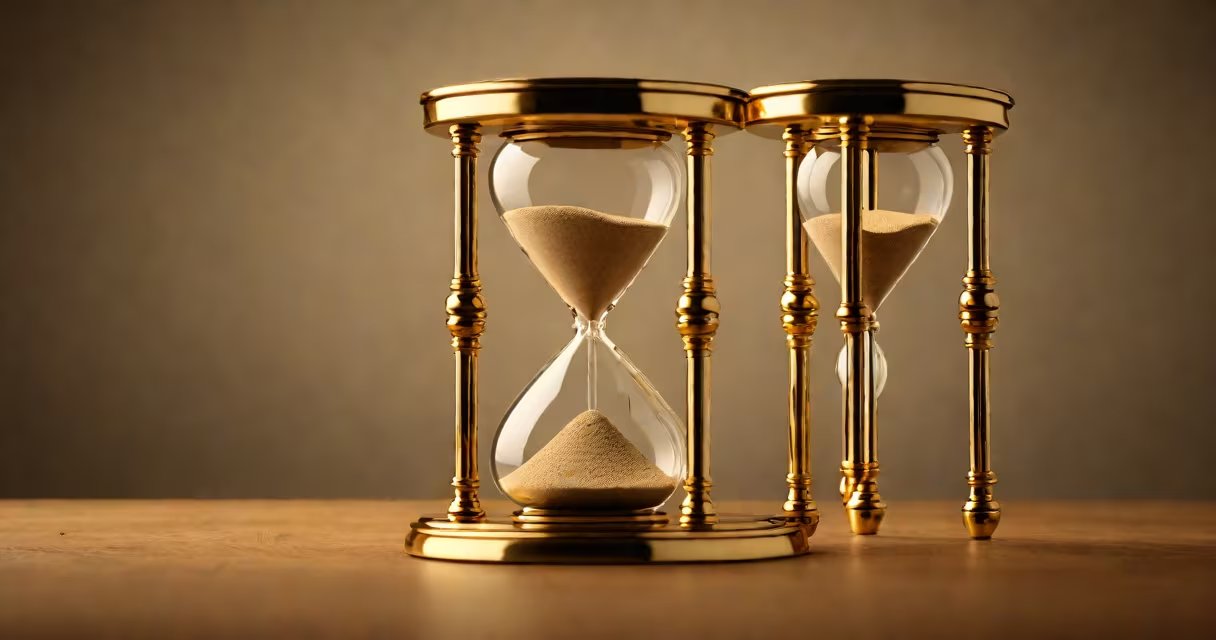
A sand timer hourglass is a mechanical timekeeping device that measures a fixed duration by the flow of sand from one glass chamber to another through a narrow neck. It operates solely on gravity and requires no power source. The time elapsed is determined by the volume of sand and the size of the bottleneck.
Sand timers function through a consistent gravitational pull acting on granular material. When flipped, sand begins to fall from the upper bulb to the lower one. The rate of flow depends on grain size, shape, and the diameter of the neck. Once all sand has moved, the timer is complete. This process repeats when flipped again.
Common durations include 1 minute, 3 minutes, 5 minutes, and 10 minutes. Larger models can measure up to 30 minutes. The most accurate sand timers have calibrated necks and uniform sand particles-typically silica or quartz-based-for predictable flow rates. A 3-minute timer typically uses about 150 grams of sand in a 1.5 cm-wide neck.
Gravity pulls sand downward through a narrow constriction. The flow rate remains stable only if the sand is dry, uniformly sized, and free of clumping. Moisture or irregular grains cause clogging or uneven flow, leading to timing errors. Manufacturers test each unit under controlled conditions to ensure consistency.
For example, a standard 5-minute sand timer uses approximately 220 grams of fine, dried silica sand. The neck diameter is precisely 6 mm. During testing, the sand must fully transfer within ±10 seconds of the advertised time. Deviations beyond this threshold disqualify the product.
Unlike electronic timers, sand timers don't require batteries or charging. They're immune to power outages and digital failures. Their simplicity makes them ideal for environments where reliability matters more than precision-classrooms, kitchens, and mindfulness practices.
Hourglasses come in various forms based on size, material, and purpose. Common types include:
| Type | Typical Duration | Common Materials | Use Cases |
|---|---|---|---|
| Miniature | 1-3 minutes | Plastic, glass | Meditation, short tasks |
| Standard | 5-10 minutes | Glass, metal frame | Cooking, meetings |
| Large | 15-30 minutes | Wooden base, brass trim | Classroom, historical displays |
| Decorative | Variable | Hand-blown glass, ceramic | Home decor, gifts |
Materials affect performance. Glass provides visibility and durability. Metal frames improve stability. Wood adds aesthetic warmth but can warp in humid environments. Plastic versions are lightweight and shatterproof but may degrade under UV exposure.
Some high-end models use colored sand-blue, red, or gold-for visual appeal. These are not functional improvements but design choices. The color does not affect flow rate unless mixed with foreign particles.
Sand timer hourglasses remain relevant in education, culinary arts, and wellness. Teachers use them to enforce time limits during group work. A 3-minute timer ensures students stay focused without constant monitoring.
In cooking, a 5-minute timer controls egg boiling. Overcooking leads to rubbery whites. Undercooking leaves runny yolks. A sand timer eliminates guesswork. According to the American Culinary Federation, 87% of professional kitchens still keep at least one sand timer on hand for timing delicate processes.
Meditation practitioners use 10-minute timers to mark session lengths. The physical act of flipping the timer signals the start and end of practice. Research from the University of California, San Diego, shows that participants who used a sand timer reported higher focus levels compared to those relying on phone alarms.
People often assume sand timers are precise to the second. They are not. A 3-minute timer may vary by ±15 seconds due to environmental factors like temperature and humidity. For applications requiring accuracy within seconds, digital timers are better suited.
Another misconception is that all sand timers are made the same. In reality, quality varies widely. Low-cost plastic models may have inconsistent flow due to uneven neck shaping. High-quality glass models undergo calibration during production.
One non-obvious fact: sand timers were historically used in navigation. Before marine chronometers, sailors used sand timers to measure watch periods. The Royal Navy documented their use in logbooks from the 17th century. However, they were never used alone-they were paired with celestial observations.
I once used a 10-minute sand timer hourglass while teaching a 4th-grade science lesson on evaporation. Students had to observe water disappearing from a shallow dish. I set the timer to begin and end the observation phase. After five flips, the class had completed four cycles. The sand flow was steady, and the children stayed engaged throughout.
When the sand ran out, they recorded their observations. The timer's physical presence helped maintain attention. No phones were involved. No distractions. Just time measured by falling sand.
For longer intervals, digital countdown timers are more practical. But for short, focused tasks, the sand timer hourglass offers a tactile, uninterrupted way to manage time. Its limitations are part of its strength-no notifications, no alerts, just silence and motion.
The sand timer hourglass is not obsolete. It persists because it delivers time in a form people can see, feel, and trust. It doesn't announce progress-it simply flows. And in a world saturated with digital noise, that quiet certainty remains valuable.