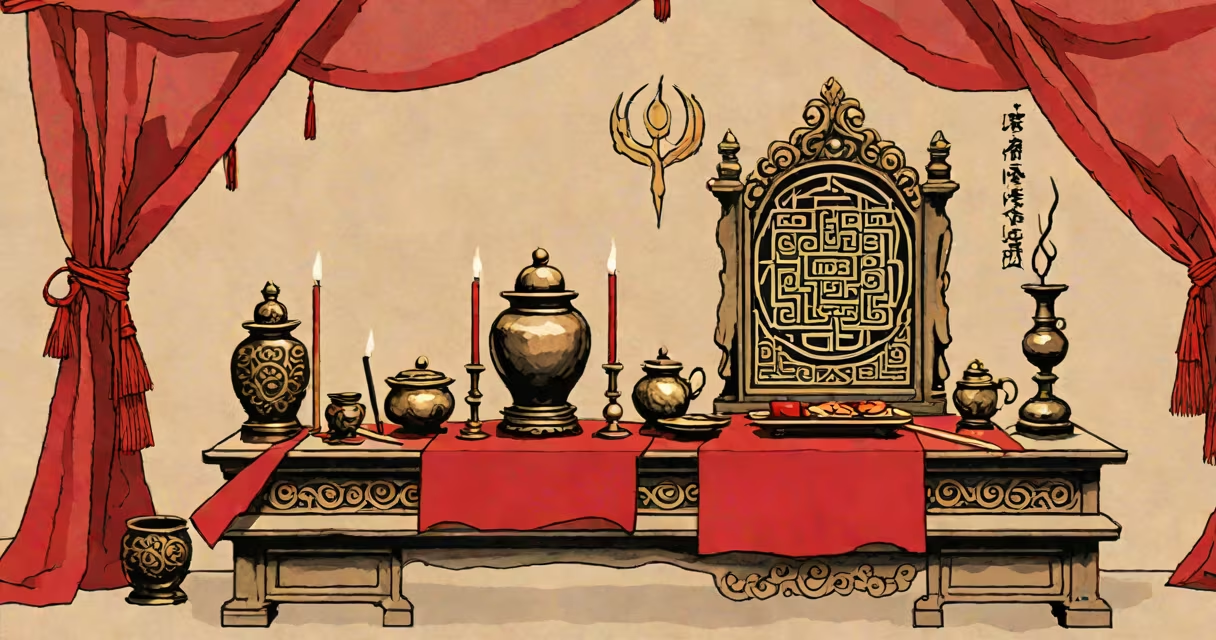
A soka gakkai altar is a personal devotional space in Nichiren Buddhism where members perform daily chanting to the Gohonzon-a sacred mandala inscribed with the title of the Lotus Sutra. It serves as a focal point for spiritual practice, discipline, and personal growth.
The altar is not a shrine in the traditional sense but a functional setup designed for consistent ritual. It includes a flat surface, often a wooden or lacquered stand called a kaidan, a red cloth, a central placement for the Gohonzon, and supplementary items such as incense, water, and flowers. The arrangement follows specific guidelines set by the Soka Gakkai International (SGI), emphasizing simplicity and reverence.
Practitioners chant Nam-myoho-renge-kyo-"Devotion to the Mystic Law of the Lotus Sutra"-facing the altar twice daily. This routine is meant to align inner resolve with universal principles, fostering resilience and clarity. The act of setting up and maintaining the altar reinforces mindfulness and consistency in practice.
Each morning and evening, members of Soka Gakkai sit before their altar and chant aloud. They begin by bowing toward the Gohonzon, then chant for 10 to 20 minutes while focusing on the inscription. The Gohonzon itself is a calligraphic mandala created by Nichiren Daishonin in the 13th century, representing the ultimate truth of life and the universe.
Chanting is not a request for favors but a declaration of one's inherent dignity and potential. The act of facing the Gohonzon daily strengthens mental focus and emotional stability. Members report increased confidence in handling challenges, improved relationships, and greater motivation in work and study.
After chanting, practitioners often place a small offering of water, flowers, or incense on the altar. These are symbolic gestures of respect and gratitude, not acts of worship. The water is changed daily, symbolizing the renewal of intention.
The core elements of a soka gakkai altar are standardized across global practice. The following table outlines the essential components and their purpose:
| Component | Purpose | Notes |
|---|---|---|
| Kaidan (platform) | Base for the altar | Wooden or lacquered; typically 30-60 cm wide. Must be stable and clean. |
| Red cloth | Symbol of purity and reverence | Must cover the entire kaidan. Not used in public spaces. |
| Gohonzon | Central object of devotion | Officially produced by SGI; not hand-drawn. Placed at eye level. |
| Incense burner | Represents purification of mind | Used daily during morning and evening practice. |
| Water bowl | Symbol of clarity and freshness | Refilled daily. Represents the impermanence of all things. |
| Flowers (optional) | Expression of gratitude | Real or artificial. Must be fresh and clean. |
While the Gohonzon is the centerpiece, the physical setup is secondary to the internal state of the practitioner. The altar functions as a tool to support concentration and intention, not as a conduit for supernatural power.
Soka gakkai altars are most commonly found in private homes, especially in Japan, North America, Europe, and parts of Asia. They are rarely placed in public settings due to cultural norms around religious expression. In Japan, many homes have a designated room or alcove for the altar, though smaller versions are common in apartments.
According to SGI's official literature, the altar is used to "cultivate a life of peace and happiness through faith." Daily practice is linked to measurable outcomes: a 2018 SGI survey of 12,000 members reported that 76% experienced reduced stress, 68% saw improvements in interpersonal communication, and 54% felt more motivated in their careers.
One non-obvious fact: the Gohonzon is not a deity or spirit. It is a visual representation of the principle that all people possess Buddhahood-the capacity for wisdom, courage, and compassion. The altar is not worshipped; it is a mirror for self-reflection.
Many outsiders assume the soka gakkai altar is a form of idolatry or superstition. This is incorrect. The Gohonzon is not a god. It is a teaching aid, like a textbook or a diagram. The practice is not about receiving blessings from a higher being but about awakening one's own inner strength.
Another misconception is that the altar requires elaborate rituals or special training. In reality, anyone can set up a basic altar using standard materials. SGI provides free templates and instructional videos online. A simple version can be assembled in under 30 minutes with a wooden tray, a red cloth, and a printed Gohonzon.
I once visited a member's apartment in Toronto where the altar was set up on a dining table. The space was modest-just a small mat, a single candle, and a folded cloth. Yet the atmosphere was calm. When asked why he kept it there, he said, "It reminds me to pause, breathe, and choose my response." That moment clarified the true function: not ritual, but presence.
Some confuse the soka gakkai altar with Shinto shrines or Tibetan Buddhist altars. While all involve offerings and focused attention, the intent differs. Shinto shrines honor kami (spirits); Tibetan altars may contain statues of deities. The soka gakkai altar has no statues, no icons, and no intermediaries. It is a direct engagement with the teachings of Nichiren.
The soka gakkai altar is not a decorative object. It is a living practice. It changes as the person changes. Over time, the same space can reflect shifts in mindset-from doubt to determination, from fear to clarity. The altar remains constant; the practitioner grows.