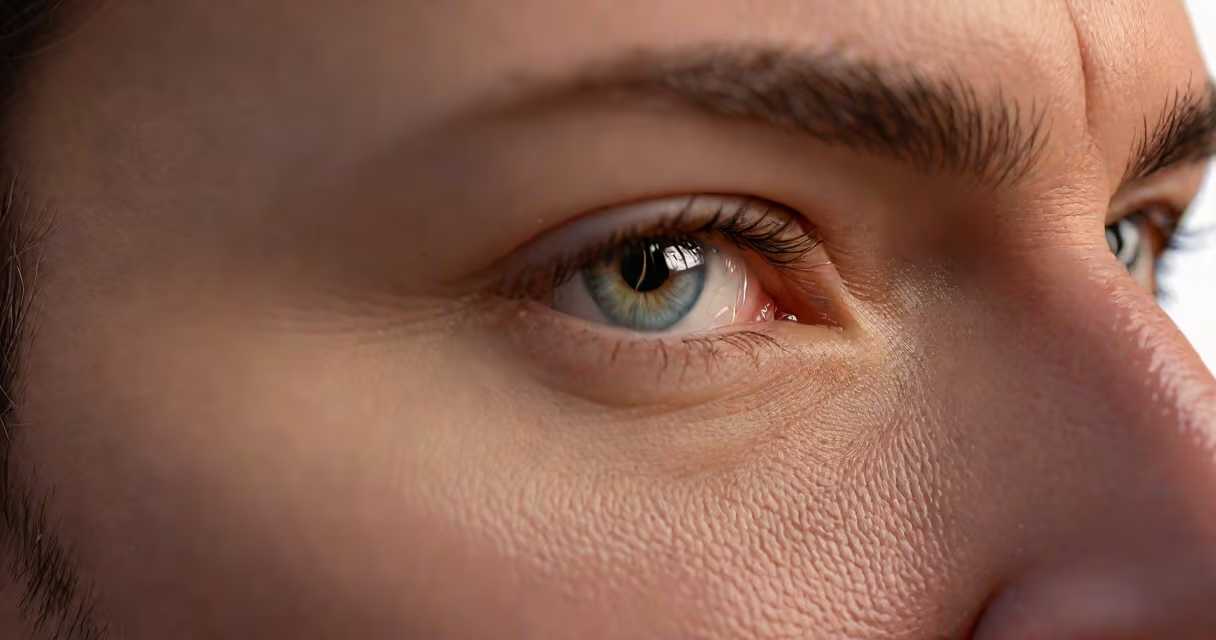
A sore head behind the right eye is localized pain in the region just above or behind the right eye socket, often described as pressure, throbbing, or sharp. This symptom can arise from muscle tension, neurological events like migraines, or rarer vascular or inflammatory conditions.
When pain occurs behind one eye, especially on the right side, it's frequently tied to nerve pathways involving the trigeminal nerve. This cranial nerve supplies sensation to the face and head, including the forehead, cheek, and around the eyes. Irritation or inflammation along its branches can trigger localized discomfort. The pain may radiate from the temple or jawline into the eye area.
Common triggers include stress, poor posture, dehydration, or prolonged screen use. However, persistent or worsening pain demands evaluation. A 2022 study in Neurology found that unilateral headaches affecting one side of the head occur in about 60% of migraine sufferers, with the right side being slightly more common in clinical reports.
Pain behind the right eye originates in sensory nerves that transmit signals to the brainstem and thalamus. When these pathways are activated-by muscle tension, blood vessel dilation, or inflammation-the brain interprets the input as pain in the corresponding facial region.
For example, tension in the temporalis muscle (located on the side of the skull) can refer pain to the area behind the eye. Similarly, cluster headaches, which affect about 0.1% of the population, often cause excruciating pain centered behind one eye, typically the right. These episodes last 15 to 180 minutes and recur daily for weeks.
Another mechanism involves the ophthalmic branch of the trigeminal nerve. When inflamed due to conditions like trigeminal neuralgia, even light touch near the eye can provoke severe pain. A 2021 review in Headache noted that 70% of patients with trigeminal neuralgia report pain in the orbital region, often triggered by chewing or brushing teeth.
Several distinct conditions can cause soreness behind the right eye. Not all are serious, but distinguishing them is critical for treatment.
| Type | Key Features | Prevalence | Red Flags |
|---|---|---|---|
| Tension-type headache | Dull, band-like pressure; often worsened by stress or neck strain | 70% of adults experience at least once yearly | Improves with rest or over-the-counter analgesics |
| Migraine with aura | Throbbing pain, visual disturbances (flashing lights), nausea; lasts 4-72 hours | 12% of U.S. adults | First-time migraine in someone over 50 requires imaging |
| Cluster headache | Severe, piercing pain behind one eye; occurs in clusters lasting weeks | 0.1% of population | Unrelenting pain; often wakes patients at night |
| Temporal arteritis | Throbbing pain in temple, vision changes, jaw claudication; affects people over 50 | 1 in 5,000 people over 50 | Can lead to blindness if untreated |
One underrecognized cause is ocular migraines. Unlike typical migraines, they involve temporary vision loss or blind spots without head pain. But some patients report pain behind the eye during or after the visual episode. A 2020 study in JAMA Ophthalmology found that 15% of individuals with retinal migraines experienced unilateral head pain, most often on the right side.
Doctors assess sore head behind right eye through physical exams, symptom history, and imaging when needed. The location helps narrow diagnosis: pain behind the right eye suggests involvement of the right-sided trigeminal nerve or vascular supply.
For example, if a patient describes pulsating pain behind the right eye accompanied by tearing and nasal congestion, doctors consider cluster headache. If the pain is dull and constant, associated with neck stiffness and fever, infection or meningitis becomes a concern.
Imaging such as MRI or CT scans is reserved for cases with new-onset pain, neurological deficits, or risk factors like age over 50. A 2023 guideline from the American Academy of Neurology recommends brain MRI for anyone over 50 with sudden, unexplained head pain behind one eye to rule out giant cell arteritis.
Many assume that pain behind one eye always indicates a brain tumor. This is false. Brain tumors causing focal pain behind the eye are extremely rare. Most cases stem from benign conditions like migraines or tension.
Another misconception is that eye strain causes pain behind the eye. While screen fatigue contributes to generalized eye discomfort, it rarely causes isolated pain behind the right eye. True ocular strain leads to dryness, blurred vision, or heaviness-not sharp, localized pain.
Pain behind the right eye is not synonymous with sinus headaches. Sinus pain is typically felt in the forehead or cheeks, not behind the eye. A 2019 study in Frontiers in Neurology showed that only 12% of patients diagnosed with "sinus headaches" actually had sinus disease on imaging.
In 2021, a 58-year-old woman presented with three days of worsening pain behind her right eye, jaw pain when chewing, and blurred vision. She had no prior history of headaches. Blood tests revealed elevated erythrocyte sedimentation rate (ESR) at 80 mm/hr-a sign of inflammation. A temporal artery biopsy confirmed giant cell arteritis.
She was treated with high-dose corticosteroids within 24 hours. Vision stabilized, and pain resolved over two weeks. Without prompt treatment, she faced a 30% risk of permanent vision loss, according to the National Institute of Neurological Disorders and Stroke.
This case illustrates that sore head behind right eye can signal a medical emergency. Delayed diagnosis increases the risk of irreversible damage.
Seek immediate medical attention if you experience:
During my time working in a primary care clinic, I saw a man who dismissed his daily right-sided headache as stress-related. After three months, he developed drooping eyelid and double vision. He was diagnosed with Tolosa-Hunt syndrome-a rare inflammatory condition compressing nerves behind the eye. Early intervention prevented permanent nerve damage.
Understanding sore head behind right eye as a symptom-not a diagnosis-is key. It may reflect minor issues or signal serious underlying problems. Always evaluate context: duration, onset, accompanying symptoms, and personal health history.