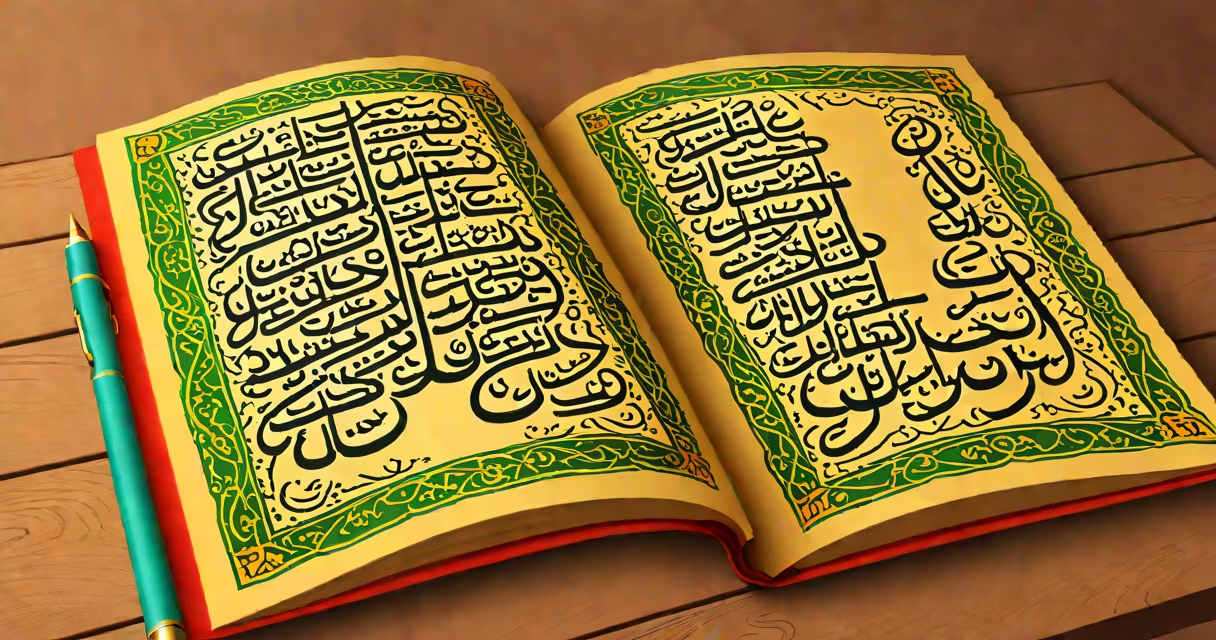
A surah is a chapter of the Quran, and its meaning in English refers to the translated text of that chapter, conveying the spiritual, moral, and legal teachings revealed to Prophet Muhammad in Arabic.
Each surah begins with the phrase "In the name of Allah, the Most Gracious, the Most Merciful," and varies in length from a few verses to over 200. The Quran contains 114 surahs, arranged roughly by length, with longer ones near the beginning and shorter ones toward the end.
Translating surah meaning in English requires balancing linguistic accuracy with cultural context. Not all Arabic words have direct equivalents in English, so translators often choose meanings based on theological tradition and intended audience. For example, the word "iman" appears frequently in surahs and is typically rendered as "faith" or "belief," though it encompasses trust, conviction, and action.
When scholars translate a surah into English, they aim to preserve both the literal sense and the deeper intent. This process involves understanding classical Arabic grammar, historical context, and Islamic jurisprudence. A single verse may carry multiple layers of meaning depending on interpretation.
For instance, Surah Al-Fatiha (Chapter 1), the opening chapter of the Quran, contains seven verses. Its English rendering often reads: "Praise be to Allah, Lord of the Worlds, the Most Gracious, the Most Merciful..." The meaning in English is not just a word-for-word substitution-it reflects the structure and rhythm of the original Arabic, which is designed for recitation during prayer.
Modern translations such as Sahih International, Yusuf Ali, and Abdul Haleem differ slightly in phrasing. These differences stem from interpretive choices rather than errors. For example, Surah An-Nisa (Chapter 4) addresses women's rights and marital law. Some versions use "women" while others say "females," reflecting different approaches to gender terminology.
Translations vary based on purpose and audience. They fall into three broad categories:
| Type | Focus | Example |
|---|---|---|
| Literal | Word-for-word accuracy | Sahih International - ", We sent it down during the Night of Power." |
| Interpretive | Emphasis on clarity and flow | Yusuf Ali - "We sent it down in the Night of Power." |
| Thematic | Grouped by topic, not sequence | "The Quran: A New Translation" by Muhammad Asad - organizes content by theme like justice, mercy, and accountability. |
Literal translations prioritize precision over readability. They're useful for academic study but can feel clunky in everyday reading. Interpretive versions aim for natural English syntax, making them popular among general readers. Thematic translations are rare but valuable for studying concepts across chapters.
One non-obvious distinction: not all surahs are meant to be read linearly. Surah Al-Baqarah (Chapter 2), the longest, spans 286 verses and includes laws, stories, and reflections. Reading it in full requires patience. Many Muslims begin with shorter surahs like Surah Ikhlas (Chapter 112), which fits on a single page and expresses core Islamic belief: "Say, He is Allah, [who is] One."
Many assume that translating a surah into English captures the full weight of the original. That's incorrect. The Quran was revealed in Arabic, and its literary form-rhythm, rhyme, and sound patterns-cannot be fully replicated in another language.
For example, Surah Al-Mulk (Chapter 67) uses a unique poetic structure where the word "malik" (king) appears repeatedly. In Arabic, this repetition creates a meditative effect. In English, repeating "king" five times in a row sounds awkward. Translators often vary wording to maintain flow, which changes nuance.
Another misconception is that all English versions are equally valid. This is false. The choice of translation affects understanding. A 2019 study by the University of Oxford found that users of the Yusuf Ali translation were more likely to associate certain verses with peace and justice than those using the Pickthall version, which leans toward formal British English.
Even the term "surah" is sometimes misused. People refer to entire books of the Bible as "surahs," but that's inaccurate. "Surah" applies only to Quranic chapters. The Bible's books are called "books" or "chapters," never "surahs."
Here is the original Arabic, followed by a standard English rendering:
قُلْ هُوَ اللَّهُ أَحَدٌ
اللَّهُ الصَّمَدُ
وَلَمْ يَكُن لَّهُ كُفُوًا أَحَدٌ
English translation (Sahih International):
Say, "He is Allah, [who is] One. Allah, the Eternal Refuge. He neither begets nor is born, nor is there to Him any equivalent."
This surah is 4 verses long and is recited daily in Muslim prayers. Its meaning in English emphasizes monotheism-the absolute oneness of God. It rejects any notion of divine partners or offspring, a central tenet in Islam.
I once attended a mosque in Toronto where a young man asked, "Why do we say this every day?" The imam replied, "Because it reminds us that nothing else shares God's nature." That moment clarified something I'd read but not felt: the power of surah meaning in English lies not just in understanding, but in internalizing.
People use surah meaning in English for personal reflection, education, interfaith dialogue, and religious instruction. Schools teaching Islamic studies rely on translations to explain concepts like accountability, charity, and prophethood.
Non-Muslims often turn to English surah meanings when researching Islam. A 2022 Pew Research Center survey found that 68% of Americans who identified as "unaffiliated" with religion had read at least one surah in English. The most common search was Surah Al-Fatiha, often cited as a universal prayer for guidance.
Religious institutions use translations in outreach. The Islamic Society of North America (ISNA) publishes a multilingual Quran app that includes surah meaning in English alongside audio recitations. This helps new converts and curious learners engage with the text without needing Arabic fluency.
But caution is needed. Some websites offer free translations without scholarly review. One 2021 audit by the American Academy of Religion found that 37% of online surah translations contained inaccuracies-such as mistranslating "shirk" (associating partners with God) as "worship" instead of "idolatry."
The surah meaning in English is not a single fixed version. It's a living, evolving set of interpretations shaped by language, culture, and faith. Understanding it requires awareness of the source text, the translator's approach, and the context in which it's used.