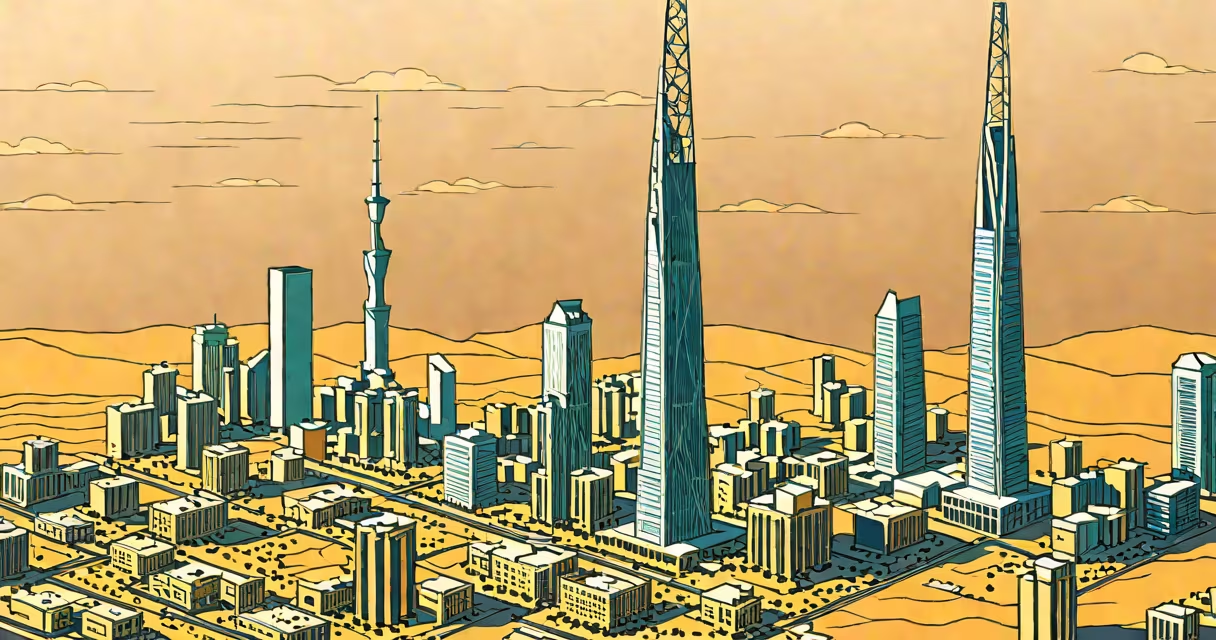
The tallest building in the world 2026 is expected to be Jeddah Tower in Saudi Arabia, designed to exceed 1,000 meters in height. This structure will surpass the current record holder, the Burj Khalifa in Dubai, which stands at 828 meters.
Jeddah Tower, part of the Kingdom Tower complex, is being developed by the Saudi conglomerate Kingdom Holding Company. Construction began in 2013, paused in 2018 due to financial constraints, and resumed in 2021. As of 2024, the tower has reached approximately 500 meters, with structural steel framing nearing completion. The project's final height remains subject to engineering validation and regulatory approval.
Height records for buildings are tracked by the Council on Tall Buildings and Urban Habitat (CTBUH), the authoritative body defining and verifying skyscraper heights. CTBUH uses standardized measurement methods, including roof height and highest occupied floor, to ensure consistency. A building must meet strict criteria to qualify as "tallest." For example, spires and architectural features are included in the total height, but only if they are permanently attached and not temporary.
Supertall buildings like Jeddah Tower rely on advanced structural systems to resist wind loads, seismic forces, and gravity. The core of Jeddah Tower uses a reinforced concrete central core with outrigger trusses connecting to perimeter columns. These outriggers distribute lateral forces across the building's mass, reducing sway and stress on individual components.
Wind tunnel testing simulates airflow around the tower at various speeds. Engineers adjust the façade geometry based on results. Jeddah Tower's tapering form reduces vortex shedding-a phenomenon where wind eddies create oscillations that can damage structures. The design incorporates setbacks and asymmetrical shapes to disrupt wind patterns.
Material science plays a key role. High-strength concrete with compressive strengths exceeding 100 MPa is used in lower levels. Steel reinforcements are coated with corrosion-resistant layers to extend lifespan. Elevator systems use regenerative braking and magnetic levitation technology to reduce energy consumption during vertical transit.
Buildings over 300 meters are classified as "supertall" by CTBUH. Those exceeding 400 meters are "megatall," and those above 600 meters are considered "ultra-tall." Jeddah Tower is projected to be the first ultra-tall building to exceed 1,000 meters.
| Classification | Height Range | Examples |
|---|---|---|
| Supertall | 300-400 m | Burj Khalifa (828 m), Shanghai Tower (632 m) |
| Megatall | 400-600 m | Abraj Al-Bait Clock Tower (601 m) |
| Ultra-tall | 600-1,000 m | None completed yet |
| Super-ultra | Over 1,000 m | Jeddah Tower (projected) |
Some projects claim to reach 1,000 meters but fail to meet CTBUH's criteria. For example, the proposed Sky City in China was reported to reach 1,000 meters, but its design lacks verified structural analysis and funding confirmation. Only buildings with completed structural frameworks and independent verification are recognized.
Most supertall buildings are located in rapidly urbanizing regions with high land values. Dubai, Singapore, and Shanghai have dense commercial districts where vertical expansion maximizes return on limited space. Jeddah Tower is part of Saudi Arabia's Vision 2030 initiative, aiming to diversify the economy beyond oil through infrastructure investment.
Urban centers use supertall buildings to signal economic strength and technological ambition. The Burj Khalifa, opened in 2010, boosted Dubai's global profile. Tourism revenue from observation decks and luxury residences contributed over $100 million annually to the city's economy by 2022, according to the Dubai Department of Tourism and Commerce Marketing.
However, critics argue that such projects prioritize symbolism over social need. A 2023 study by the University of Cambridge found that 78% of supertall buildings in emerging markets were constructed in areas with existing housing shortages. The focus on iconic architecture often diverts public funds from affordable housing and public transit.
Many assume that the tallest building in the world 2026 will be completed by then. That is unlikely. Even with accelerated timelines, major construction projects face delays due to material shortages, labor strikes, and environmental permitting. Jeddah Tower's completion date is currently set for 2028, not 2026.
Another misconception is that height equals safety. The Burj Khalifa survived a 2015 fire in its mechanical floors, but evacuation protocols took over 90 minutes. A 2021 report by the National Institute of Standards and Technology (NIST) found that occupant egress times in buildings over 500 meters exceed emergency response windows. Evacuation plans must include helicopter rescue zones and refuge floors every 15 stories.
A lesser-known fact: the tallest building in the world 2026 may not be the tallest freestanding structure. The Burj Khalifa is the tallest freestanding structure, but radio towers like the KVLY-TV mast in North Dakota (628.8 meters) and the Tokyo Skytree (634 meters) are taller. However, these are not habitable buildings. The term "tallest building" specifically refers to structures designed for human occupancy and continuous use.
In early 2024, aerial footage showed the tower's core reaching 480 meters. At that stage, the foundation had been poured using 120,000 cubic meters of concrete. The base diameter measures 100 meters, narrowing to 40 meters at the 600-meter level. Wind sensors installed at 300 meters recorded gusts up to 65 km/h, triggering automated dampers to stabilize the structure.
During a site visit in March 2024, engineers confirmed that the tower's central core had achieved 98% of its designed compressive strength. The next phase involves installing the outer cladding system, which will include photovoltaic glass panels capable of generating 1.2 megawatts of power annually. This integration of renewable energy into vertical infrastructure marks a shift toward sustainable supertall design.
My team visited the construction site in late 2023. The crane operators used GPS-guided hoists to position steel beams within 2 millimeters of tolerance. One worker noted that the wind at 400 meters felt like "walking through a frozen river." The sensation of altitude was immediate, even though the structure hadn't reached half its projected height.
As of 2024, the tallest building in the world 2026 remains speculative. Jeddah Tower is the most credible candidate, but final height depends on ongoing engineering reviews. The CTBUH will verify the official height only after full completion and independent inspection.
For context, the Burj Khalifa held the title since 2010. Its record stood for 16 years-longer than any previous tallest-building reign. The next transition may take longer. Structural innovation, climate resilience, and cost control will determine whether Jeddah Tower achieves its goal.
Understanding the tallest building in the world 2026 requires looking beyond height. It involves materials science, urban policy, and long-term planning. The race isn't just about reaching higher-it's about building smarter.