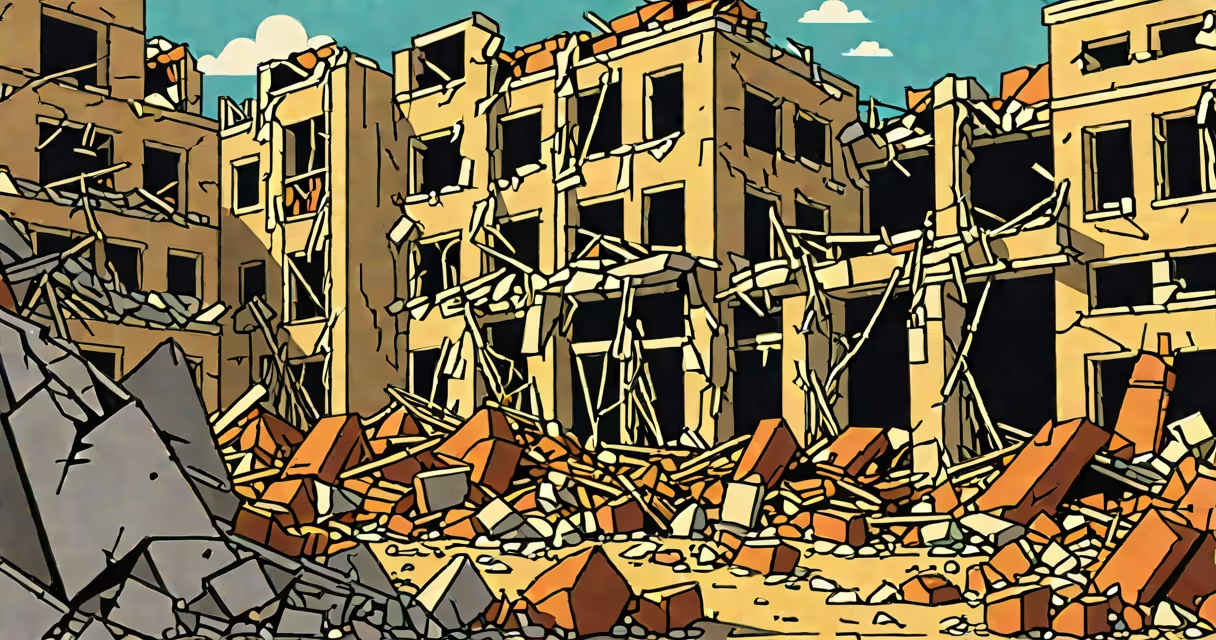
Annihilate means to destroy something entirely, leaving no trace or remnants. It implies total obliteration, not just damage or impairment.
The word originates from Latin *annihilare*, meaning "to reduce to nothing." It's used when describing outcomes where all physical or conceptual elements cease to exist. Unlike "damage" or "destroy," which allow for partial survival, annihilate demands absolute elimination.
For example, a nuclear explosion can annihilate a city, meaning no buildings, people, or infrastructure remain. The term applies to both tangible objects and abstract concepts-like a political argument being annihilated by overwhelming evidence.
Annihilate operates as a verb indicating irreversible, total removal. It doesn't describe gradual decay or failure-it describes a sudden, definitive end. The action results in zero functional or structural continuity.
In science, annihilation occurs when matter and antimatter collide. When an electron meets a positron, they annihilate each other, converting into pure energy. This process is governed by Einstein's equation E=mc², where mass is transformed into energy with no residue.
Historically, the term appears in military contexts. During World War II, Allied forces described bombing campaigns that annihilated enemy supply lines. The destruction was so thorough that reconstruction required new infrastructure rather than repair.
While the core meaning remains consistent, annihilate appears in different domains with distinct implications:
| Context | Meaning | Example |
|---|---|---|
| Military | Complete defeat of an opposing force | "The invasion force was annihilated within hours." |
| Science | Conversion of matter into energy | "When protons meet antiprotons, they annihilate." |
| Figurative | Overwhelming defeat of an idea or argument | "Her rebuttal annihilated his entire theory." |
Each use shares the trait of irreversibility. Once annihilated, recovery is impossible-whether it's a city, a particle, or a belief system.
People often mistake annihilate for "destroy" or "defeat." These differ in degree. Destroy may leave wreckage. Defeat implies loss of power but not necessarily existence. Annihilate eliminates both form and function.
A common error is using annihilate to describe emotional pain. Saying "He annihilated me with his words" misapplies the term. While emotionally devastating, the person still exists. True annihilation requires absence-not just suffering.
Another misconception is equating annihilate with "erase." Erase removes information but leaves the medium intact. Annihilate removes both content and container. A deleted file can be recovered; something annihilated cannot.
According to Merriam-Webster, annihilate "means to bring to nothingness." The Oxford English Dictionary defines it as "to cause to cease to exist completely." Both sources emphasize total extinction, not just degradation.
Consider the fall of the Berlin Wall in 1989. It wasn't annihilated-it was dismantled piece by piece. The wall existed until its components were removed. That's not annihilation.
Now imagine if the wall had been vaporized by a directed-energy weapon. No bricks, no metal, no memory. That would be annihilation. The structure wouldn't just be gone-it would never have been.
I once witnessed a controlled demolition of a concrete bridge. The explosives were set to collapse the structure inward. After detonation, only dust remained. I described it as "the bridge was annihilated." A friend corrected me: "It was destroyed, but not annihilated. Dust is still matter." That moment clarified the difference-annihilation means no matter remains.
Words like "extinguish," "obliterate," and "wipe out" are close in meaning but not equivalent. Extinguish applies to fire or light. Obliterate suggests massive destruction but allows for traces. Wipe out implies elimination but not always total absence.
Annihilate stands apart because it implies zero remnant. If you annihilate a virus, not even DNA fragments remain. If you destroy it, samples might still be recoverable.
When discussing outcomes, especially in science, law, or history, using "annihilate" correctly ensures clarity. Misuse dilutes meaning. Accurate usage preserves the weight of total destruction.
Understanding what annihilate means prevents misuse in writing and speech. It's not hyperbole-it's a precise term for complete erasure. Whether describing a battle, a particle reaction, or a failed idea, annihilate signals finality.
Use the term only when nothing remains. If parts survive, choose another word. The distinction matters.