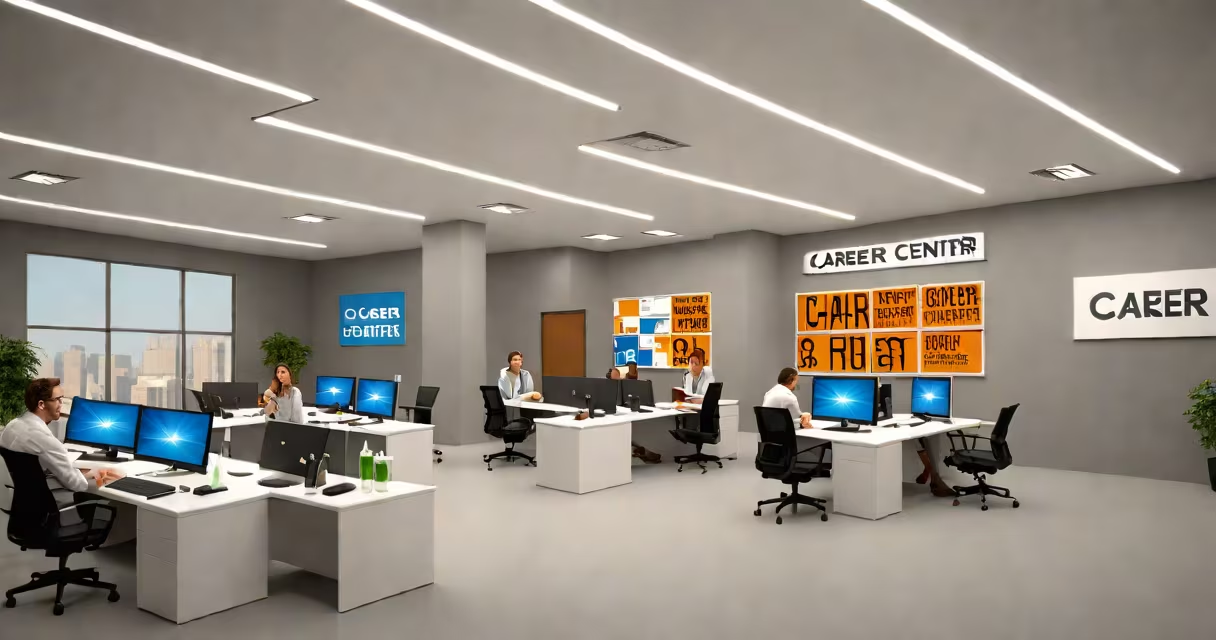
A career center is a campus or community-based office that provides job search support, career counseling, resume reviews, interview preparation, and access to internships and job listings for students, graduates, and job seekers.
These centers operate under institutions like colleges, universities, technical schools, or local workforce development agencies. They serve as hubs connecting individuals with employment opportunities tailored to their skills, education level, and career goals. The primary goal is to improve employability through structured guidance and direct access to employers.
For example, a university's career center may host a fall recruiting fair with 50 companies hiring entry-level roles in engineering, business, and healthcare. Students attend, submit resumes, and complete on-site interviews. The center often tracks outcomes-such as 68% of attendees receiving at least one offer-providing measurable impact.
Staffed by trained career advisors, the career center offers individual appointments, group workshops, and online tools. Advisors assess a person's strengths, clarify career paths, and recommend next steps based on academic background and labor market demand.
Students typically begin using the center early in their academic process. A sophomore studying computer science might schedule a session to refine their GitHub portfolio and practice coding interview questions. The advisor suggests attending a tech company networking event hosted by the center and provides a list of 12 startups currently hiring interns.
Employers partner with the center to recruit talent. They post jobs via the center's secure portal, conduct on-campus interviews, and sometimes sponsor career panels. This reduces hiring friction-employers gain access to a vetted pool of candidates, while students avoid generic job board spam.
Not all career centers are the same. Their size, focus, and service model depend on the institution they serve.
Some centers specialize in specific industries. For instance, a medical school's career center focuses on residency matching, fellowship applications, and hospital credentialing. Others emphasize entrepreneurship-offering pitch coaching and startup incubation programs.
Nonprofit organizations like the National Association of Colleges and Employers (NACE) report that 72% of U.S. colleges with 1,000+ undergraduates have dedicated career centers. These centers often follow NACE's guidelines for ethical employer engagement and student privacy.
Many assume the career center only helps students land summer internships. In reality, it supports long-term career planning-from choosing a major to going through mid-career transitions.
Another misconception is that career centers only assist high-performing students. Data from the U.S. Department of Education shows that 44% of career center users are first-generation college students. Services are designed to close equity gaps by offering free resume editing, mock interviews, and access to remote job boards.
There's also confusion between the career center and academic advising. Academic advisors help with course selection and degree requirements. Career center staff focus on employment outcomes, job search strategies, and professional branding-not class schedules.
The center connected her with a local manufacturing firm that needed certified welders. She completed a 30-day trial shift, then received a full-time offer with health benefits and paid training. Her starting salary was $23/hour-above the state average for entry-level welders.
This outcome wasn't luck. The career center had pre-vetted the employer, confirmed the role included onboarding, and scheduled a follow-up check-in after 90 days. The student later credited the center's structured outreach as critical to her success.
According to the Bureau of Labor Statistics, 62% of new jobs in 2023 were in fields requiring postsecondary credentials. Without career center support, many graduates struggle to translate degrees into stable employment.
I've seen this firsthand. During a visit to a community college in Pennsylvania, I watched a career counselor walk a veteran through a resume rewrite. He'd served in logistics and wanted to pivot into supply chain management. After three sessions, he landed a job at a regional distribution hub within six weeks. The center didn't just place him-it helped him reframe his military experience as transferable skills.
When used effectively, the career center reduces time-to-hire, increases job satisfaction, and strengthens economic mobility. It's not a one-off event. It's a continuous process of skill-building, relationship development, and opportunity alignment.
Every student, job seeker, and career changer should engage with the career center early and often. returning to education, the career center offers targeted, evidence-based support.