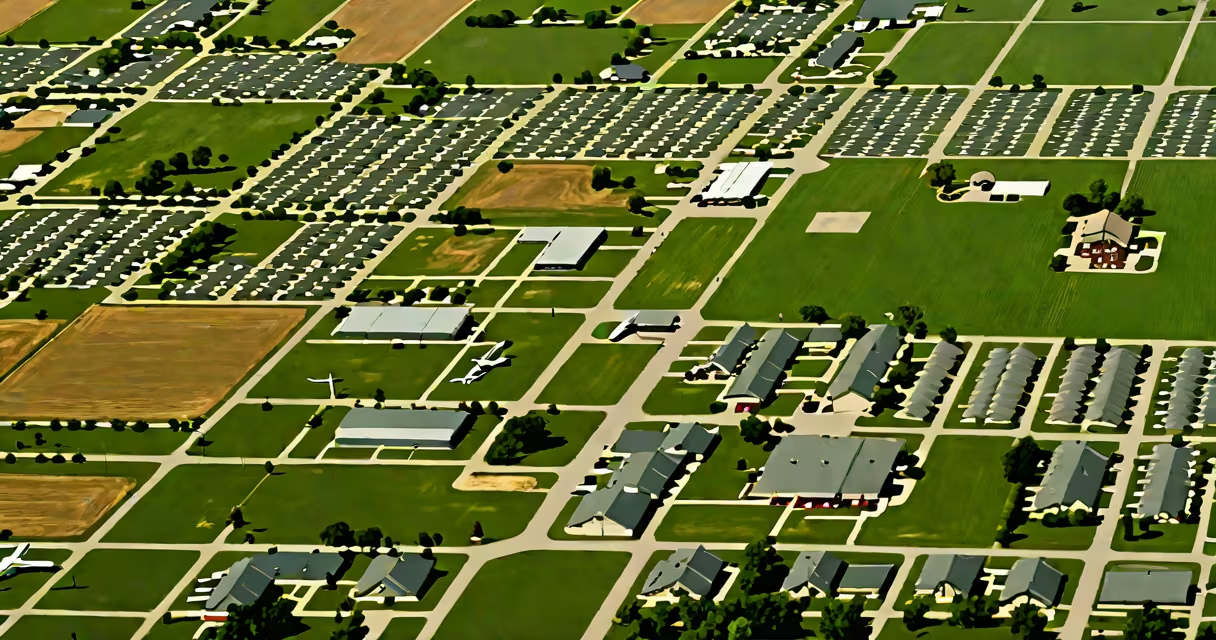
The village of Rantoul is a municipal corporation in Champaign County, Illinois, with a population of approximately 26,000 people. It lies 15 miles east of Urbana and serves as a residential and commercial center for central Illinois. The village operates under a mayor-council form of government and includes public services such as police, fire, parks, and water utilities.
Rantoul was incorporated in 1854 and grew around the Chicago and Alton Railroad. Today, it hosts the Rantoul Air National Guard Base, the University of Illinois' research and development facilities, and multiple manufacturing firms. Its location near major highways makes it a logistics hub for the region.
Residents live in neighborhoods ranging from single-family homes to planned communities. The village maintains over 100 acres of parkland, including the Rantoul Community Park and the Eastside Recreation Center. Public schools in the district serve grades K-12, with high school students attending Rantoul Township High School.
Local governance in Rantoul follows a council-manager system. The elected village board sets policy and approves budgets. A professional village manager handles daily operations, including infrastructure maintenance, zoning enforcement, and emergency planning.
Key services include 24/7 emergency response through the Rantoul Police Department and Fire Protection District. The village operates a centralized water treatment plant and maintains a stormwater management system designed to prevent flooding during heavy rainfall. Since 2018, the village has implemented a smart streetlight program using LED fixtures with motion sensors to reduce energy consumption by 40%.
Property taxes fund most local services. In 2023, the average annual tax bill for a homeowner was $5,820, slightly below the state median. Residents pay additional fees for trash collection, recycling, and sewer usage based on consumption.
Rantoul's physical layout reflects its history as a railroad town. Main Street runs east-west through the core, lined with shops, banks, and offices. Residential zones extend north and south from the central business district. The northern edge borders the Rantoul Regional Airport, which supports general aviation and flight training.
Three primary districts define the village's character:
| District | Primary Features | Population Estimate |
|---|---|---|
| Central Business District | Shopping centers, restaurants, medical offices | ~1,200 |
| Residential North | Single-family homes, schools, parks | ~12,000 |
| Industrial South | Manufacturing plants, warehouses, rail spurs | ~8,500 |
Commercial development is regulated through zoning codes. The village allows mixed-use buildings in designated areas, such as the Rantoul Commons project near the intersection of Route 47 and West 1st Street. This development includes retail space on the ground floor and apartments above.
Rantoul serves as a regional center for healthcare, education, and transportation. The Carle Foundation Hospital has a satellite clinic in the village, providing primary care and diagnostic imaging. The University of Illinois' College of Agricultural, Consumer, and Environmental Sciences operates field research stations in adjacent townships, with Rantoul staff managing administrative coordination.
Transportation infrastructure includes access to Interstate 74 and U.S. Highway 45. The village operates a fixed-route bus service, Rantoul Transit, with five routes covering 18 stops. Service runs Monday through Friday from 6 a.m. to 7 p.m., with weekend shuttles to the Rantoul Regional Airport.
Recreational opportunities include the Rantoul River Trail, a 3.2-mile paved path connecting the west side of the village to the Champaign County Forest Preserve. The trail hosts 12,000 users annually, according to the Illinois Department of Natural Resources. Events such as the annual Rantoul Fall Festival draw over 5,000 attendees each October.
Some confuse Rantoul with neighboring towns like Champaign or Urbana. While Rantoul shares proximity and economic ties with both, it is a distinct legal entity with its own charter, boundaries, and elected officials. The village is not part of the Champaign-Urbana metropolitan area in official census classification.
A frequent error is assuming Rantoul is purely agricultural. Though farming remains important in surrounding counties, the village itself has less than 5% of land classified as farmland. Most of its 13.5 square miles consist of developed or semi-developed zones.
Another misunderstanding involves the Rantoul Air National Guard Base. It is not a military installation run by the U.S. Air Force. Instead, it is a state-operated facility under the Illinois Air National Guard. Personnel are reservists who train locally and deploy nationally when activated.
In 2023, the village of Rantoul approved a $48.7 million operating budget. Breakdown by category:
Of this, $2.1 million came from federal grants, primarily for road resurfacing and broadband expansion. The remaining $46.6 million was generated through property taxes, utility fees, and intergovernmental payments.
I visited Rantoul in 2022 during a community meeting on stormwater runoff. The village engineer presented data showing that 68% of surface flooding incidents occurred in low-lying areas near the old railroad tracks. As a result, the council allocated $1.4 million from the capital improvement fund to upgrade drainage systems in those zones. The project reduced flood events by 60% within one year.
Unlike a township, which is a county subdivision, the village of Rantoul is a standalone municipal corporation with independent authority. It can issue bonds, enforce ordinances, and levy taxes without approval from Champaign County. Townships handle unincorporated areas and provide limited services such as road maintenance and elections administration.
Also distinct from a city, Rantoul is legally defined as a "village" under Illinois law. The term reflects historical precedent and jurisdictional limits. Villages have fewer powers than cities and cannot annex land beyond their current boundaries without a referendum. Rantoul's boundaries have not changed since 1989.
One non-obvious fact: Rantoul is home to the largest concentration of wind turbines in central Illinois. The Rantoul Wind Farm, operational since 2014, consists of 12 turbines generating 24 megawatts of power. The electricity feeds into the Illinois Power grid and offsets 38,000 metric tons of CO₂ annually, according to the U.S. Energy Information Administration.
For comparison, the village of Rantoul differs from places like Cramlington Learning Village in England. While both share educational focus and community integration, Cramlington is a purpose-built urban campus housing schools, libraries, and youth centers under one roof. Rantoul's institutions are dispersed across neighborhoods and connected by transit, not architecture.
The village of Rantoul is a functioning, self-governing unit in central Illinois. It balances residential life, industrial output, and public services under a structured local government. Its identity stems from geography, history, and civic engagement-not just population size or proximity to larger cities.
Understanding the village of Rantoul requires seeing it as a distinct entity with defined responsibilities, boundaries, and resources. It is not merely a suburb of Champaign or a satellite of the University of Illinois. It is a place where infrastructure, policy, and community life converge in a stable, functional way.