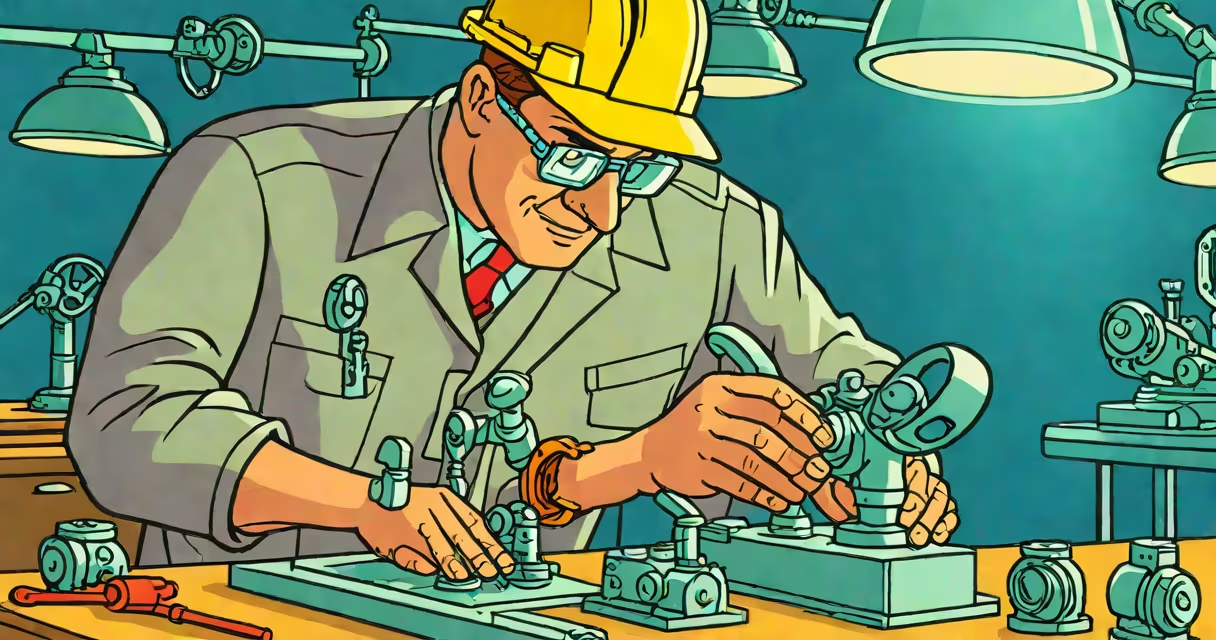
A quality inspector is a professional who evaluates products, materials, or processes to confirm they meet specified standards for safety, performance, and consistency. They detect defects early, reduce waste, and ensure compliance with regulations. Their work prevents faulty items from reaching customers.
Quality inspectors perform visual, dimensional, and functional tests during or after production. They use tools like calipers, gauges, microscopes, and software-based inspection systems. When deviations occur, they document findings and recommend corrective actions. This role exists across industries including automotive, aerospace, food, pharmaceuticals, and electronics.
According to the U.S. Bureau of Labor Statistics, quality inspectors earned a median annual wage of $48,690 in 2022, with employment projected to grow 3% through 2032. The National Institute for Standards and Technology (NIST) emphasizes that consistent inspection reduces product recalls by up to 40% in high-risk sectors like medical devices.
Inspectors follow detailed checklists based on engineering drawings, industry standards (such as ISO 9001), or internal company procedures. Each inspection step is documented to support traceability and audit readiness. For example, in a car parts factory, an inspector might measure the thickness of a brake rotor using a micrometer and compare it against a tolerance of ±0.005 inches.
They often operate in teams within quality control departments. Some roles require certification-like ASQ Certified Quality Inspector (CQI)-which validates knowledge of statistical process control, sampling methods, and root cause analysis. Inspections may happen at multiple stages: incoming raw materials, in-process components, and final assembly.
When a defect is found, inspectors don't just flag it-they record the issue's location, severity, and potential impact. A single flawed circuit board in a batch of 1,000 could lead to system failure in a medical device. The inspector logs the serial number, takes photos, and alerts supervisors. This triggers a review by engineers and may halt production until the cause is resolved.
Inspection methods vary by material, complexity, and risk level. Here are common approaches:
| Method | Use Case | Tools Used | Example |
|---|---|---|---|
| Visual Inspection | Surface flaws, scratches, discoloration | Eye, magnifying lens, camera | Checking for dents on a smartphone casing |
| Dimensional Measurement | Tolerance verification | Calipers, micrometers, CMM | Measuring a gear tooth width to 0.1 mm precision |
| Non-Destructive Testing (NDT) | Internal defects without damaging parts | X-ray, ultrasonic equipment | Detecting air pockets in a welded pipe joint |
| Functional Testing | Performance under simulated conditions | Test rigs, environmental chambers | Running a battery-powered drill for 10 minutes under load |
Some inspections rely on automated systems. In semiconductor manufacturing, machine vision cameras scan wafers at 10,000 frames per second to catch microscopic imperfections invisible to the human eye. These systems feed data into real-time dashboards monitored by inspectors who validate anomalies.
Many assume inspectors only reject bad parts. That's incomplete. Their job includes preventing defects before they happen. A skilled inspector identifies patterns-like recurring surface cracks in cast metal parts-and reports them to production engineers. This feedback loop enables process improvements, reducing rework and scrap rates.
Another misconception is that inspectors replace engineers. They do not. Engineers design tolerances and test protocols. Inspectors apply those standards consistently. For example, in a pharmaceutical plant, engineers define acceptable limits for tablet weight variation. Inspectors verify every batch meets those limits before release.
Inspectors aren't always passive observers. In high-stakes environments like aircraft engine assembly, inspectors have formal authority to stop production. The Federal Aviation Administration (FAA) requires this "right to halt" for critical safety checks. One inspector once stopped a jet engine build after noticing a mismatched bolt pattern-preventing a potential in-flight failure.
In a vehicle manufacturing facility, a quality inspector checks the alignment of headlights on a new model. The specification allows ±1 degree of deviation from the centerline. Using a laser alignment tool, the inspector measures the beam angle on 10 units per hour. One unit shows a 1.8-degree misalignment.
The inspector documents the issue, captures images, and flags it in the enterprise resource planning (ERP) system. The line supervisor pauses the line. A technician adjusts the mounting bracket. The corrected unit is re-inspected and approved. Without this intervention, the vehicle could fail a safety inspection during registration.
This scenario illustrates how a quality inspector contributes to both compliance and customer trust. The cost of fixing the error at this stage is far lower than recalling a vehicle later. According to a 2021 study by the American Society for Quality (ASQ), companies with dedicated inspection roles reported 27% fewer field failures than those relying solely on post-production testing.
Successful quality inspectors combine technical aptitude with attention to detail. They must understand blueprints, interpret measurement data, and communicate findings. Many start with a high school diploma and on-the-job training. Others pursue associate degrees in quality technology or certifications like ISO 9001 Lead Auditor.
I once observed a team at a Midwest auto supplier conducting a daily pre-shift inspection. Each inspector used a standardized checklist to verify tool calibration, lighting levels, and sample part availability. Over six months, their defect rate dropped by 34%. The key wasn't better tools-it was consistent adherence to procedure.
Advancement paths include senior inspector, quality manager, or auditor roles. Some move into process engineering or regulatory affairs. The demand remains steady due to increasing global standards and supply chain complexity. As production moves toward smart factories, inspectors increasingly collaborate with data analysts to interpret sensor outputs from automated lines.
Understanding what is a quality inspector reveals a role that blends vigilance, precision, and problem-solving. They are not gatekeepers of rejection-they are enablers of reliability. Their work helps everyday items-from phones to pacemakers-function safely and as intended.