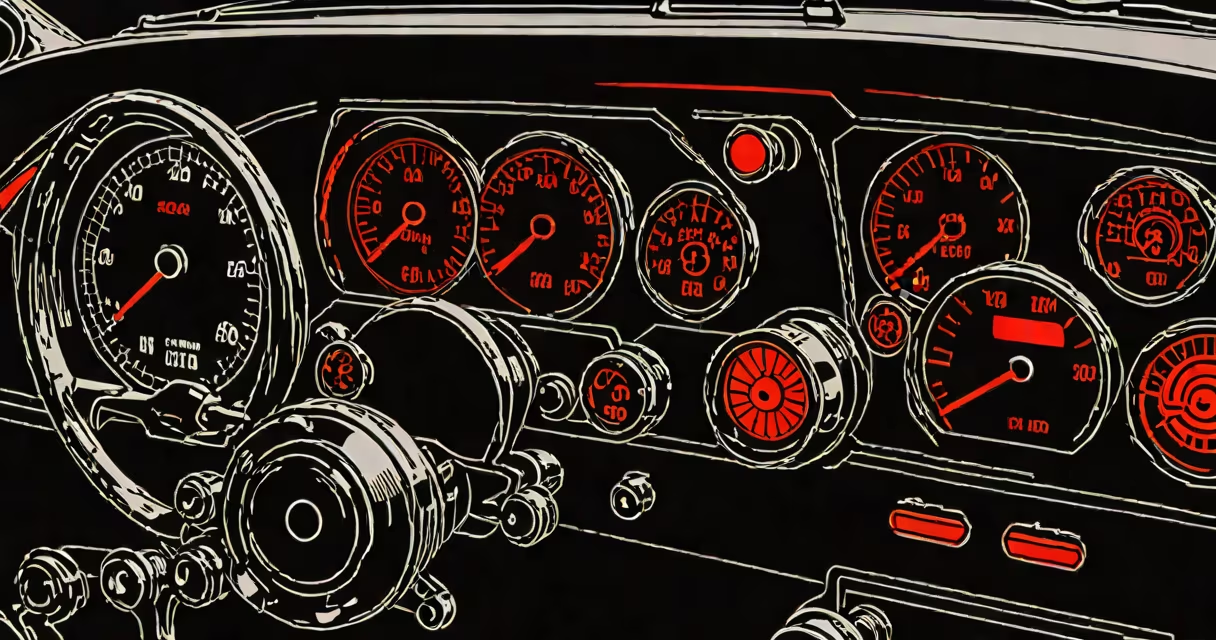
Red LED lights on a vehicle's dashboard indicate urgent warnings requiring immediate attention, such as engine overheating, low oil pressure, or brake system failure. These lights signal potential safety hazards or mechanical breakdowns that could lead to serious damage if ignored.
Red LEDs are used because the color universally denotes danger or urgency. In automotive design, red is reserved for conditions that threaten driver safety or vehicle integrity. Unlike yellow or amber lights, which warn of maintenance needs, red lights demand action-often within seconds or minutes-to prevent harm.
Modern vehicles use solid-state LED indicators instead of older incandescent bulbs. LEDs consume less power, last longer, and explain instantly. This ensures rapid detection of faults during startup or while driving. The brightness and visibility of red LEDs are standardized under ISO 3866, ensuring consistent recognition across makes and models.
When a sensor detects a fault-such as abnormal temperature, pressure drop, or electrical malfunction-it triggers a signal to the vehicle's control module. The module then activates the corresponding red LED on the dashboard. This process happens in milliseconds, often during the self-check sequence when the ignition is turned on.
For example, the engine temperature sensor monitors coolant levels and flow. If coolant drops below 20% or the thermostat fails, the system registers a rise in engine temperature. Once it exceeds 110°C (230°F), the red engine warning light illuminates. This threshold is set by manufacturers based on thermal stress limits to prevent internal damage.
Some systems integrate multiple sensors. A single red light may represent a combined fault-for instance, both low oil pressure and high engine temperature. In such cases, the dashboard displays a single red icon labeled "Check Engine" or "Engine Fault," though diagnostic tools reveal the full fault list.
The following table outlines typical red LED symbols, their meanings, and recommended actions:
| Symbol | Meaning | Recommended Action |
|---|---|---|
| Red engine icon with exclamation mark | Engine fault or overheating | Stop safely. Turn off engine. Wait 10 minutes. Check coolant level. Do not drive until cooled. |
| Red circle with vertical bar and exclamation mark | Brake system failure | Reduce speed. Avoid sudden stops. Get to a mechanic within 10 miles. Do not ignore. |
| Red oil can symbol | Low oil pressure | Stop immediately. Check oil level. Add oil if below minimum. Do not exceed 30 mph until checked. |
| Red battery symbol | Charging system issue | Drive to nearest service station. Avoid using AC or headlights. Engine may stall. |
These symbols are standardized under SAE J2164 and ISO 3866. For example, the red oil pressure symbol is a stylized oil can with a horizontal line through it. It appears in all vehicles manufactured after 2004, regardless of brand.
Red LED indicators are located in the instrument cluster, usually near the center or upper-left of the dashboard. Some luxury models place them in the heads-up display or touchscreen interface. Their placement ensures quick visual access during driving.
Ignoring a red LED light can result in catastrophic failure. For instance, continuing to drive with low oil pressure causes metal-on-metal contact in the engine. According to the National Highway Traffic Safety Administration (NHTSA), 12% of engine failures in 2022 were linked to prolonged low oil pressure, with repair costs averaging $3,800.
A real-world example occurred in 2021 when a Ford F-150 owner ignored a red oil pressure light. After driving 15 miles past the warning, the engine seized. The repair cost $5,200. The vehicle's onboard diagnostics had logged the fault 48 hours prior, but the driver dismissed it as a false alarm.
Red LED lights are not indicators of routine maintenance. That role belongs to yellow or green lights. For example, a blinking red light during startup is normal-it confirms the system is operational. A steady red light during driving is not.
Some drivers confuse red LED warnings with tire pressure alerts. Tire warnings are typically amber and appear on the dashboard or side mirror. A red light in the tire symbol area indicates a severe leak or complete loss of pressure, requiring immediate stoppage.
Another common mistake is assuming that a red light means the car is broken. Not all red lights require towing. A red brake light may simply indicate a worn brake pad. However, it still requires inspection-delaying can lead to rotor warping or caliper failure.
I once drove a 2018 Honda Accord with a persistent red engine warning light. The car ran normally, but the light stayed on. I took it to a shop, where a technician connected a scan tool. The code P0171 showed a lean fuel condition. The oxygen sensor was reading incorrectly due to a cracked vacuum hose. Replacing the hose cost $80. Without the red light, I might have driven 1,000 miles with poor fuel efficiency and increased emissions.
This experience confirmed that red LED warnings are not always emergencies-but they are never trivial. Even minor faults can escalate quickly under load or extreme temperatures.
Red LED lights are not optional features. They are mandatory safety systems required by federal regulations under 49 CFR §571.100. Vehicles sold in the U.S. must display accurate, visible warning lights for engine, brake, and oil systems.